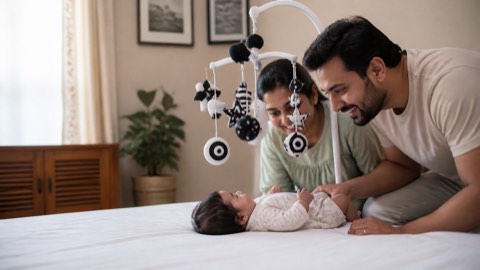
Your baby at 10 months: first words, first steps and family food

Ten months is when a baby starts joining the family properly — eating a toned-down version of your food, and using a sound that means something.
What is new this month
Standing alone for a few seconds, squatting down and getting back up, and cruising confidently. Some babies walk this month; most do not, and the normal range runs to about eighteen months.
First words appear — 'mama', 'papa', 'baba', or a made-up sound used consistently for a particular thing, which counts as a word. Understanding is much larger: most ten-month-olds follow simple instructions with a gesture.
Fine motor skills sharpen: putting objects into a container and taking them out, poking with an index finger, and holding a spoon (badly, and with enthusiasm).
Eating with the family
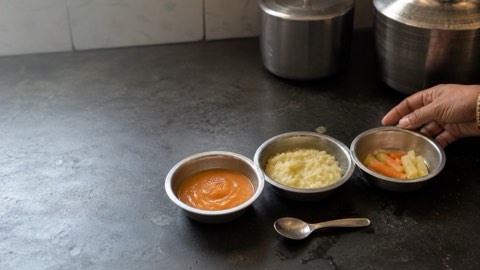
By now a baby should be eating a chopped, softened, less-spiced version of what the family eats — dal-rice, soft roti torn into dal, khichdi with vegetables, curd rice, upma, idli, egg, soft fish or chicken for families who eat them.
Three meals and one or two snacks a day, at the family table where possible. Babies learn eating by watching people eat, and a baby fed separately in front of a screen learns something else entirely.
Still no added salt or sugar, no honey, no cow's milk as a drink, and no whole nuts or other choking shapes.
Let the mess happen. Self-feeding with hands and a spoon is a developmental task, not a housekeeping failure.

Sleep and behaviour
Two naps, roughly 12-15 hours of sleep in 24. Some babies begin resisting the morning nap; hold it as long as you can, since dropping to one nap before around fourteen months usually produces an overtired, harder evening.
Expect testing: dropping food deliberately, saying no with the whole body, and checking your face after doing something forbidden. This is learning about cause and effect rather than defiance, and calm consistency works better than a big reaction.
Separation anxiety may still be strong. Short goodbyes, a familiar caregiver and reliable returns are what shorten the phase.
When to see a doctor
The standing newborn rules still apply: any fever in a baby under three months means the hospital the same day; fast or laboured breathing, the chest sucking in, blue lips, a fit, a rash that does not fade under pressure, refusing feeds, no wet nappy for six to eight hours, or a baby who is floppy and hard to wake are all same-day emergencies at any age.
This month specifically: not standing with support, not babbling or making consonant sounds, no pointing or gestures, no response to their name, no interest in games, not picking up small objects, using only one side of the body, or losing any skill.
This article is general information, not medical advice, and is no substitute for personal medical advice. For any decision about your or your child's health, please consult your doctor.
Frequently asked questions
What counts as a first word?
Any consistent sound used for a specific thing — 'ba' for bottle every time counts. Words used for anything and everything do not, yet.
Should I give a bottle at bedtime?
No. Milk pooling around the teeth overnight is the main cause of early childhood tooth decay. Finish milk, clean the teeth or gums, then bed.
My baby walked at nine months and my sister's has not at eleven.
Both are normal. The walking window runs from about nine to eighteen months, and early walking predicts nothing about later ability.
How do I stop him throwing food from the high chair?
Say once, calmly, that food stays on the tray, and end the meal when throwing continues. It is a cause-and-effect experiment, and the effect that ends it is the meal finishing rather than a big reaction.
Sources
Every clinical figure on this page is taken from the guidelines below. Where our numbers and your doctor's differ, ask which guideline they follow.
- WHO. Infant and young child feeding: Model Chapter for textbooks for medical students and allied health professionals (2009)Supports the claims that babies around 10 months should be eating family foods (complementary feeding), that three meals and snacks per day is appropriate, and that no added salt, sugar, or honey should be given to infants.
- IAP. IAP Guidelines on Infant and Young Child Feeding (2010)Supports India-specific complementary feeding guidance including progression to family foods such as dal-rice, khichdi, idli and egg by around 10 months, and avoidance of cow's milk as a main drink in the first year.
- NICE. Fever in under 5s: assessment and initial management (NG143) (2021)Supports the emergency red-flag signs listed on this page — fast or laboured breathing, chest recession, a non-blanching rash, fits, a floppy or unresponsive baby — as features requiring same-day emergency assessment.
- ADA. Baby Teeth: Decay Prevention (2023)Supports the claim that milk pooling around teeth overnight is the main cause of early childhood tooth decay and that feeding should be completed before sleep with teeth/gums cleaned afterwards.
Reviewed by
- Nakul Phatak — CEO, theAsianparent India & IndonesiaHead of theAsianparent India; father of one
- Roshni Chugani — Head of Marketing, theAsianparent India & Singapore12 years in the mother-and-baby space; mother of two
Published by: theAsianparent editorial team