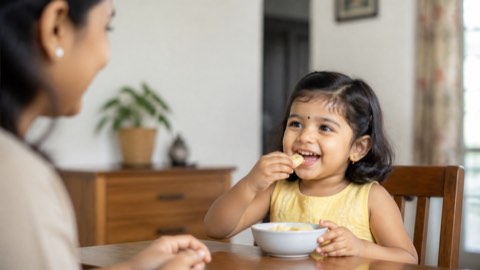
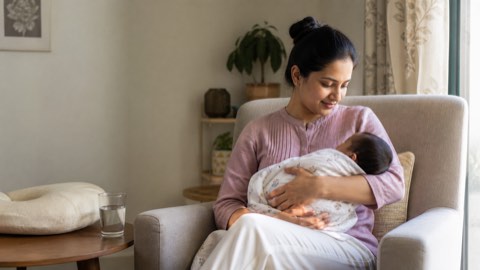
Indian baby food from 6 to 12 months: a month-by-month recipe plan

The Indian kitchen already makes the best baby food there is. Here is the month-by-month plan — what to introduce when, how thick, and the recipes that take ten minutes.
Six to seven months: smooth and single
Start with one food at a time, two to three days apart, smooth and thick enough to sit on a spoon. Two or three spoons once a day, building to twice a day — milk remains the main meal.
Ragi porridge: roast a tablespoon of ragi flour in a pan, whisk into water, cook five minutes until thick, add a teaspoon of ghee. Dal soup with the dal: pressure-cook moong dal soft, mash thoroughly, thin with the cooking water. Rice mash: overcooked rice mashed with a little water and ghee.
Vegetable purees: steam and mash carrot, pumpkin, bottle gourd or potato. Fruit: mashed banana, chikoo, steamed apple or pear. Suji kheer made with water and later milk. Every one of these takes minutes and uses what is already in the kitchen.
Eight to nine months: thicker, mixed, and messier
Move from purees to mashes with soft lumps — this is the month texture matters most, because chewing skills are built now and babies kept on smooth food get fussy later.
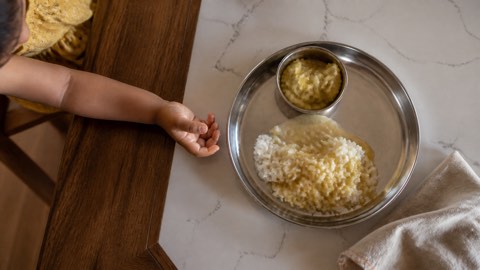
Khichdi is the workhorse: rice and moong dal cooked soft together with a pinch of haldi and a spoon of ghee, mashed, with a mashed vegetable stirred in — a different one each day. Curd rice, mashed. Idli mashed in dal. Egg: well-cooked, mashed with a little ghee. Ragi or wheat porridge with milk. Soft-cooked vegetable pieces to hold.
This is also finger-food time: steamed carrot sticks, soft banana pieces, small idli chunks, well-cooked pasta or paneer cubes. Messy, slow and important — self-feeding builds appetite regulation and hand skills.
Ten to twelve months: family food, toned down
By ten months most babies can eat a chopped, softened, less-spiced version of what the family eats — the aim by the first birthday is exactly that, three small meals plus a snack or two, alongside breastmilk or formula.
Soft roti torn into dal, paneer bhurji, upma, poha (softened, no hard peanuts), dosa pieces, sambar rice, curd rice, dal-rice with vegetables, soft-cooked chicken or fish for families who eat it, boiled egg. Add a spoon of ghee to meals — babies need the calories.
Still no added salt or sugar for the first year, no cow's milk as a drink before one, no honey before one, and no choking shapes: whole nuts, whole grapes, hard chunks of raw carrot or apple, popcorn. Grind nuts to a powder and stir into porridge instead — that is where the good fats come from.
Making it work in a real kitchen
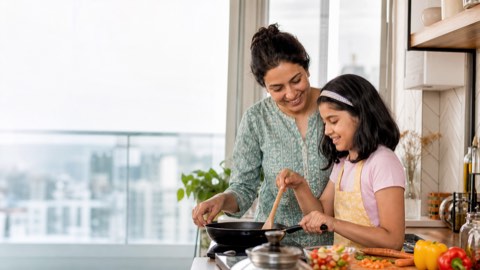
Cook once, use twice: the family's dal, rice and vegetables become the baby's meal if you remove a portion before adding salt and chilli. This is the single biggest time-saver and it introduces family flavours from the start.
Batch the dry work: roast and grind a jar of mixed sattu-style flour (ragi, wheat, moong dal, rice), keep ground nut powder in an airtight box, and steam a few vegetables together in the pressure cooker with the day's dal.
Hygiene rules stay strict at this age: freshly cooked food each time, no reheating yesterday's baby portion, boiled water, clean bowl and spoon, hands washed. And feed at the family table wherever possible — babies learn eating by watching people eat.
Frequently asked questions
How much should the baby eat at each meal?
Start with two or three spoons and follow the baby: turning away and sealing lips means finished. By a year, roughly a small katori per meal is typical, but appetite swings hugely day to day. Judge by the week and the growth chart, not the meal.
Can I add salt and sugar for taste?
Not in the first year. It feels bland to you, not to a baby who has never had either. Flavour comes from ghee, haldi, jeera, hing, curry leaves and the food itself.
My baby spits everything out
is she rejecting food? — Early on, most of it comes back out because the tongue is still learning. Keep offering the same food a dozen times without pressure; acceptance usually follows exposure. Real refusal over weeks, with poor weight gain, is a doctor's question.
Are packaged baby cereals bad?
Not bad, and their iron fortification is genuinely useful. Just do not let the packet replace the pot — home food brings texture, variety and family taste training that a box cannot.
Sources
Every clinical figure on this page is taken from the guidelines below. Where our numbers and your doctor's differ, ask which guideline they follow.
- WHO. Complementary feeding: Guiding principles for feeding children 6–24 months (2003)Backs the core guidance that complementary feeding begins at 6 months, breast milk remains the primary feed, foods are introduced one at a time with progression from smooth to lumpy textures, and that the family meal (minus salt and spices) is appropriate for the infant.
- WHO. Infant and young child feeding: Model chapter for textbooks (2009)Supports the recommendation of no added salt or sugar in the first year, no honey before one year, no cow's milk as a main drink before 12 months, and building meal frequency from once to three small meals plus snacks by the first birthday.
- IAP. IAP Guidelines on Complementary Feeding (2020)Supports the India-specific foods recommended (ragi, khichdi, dal, curd rice, idli), the month-by-month texture progression from purees to mashes to soft family foods, and the guidance on finger foods and self-feeding from around 8–9 months.
- ICMR. Nutrient Requirements and Recommended Dietary Allowances for Indians (2020)Backs the emphasis on energy-dense additions such as ghee to meet the high calorie needs of infants aged 6–12 months, and the recommendation to include ground nuts and mixed cereal-pulse flours (sattu-style) as nutrient-rich complementary foods for Indian infants.
Reviewed by
- Nakul Phatak — CEO, theAsianparent India & IndonesiaHead of theAsianparent India; father of one
- Roshni Chugani — Head of Marketing, theAsianparent India & Singapore12 years in the mother-and-baby space; mother of two
Published by: theAsianparent editorial team