Ovulation calculator: see your fertile days on a real calendar
Use the calculator below to estimate your fertile days, including the day of ovulation. Your chances of conceiving are generally highest in the two days before ovulation. This is not a contraception tool.
Find your fertile days
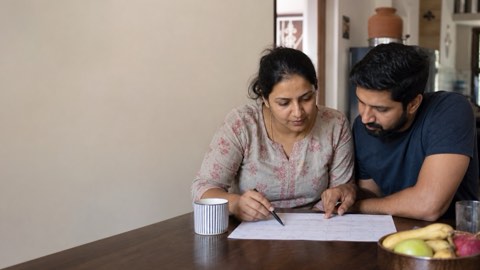
Enter the first day of your last period and your average cycle length. Cycle length can change from month to month, so an average is the most useful number to give. Cycles typically run between 21 and 35 days; if yours varies, use your best estimate from the last three.
Count from the first day of one period to the first day of the next. Cycles typically run 21 to 35 days. If yours varies, use the average of your last three.
What the calculator gives you — and what it does not
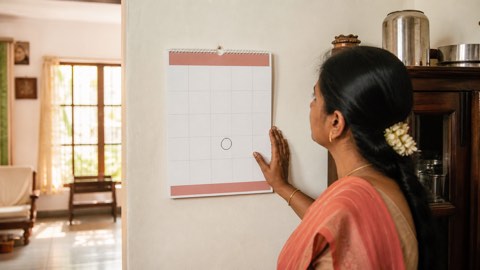
It lays your next three cycles out on a calendar: period days, the six fertile days, the estimated day of ovulation, and the next period's date. If you conceive this cycle, the likely due date is worked out underneath.
But this is an estimate, not a test. No calendar can know when your egg was actually released. It assumes your next cycle will behave like your average one, and stress, illness, travel or a change in weight can all shift a cycle.
Which is exactly why using this as contraception is dangerous. A day that looks 'safe' on the calendar may not be safe that particular month. If you want to prevent pregnancy, talk to a doctor about an actual method.

Why there are up to six fertile days, and how to use them
An egg usually lives for just 12 to 24 hours after release. Sperm, though, can survive up to five days inside the body when conditions are favourable.
So the window opens five days before ovulation and closes on the day of ovulation itself: six days in total. The odds are highest with intercourse in the two days before ovulation and on the day itself.
Which means you can relax. There is no need to hunt for the exact day. Intercourse every one to two days across this window covers it, without the strain of working to a schedule.
Why the calculation counts backwards from the next period
Ovulation is often described as happening on day 14 of the cycle. That estimate applies to a textbook 28-day cycle and does not reliably predict ovulation for everyone.
A calendar method instead estimates ovulation at about 14 days before the next expected period. The gap between ovulation and the next period is usually more consistent than the first half of the cycle, which is the part that varies.
So this calculator uses your average cycle length to estimate your next period, then counts backwards to estimate ovulation. Your actual ovulation day may still be earlier or later, even if your cycles usually look regular.
If the calendar is only a guide, what else tells me I am ovulating?
Cervical mucus is a genuinely useful signal and probably the least discussed. In the fertile days it turns thin, slippery and stretchy, like raw egg white. Unlike temperature, it tells you something about the cycle you are in now.
Basal body temperature rises by about half a degree after ovulation and stays up until the next period. Because the rise comes after the egg has gone, it confirms that ovulation happened rather than predicting when it will.
Some women feel a one-sided twinge low in the belly. Many feel nothing at all, and feeling nothing does not mean you are not ovulating.
Do home ovulation strips help?
So far this page has estimated a fertile window from your last period and your average cycle length, and described the physical signs that point to ovulation. Pharmacy strips are a third way to check, but only if they are used properly and read in context.
Ovulation strips measure luteinising hormone (LH) in urine. LH surges 24 to 36 hours before the egg is released, and the strip catches that surge.
Technique matters. Test in the afternoon or evening rather than with first-morning urine, unless the product instructions say otherwise: the surge usually starts in the morning and reaches urine by midday. Do not drink a lot of water in the two hours before, because dilute urine fades the line.
Know the limits too. A positive strip proves the hormone rose, not that an egg was actually released. In PCOS (polycystic ovary syndrome) baseline LH runs high, so strips can read positive without reflecting what is happening. In that case the money is better spent on a doctor's visit than on more strips.
We have been trying for a while with no result
If you are under 35 and have not conceived within 12 months of trying, or you are 35 or over and have not conceived within 6 months, it is worth seeing a doctor.
There can be several reasons. If your cycle swings by more than seven days from month to month, calendar estimates are not worth much on their own and a medical view helps. Where PCOS is involved, some cycles release no egg at all, so relying on dates alone mostly leads to disappointment. Mucus observation and LH strips do better than the calendar there, used with a doctor's guidance, since PCOS also fools the strips.
Have your partner checked as well. The standard work-up covers both partners, and a male factor is found in roughly half of all couples having difficulty conceiving.
Questions
Should we have intercourse every day during the fertile window?
If you both want to, there is no harm in it, but it is not necessary. Intercourse every one to two days across the fertile window gives good coverage. Choose a frequency that feels manageable rather than following a rigid schedule.
Does lying down or raising my legs afterwards help?
There is no good evidence that lying down or raising your legs after intercourse improves the chance of conception.
My period is late
am I pregnant? — Not necessarily. Pregnancy is one possible cause, but illness, stress, travel, weight changes and ordinary cycle variation can all delay a period. Take a home pregnancy test from the first day of the missed period, following the test instructions. If it is negative and your period still does not come, repeat it after a few days or seek medical advice.
Can timing intercourse give us a boy or a girl?
No. Timing intercourse, changing diet or similar methods cannot determine a baby's sex. In India, sex selection before or after conception is prohibited under the Pre-conception and Pre-natal Diagnostic Techniques (Prohibition of Sex Selection) Act, 1994.
Sources
Every clinical figure on this page is taken from the guidelines below. Where our numbers and your doctor's differ, ask which guideline they follow.
- ASRM. Optimizing natural fertility: a committee opinion (2022)The six-day fertile window ending on the day of ovulation; intercourse every one to two days; cervical mucus and LH testing as fertility-awareness methods.
- ASRM. Fertility evaluation of infertile women: a committee opinion (2021)Evaluation after 12 months of trying under 35, and after 6 months at 35 and over.
- ACOG. Evaluating Infertility (2023)Assessment covers both partners; a male factor contributes in roughly half of couples.
- NHS. Trying to get pregnant (2023)Ovulation timing relative to the next period, and cycles commonly running 21 to 35 days.
Reviewed by
- Nakul Phatak — CEO, theAsianparent India & IndonesiaHead of theAsianparent India; father of one
- Roshni Chugani — Head of Marketing, theAsianparent India & Singapore12 years in the mother-and-baby space; mother of two
Published by: theAsianparent editorial team