Your baby at 12 months: the first birthday, and what changes now

One year old. Birth weight has roughly tripled, milk is no longer the main meal, and a set of rules that ran the whole first year quietly expires.
Where most babies are at one
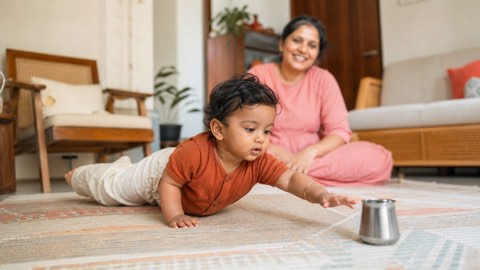
Movement: standing alone, cruising, walking with or without help. Some run; some are still crawling with intent. Anywhere up to eighteen months is normal for independent walking.
Language: one to three words used with meaning, a lot of expressive jargon, and understanding far beyond that — simple instructions, familiar names, and 'no'. Gestures are constant.
Play and social: handing things to you to share attention, copying household actions, pointing to show rather than only to ask, waving, and clapping. Stranger wariness and separation protest are still normal and often peak now.
What changes at twelve months
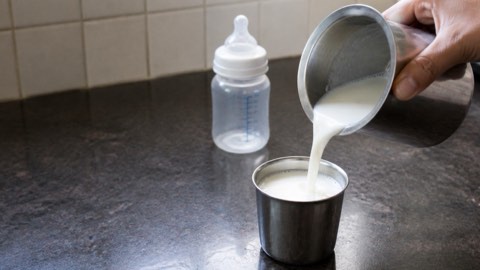
Cow's milk becomes an option as a drink, capped at around 400-500 ml a day including curd and paneer. More than that displaces iron-rich food and is a common cause of toddler anaemia.
Honey becomes safe. Whole nuts and other choking shapes do not — grind nuts into food until about four or five years.
Family food, chopped and softened, is now the main diet: three meals plus one or two snacks, with milk around them. Still no added salt or sugar for a while yet, and no chai.
Bottles should be on the way out between twelve and eighteen months, replaced by a cup. And breastfeeding, if it suits both of you, can continue into the second year and beyond — the WHO recommendation is two years or more.

The one-year review
Ask for weight, length and head circumference to be plotted on the chart rather than just recorded, and for the trend to be explained. A single reading says very little; a curve says a great deal.
Check the vaccine card against the schedule and catch up anything missed — the schedule resumes with boosters at 16-24 months, and private schedules add hepatitis A and typhoid around now.
Book the first dental visit, ask about a haemoglobin check (anaemia in Indian toddlers is very common), and raise any milestone worry now rather than at eighteen months. Early assessment is free at government facilities and works better the earlier it happens.
When to see a doctor
The standing newborn rules still apply: any fever in a baby under three months means the hospital the same day; fast or laboured breathing, the chest sucking in, blue lips, a fit, a rash that does not fade under pressure, refusing feeds, no wet nappy for six to eight hours, or a baby who is floppy and hard to wake are all same-day emergencies at any age.
See a doctor if, at twelve months, your child: is not standing with support, has no gestures such as pointing or waving, has no babbling with consonants, does not respond to their name, shows no interest in interactive play, cannot pick up small objects with thumb and finger, or has lost any skill they previously had. Any loss of skills at any age needs prompt assessment.
This article is general information, not medical advice, and is no substitute for personal medical advice. For any decision about your or your child's health, please consult your doctor.
Frequently asked questions
My baby is not walking or talking at one. Should I be worried?
Not on those two alone if everything else is progressing: gestures, understanding, social interest, moving somehow. Raise it at the one-year review anyway so it is on record and can be tracked.
How much should a one-year-old weigh?
Roughly three times birth weight is the usual guide, but the range is wide. What matters is the child's own curve on the growth chart rather than a number.
Should we still give formula?
Not necessarily. From one year, cow's milk in a cup within the daily limit is enough for most children eating a mixed diet. Toddler formulas are largely unnecessary.
What happens in the second year?
Growth slows sharply and appetite drops with it, which alarms almost every family. That is normal — our toddler milestones and fussy-eating guides cover what comes next.
Sources
Every clinical figure on this page is taken from the guidelines below. Where our numbers and your doctor's differ, ask which guideline they follow.
- WHO. WHO recommendations on complementary feeding / Infant and young child feeding: Guideline (2023)Supports the claim that breastfeeding can and should continue into the second year and beyond, with WHO recommending two years or more.
- IAP. IAP Guideline on Infant and Young Child Feeding (2016)Supports guidance on family foods as the main diet from 12 months with three meals plus snacks, avoidance of added salt and sugar, and the recommendation that cow's milk intake be limited to avoid displacing iron-rich foods and contributing to toddler anaemia.
- AAP. Developmental Milestones: 12 Months (2022)Supports the described 12-month developmental milestones for movement, language, play and social skills, including the red-flag signs warranting medical review (no pointing or waving, no babbling with consonants, not standing with support, not responding to name, loss of skills).
Reviewed by
- Nakul Phatak — CEO, theAsianparent India & IndonesiaHead of theAsianparent India; father of one
- Roshni Chugani — Head of Marketing, theAsianparent India & Singapore12 years in the mother-and-baby space; mother of two
Published by: theAsianparent editorial team