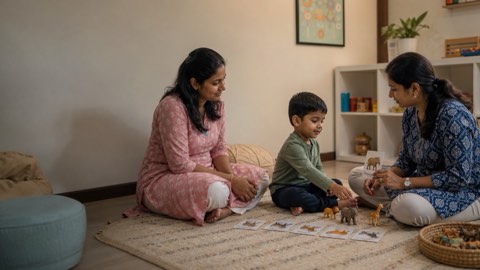
Toddler milestones from one to three years: what to expect and what to check

Milestones are a range, not a deadline — but they are also the early-warning system that catches problems while they are most treatable. Here is the map for one to three.
Twelve to eighteen months
Movement: pulling to stand and cruising by around a year, first independent steps anywhere between 9 and 18 months, walking well and starting to climb by 18 months. Feeding themselves with fingers, drinking from a cup, scribbling with a crayon.
Language and social: one or two words at a year building to about 10-20 by 18 months, understanding far more than they say, pointing at what they want, waving, showing you things, following a simple instruction, and copying household actions — sweeping, phoning, feeding a doll.
Check with the doctor if: not walking by 18 months, no pointing or gestures by 12 months, no words by 16-18 months, not responding to their name, or losing any skill they previously had.
Eighteen months to two years
Movement: running, walking up steps with help, kicking a ball, stacking a few blocks, turning book pages, beginning to use a spoon with more spilling than success.
Language: around 50 words by two years and beginning to join two together. Following two-step instructions ('pick up the ball and give it to papa'). Naming familiar objects and people, pointing to body parts.
Social and play: parallel play beside other children rather than with them (this is normal, not antisocial), simple pretend play, strong preferences, tantrums, and the word 'no' as a hobby. Check if: no two-word phrases by two, not walking steadily, no pretend play, no interest in other children, repetitive movements, or extreme distress at routine changes.

Two to three years
Movement: jumping with both feet, climbing confidently, pedalling a tricycle, drawing a circle, building a tower of six or more blocks, undressing themselves, and — with luck — using the toilet.
Language: short sentences, understood by strangers most of the time by three, asking constant questions, knowing their own name and age, and following longer instructions. Thinking: sorting shapes and colours, completing simple puzzles, remembering routines, and starting to pretend elaborately.
Social: playing alongside and beginning to play with other children, taking turns with help, showing affection and concern, and testing every limit you set. Check if: speech is unintelligible to others at three, they cannot follow simple instructions, no pretend play, no interest in other children, frequent falls or unsteadiness, or a loss of skills at any point.
What helps development
Talk, read and sing daily — the single highest-value activity there is. Narrate the day, read the same book for the hundredth time, sing rhymes with actions.
Free, messy, physical play: water, sand, dough, blocks, boxes, climbing, running. Household items beat expensive toys, and unstructured play builds problem-solving that worksheets cannot.
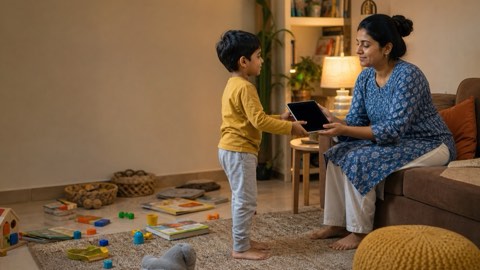
Keep screens minimal — no screens before eighteen months to two years, and limited co-viewed time after — because screen hours displace exactly the interaction and movement that development needs.
And keep the routine health items: growth monitoring at the Anganwadi or clinic, the full vaccination schedule, vitamin A and deworming as the programme provides, and a haemoglobin check if the child is pale or listless. Anaemia and undernutrition slow development quietly and are correctable.
When to see a doctor
See a doctor promptly for any loss of skills at any age; no gestures by 12 months; not walking by 18 months; no words by 18 months or no two-word phrases by 2 years; not responding to their name or to sound; no eye contact or interest in other children; persistent toe-walking, stiffness or floppiness; frequent unexplained falls; or a strong parental instinct that something is different. Early assessment at a paediatric clinic or a District Early Intervention Centre is free in the public system and works better the earlier it happens.
This article is general information, not medical advice, and is no substitute for personal medical advice. For any decision about your or your child's health, please consult your doctor.
Frequently asked questions
My child is behind on one thing but ahead on others. Is that normal?
Very. Children often pour resources into one area at a time — a child working hard on walking may pause on words. What matters is overall progress and no loss of skills. A single lagging area that persists, though, still deserves a check.
Cousins the same age are far ahead. Should I worry?
Comparison is the least useful measure there is. Milestones have wide normal ranges, prematurity shifts the whole timeline (use corrected age until two), and family patterns vary. Compare your child with your child last month.
Do walkers help a baby walk sooner?
No, and they are actively discouraged: they delay walking slightly, encourage toe-walking, and cause serious injuries when they tip or reach stairs. Floor time, push toys and furniture cruising are what build walking.
Is toe-walking a problem?
Occasional toe-walking in a new walker is common. Persistent toe-walking beyond about two years, or with tight calves, stiffness or other delays, needs a doctor — it can point to a muscle or neurological issue worth catching early.
Sources
Every clinical figure on this page is taken from the guidelines below. Where our numbers and your doctor's differ, ask which guideline they follow.
- WHO. WHO Child Growth Standards and Developmental Milestones (2006)Backs the overall developmental milestone windows cited for motor skills (walking by 18 months, first steps 9–18 months), language, and social development, and the importance of growth monitoring for detecting undernutrition that can slow development.
- AAP. Developmental Milestones: 1 Year, 18 Months, 2 Years, 3 Years (HealthyChildren.org) (2023)Supports the specific red-flag warning signs listed at each age (e.g., no pointing by 12 months, no two-word phrases by 2 years, no pretend play, loss of skills at any point) and the use of corrected age for premature children until age two.
- WHO. Guidelines on physical activity, sedentary behaviour and sleep for children under 5 years of age (2019)Backs the recommendation to keep screens minimal, with no screen time before 18–24 months, and supports the emphasis on free physical play and unstructured activity as essential for toddler development.
- MoHFW. National Nutrition Mission / POSHAN Abhiyaan: Vitamin A Supplementation and Deworming Programme (2018)Supports the recommendation for routine vitamin A supplementation and deworming as provided under the national programme, as well as haemoglobin screening and growth monitoring at Anganwadi centres.
- IAP. IAP Developmental Screening Guidelines and Immunization Schedule (2020)Supports the red-flag developmental warning signs listed at 12, 18, 24 and 36 months, the recommendation for early assessment at paediatric or District Early Intervention Centres, and the full vaccination schedule as part of routine child health care.
Reviewed by
- Nakul Phatak — CEO, theAsianparent India & IndonesiaHead of theAsianparent India; father of one
- Roshni Chugani — Head of Marketing, theAsianparent India & Singapore12 years in the mother-and-baby space; mother of two
Published by: theAsianparent editorial team