Your baby at 2 months: the first smile and the first big vaccines

Month two brings the first real smile and the first big vaccination visit — and, for most families, the peak of the crying.
Where a two-month-old is
The social smile arrives — a real one, in response to your face, usually between four and eight weeks. It is the first proper conversation, and it changes the whole month for exhausted parents.
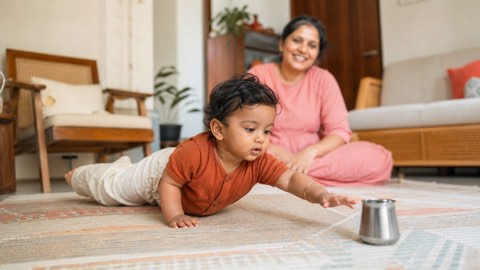
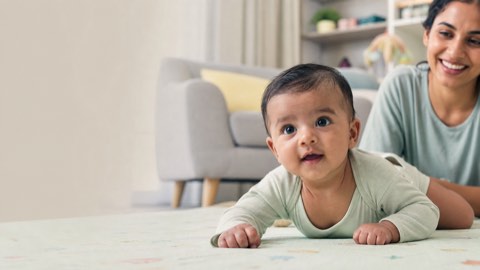
Head control improves: during tummy time the baby lifts the head briefly and turns it to follow a face or a sound. Hands are opening from their fists, and cooing starts — vowel sounds, aimed at you, with pauses for you to answer.
Weight gain continues at roughly 150-200 g a week. Vision is sharper, and the baby tracks a slowly moving face across the middle of their field.
The six-week vaccination visit
The first big set falls in this month under the national schedule: Pentavalent (covering diphtheria, pertussis, tetanus, hepatitis B and Hib), oral polio drops, rotavirus drops, and pneumococcal vaccine as per your state's schedule. All free at government facilities.
Expect a day or two of fever, crankiness and a sore leg. Comfort, extra feeds, and paracetamol at the weight-correct dose if your doctor advises it. Continue feeding on demand — the baby will want more.
A mild cold is not a reason to postpone — tell the doctor and let them decide. Missing the visit is far riskier than a runny nose.
Take the MCP card, and ask for the weight to be plotted while you are there.

Crying, feeding and sleep
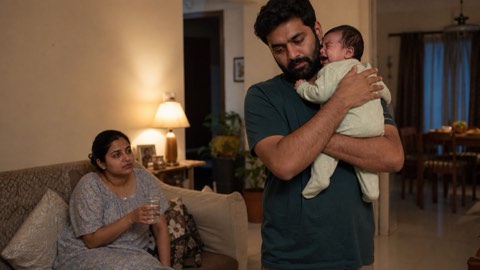
Crying peaks around six to eight weeks, and evening fussing is at its worst now. This is normal newborn crying — it rises, plateaus and falls by three to four months. Our colic guide has what actually soothes and what to skip.
The rule that matters most in this month: if the crying has pushed you to the edge, put the baby down safely on their back in the cot and step out of the room for five minutes. A baby crying safely alone is far better off than a shaken one. Never shake a baby.
Feeding continues eight to twelve times a day, often with a growth spurt around six weeks that makes it feel constant for two or three days.
Sleep is still fragmented. Some babies begin a longer stretch at night by the end of this month; many do not, and both are normal.
Daily care and the household
Back to sleep, firm flat surface, nothing soft near the face, in your room. Tummy time when awake and watched — several short sessions a day, building the neck strength that everything else depends on.
Visitors rise once the first month passes. Keep the rules: hands washed, nobody with a cough or cold, and no kissing the baby's face or hands.
Watch for the mother, not just the baby. The two-month mark is when the household's help usually withdraws and the exhaustion is cumulative — and when postpartum depression is most often first noticed.
When to see a doctor
The rule that outranks everything else at this age: any fever of 38°C or above in a baby under three months means the hospital the same day — not the next morning, and not after a sponge bath. A newborn's immune system cannot wall off an infection, and fever is often the only sign.
Same-day: refusing feeds, fewer than six wet nappies a day, a floppy or unusually drowsy baby, fast or laboured breathing, blue lips, a fit, a rash that does not fade under pressure, deepening jaundice, forceful or green vomiting, or a cry that sounds high-pitched and different from usual.
Also worth an appointment: no social smile by eight weeks, no response to sound, a persistent head tilt, or eyes that do not follow a face at all.
This article is general information, not medical advice, and is no substitute for personal medical advice. For any decision about your or your child's health, please consult your doctor.
Frequently asked questions
My baby cried for hours after the vaccination.
A miserable day or two is common. Inconsolable crying for more than three hours, a high fever, a fit, or swelling spreading from the injection site needs same-day review.
Can I give paracetamol before the vaccine to prevent fever?
Ask your paediatrician. Routine pre-dosing is generally not advised; treating fever afterwards if the baby is uncomfortable is.
Is it normal that she only sleeps on me?
Very. Work on one daytime nap in the cot, and accept the rest for now. It shifts over the next couple of months.
When will the crying stop?
It peaks now and falls steadily from around eight weeks, with most families seeing a clear improvement by three to four months.
Sources
Every clinical figure on this page is taken from the guidelines below. Where our numbers and your doctor's differ, ask which guideline they follow.
- IAP. IAP Recommended Immunization Schedule for Children (2023) (2023)Supports the schedule and composition of vaccines due at 6–10 weeks of age, including Pentavalent (DTP-HepB-Hib), OPV, rotavirus, and PCV, consistent with what the page describes for the two-month visit.
- WHO. WHO Recommendations for Routine Immunization – Summary Tables (2024)Corroborates that a mild illness such as a mild cold is not a contraindication to vaccination and that deferring vaccines for minor illness is unnecessary.
- AAP. Safe Sleep: Back to Sleep for Every Sleep (HealthyChildren.org) (2022)Supports the safe sleep guidance on the page: placing babies on their back, on a firm flat surface, with nothing soft near the face, in the parents' room, and supervised tummy time when awake.
- NICE. Fever in Under 5s: Assessment and Initial Management (NG143) (2021)Backs the red-flag instruction that any fever of 38 °C or above in a baby under three months requires same-day urgent assessment, and supports the list of other same-day danger signs including high-pitched cry, floppiness, fast or laboured breathing, and rash not fading under pressure.
Reviewed by
- Nakul Phatak — CEO, theAsianparent India & IndonesiaHead of theAsianparent India; father of one
- Roshni Chugani — Head of Marketing, theAsianparent India & Singapore12 years in the mother-and-baby space; mother of two
Published by: theAsianparent editorial team