Your baby at 3 months: the fourth trimester ends

Three months in, the newborn phase closes. The crying drops, the sleep lengthens, and a baby with opinions appears in its place.
Where a three-month-old is
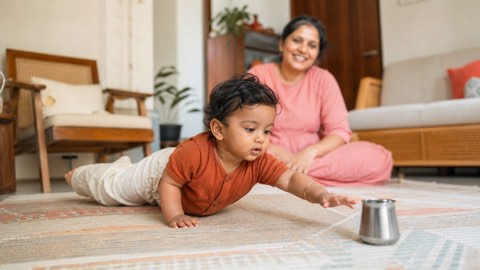
Hands are the great discovery of this month: watched, brought together, and taken to the mouth constantly. Objects placed in the hand are gripped and pulled towards the face — the beginning of deliberate reaching.
Head control is much steadier. During tummy time the baby pushes up on the forearms and holds the head up to look around, and when pulled to sit the head follows with much less lag.
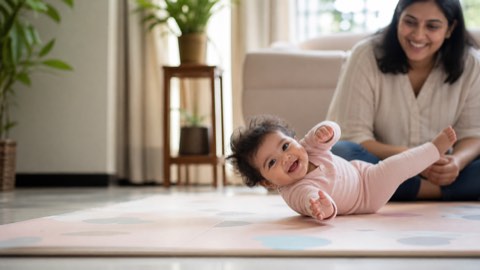
Socially, this is the reward month: laughing, squealing, long cooing conversations, and a baby who is visibly delighted to see familiar faces. Crying has usually fallen well below its six-week peak.
Weight gain slows slightly to around 100-150 g a week from here, which is normal and often alarms families who were used to the earlier pace.
Sleep and feeding
Many babies now do one longer stretch at night — four to six hours — and settle into a rough pattern of three or four daytime naps. Many do not yet, and that is equally normal.
Keep the day-night contrast strong: bright and social by day, dim and boring at night. Start a short bedtime routine now if you have not — bath or wipe-down, feed, dim room, same order every night. It pays for itself over the next year.
Feeding settles to roughly six to eight feeds a day for many babies. A growth spurt around twelve weeks can briefly make it feel like the newborn weeks again.
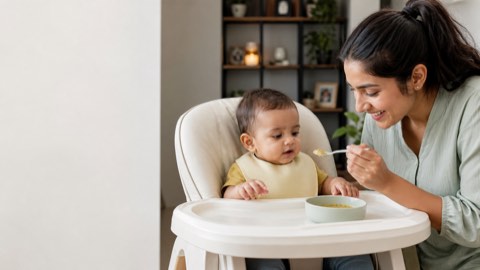
Still milk only. Six months remains the target for solids, and starting early does not help sleep — the evidence on that is clear, whatever the neighbours say.


Vaccines, checks and safety
The ten-week visit falls in this month on the national schedule — the second dose of Pentavalent, OPV and rotavirus. Take the MCP card, and ask for weight and length to be plotted.
Rolling can start any time from now, most often tummy to back first. From the day it is possible, nappy changes move to the floor or a surface the baby cannot fall from, and nobody leaves a baby unattended on a bed or sofa.
Keep tummy time going in short frequent sessions — it prevents a flat spot on the head as well as building strength.
This is also the month many Indian mothers return to work. Start expressing and introducing an occasional bottle two to three weeks before, and see our return-to-work guide for the logistics.
When to see a doctor
The rule that outranks everything else at this age: any fever of 38°C or above in a baby under three months means the hospital the same day — not the next morning, and not after a sponge bath. A newborn's immune system cannot wall off an infection, and fever is often the only sign.
Same-day: refusing feeds, fewer than six wet nappies a day, a floppy or unusually drowsy baby, fast or laboured breathing, blue lips, a fit, or a rash that does not fade under pressure.
Book an appointment for: no social smile, no cooing or vocal response, not following a face or object with the eyes, no attempt to lift the head during tummy time, hands still constantly fisted, stiffness or floppiness, no reaction to sound, or the loss of any skill the baby previously had.
This article is general information, not medical advice, and is no substitute for personal medical advice. For any decision about your or your child's health, please consult your doctor.
Frequently asked questions
My baby has stopped feeding as often. Is my supply dropping?
Feeds usually become faster and more efficient around now, so fewer and shorter is often a sign of a better feeder rather than less milk. Judge by nappies and the growth chart.
He was sleeping better and has started waking again.
The four-month sleep change often begins late in month three, when sleep cycles reorganise permanently. It is developmental and it settles — our month four page covers it.
Can I take a three-month-old travelling?
Yes, with sensible precautions — see our travel guide. Avoid crowds during illness season, and take the vaccination card.
The doctor says the head is slightly flat on one side.
Common in back-sleeping babies and improves with more tummy time when awake, varying which end of the cot the head lies at, and less time in car seats and bouncers. Back-sleeping still stands.
Sources
Every clinical figure on this page is taken from the guidelines below. Where our numbers and your doctor's differ, ask which guideline they follow.
- IAP. IAP Recommended Immunization Schedule for Children (0–18 years) (2023)Backs the description of the ten-week visit as part of the national schedule, including second doses of Pentavalent, OPV, and rotavirus vaccine.
- MoHFW. National Immunization Schedule (Universal Immunization Programme) (2023)Confirms the national schedule immunisation visit around ten weeks including Pentavalent, OPV, and rotavirus doses, and the use of the MCP card for growth monitoring.
- NICE. Fever in under 5s: assessment and initial management (NG143) (2021)Backs the same-day hospital rule for fever of 38 °C or above in a baby under three months, and the listed red-flag signs (floppiness, unusual drowsiness, fast or laboured breathing, non-blanching rash, poor feeding) requiring same-day assessment.
- AAP. Safe Sleep: Back to Sleep, Tummy to Play (2022)Backs the recommendations for supervised tummy time in short frequent sessions to build strength and prevent positional head flattening, and the instruction to continue back-sleeping despite any flat-spot concern.
- AAP. Developmental Milestones: 3 Months (2023)Backs the developmental red-flag list for a three-month review, including absence of social smile, no cooing or vocal response, failure to track faces or objects, no head lift in prone, and loss of previously acquired skills.
Reviewed by
- Nakul Phatak — CEO, theAsianparent India & IndonesiaHead of theAsianparent India; father of one
- Roshni Chugani — Head of Marketing, theAsianparent India & Singapore12 years in the mother-and-baby space; mother of two
Published by: theAsianparent editorial team