Your baby at 8 months: pulling up, pincer grip and real opinions

At eight months a baby stops being a passenger. They pull themselves up, pick up a single grain of rice, and have loud opinions about being put down.
What is new this month
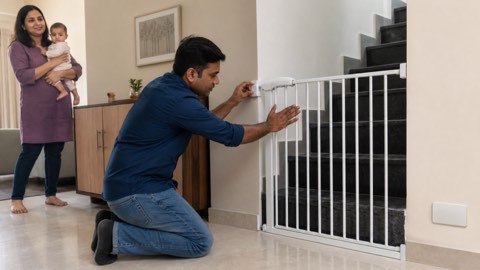
Pulling to stand against furniture, then cruising sideways along it. The moment a baby can pull up, the cot mattress must come down and anything climbable near a window or balcony has to move.
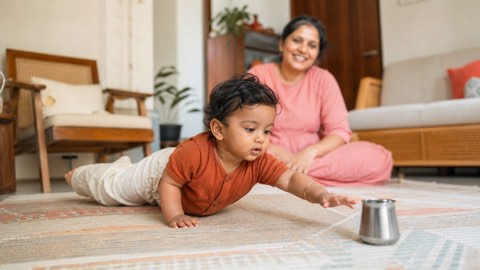
The pincer grip sharpens — thumb and index finger lifting a single pea or a bead. It is a lovely milestone and a serious choking risk, so a floor sweep becomes a daily job.
Language grows: 'mama' and 'dada' start being used with meaning, simple instructions like 'give me' begin to land, and babies point at what they want. Object permanence is solid, which is why a dropped spoon is now a game rather than an accident.
Food and feeding
Three small meals plus a snack is typical, alongside breastmilk or formula, which remains the main source of nutrition until one year.
This is prime finger-food territory: soft-cooked vegetable sticks, paneer cubes, small pieces of roti soaked in dal, banana, well-cooked pasta. Let the baby lead — self-feeding is how appetite regulation is learnt.
Avoid the choking shapes: whole grapes and tomatoes (quarter them), whole nuts (grind them into porridge instead), hard raw carrot and apple, popcorn, and anything round and firm.
Iron matters more than ever now that milk is a smaller share of the diet. Dal, ragi, egg, meat where eaten, and greens should appear daily; keep chai away from the child entirely.


Sleep, and the standing-in-the-cot phase
Many babies now pull to standing in the cot at night and cry because they cannot get down. Practise sitting from standing during the day — it genuinely shortens this phase.
Two naps are usual by now, morning and afternoon. Protect them: an overtired eight-month-old fights bedtime harder.
Separation anxiety often peaks between eight and eighteen months. Say goodbye clearly rather than sneaking away, keep it short, and always come back when you said you would.
When to see a doctor
The standing newborn rules still apply: any fever in a baby under three months means the hospital the same day; fast or laboured breathing, the chest sucking in, blue lips, a fit, a rash that does not fade under pressure, refusing feeds, no wet nappy for six to eight hours, or a baby who is floppy and hard to wake are all same-day emergencies at any age.
This month specifically: not sitting steadily, not bearing weight on the legs, no babbling, no response to name, not looking where you point, no interest in games like peekaboo, using only one side of the body, or losing skills. Also check hearing if there is no reaction to sound.
This article is general information, not medical advice, and is no substitute for personal medical advice. For any decision about your or your child's health, please consult your doctor.
Frequently asked questions
He pulls up on everything and falls constantly.
That is how it is learnt. Clear the sharp corners and hard edges from his practice route, keep the floor free of hard toys, and let him fall onto his bottom; padding him from every knock slows the learning.
Should I buy him shoes now?
Not for indoors. Bare feet are best for balance and foot development. Soft-soled shoes are only for outdoors, and proper shoes come once he is walking outside confidently.
She only wants to eat what is on my plate.
Good news. Remove a portion before adding salt and chilli, mash it, and let her have the family food. That is exactly where you want her by one year.
Is it too late to introduce new foods if she refuses everything new?
No. Keep offering without pressure, alongside something she accepts. Refusal at this age is about novelty, and exposure is what changes it.
Sources
Every clinical figure on this page is taken from the guidelines below. Where our numbers and your doctor's differ, ask which guideline they follow.
- WHO. Infant and young child feeding: Model Chapter for textbooks for medical students and allied health professionals (2009)Supports the claim that breastmilk remains the main source of nutrition until one year, and that complementary foods including soft family foods should be introduced alongside continued breastfeeding from around six months.
- WHO. Complementary feeding: family foods for breastfed children (2000)Supports guidance on offering three small meals plus snacks alongside breastmilk, encouraging self-feeding and appetite regulation, and using soft family foods such as vegetables, legumes and cereals as complementary foods.
- NHS. Baby and toddler meal ideas: Foods to avoid giving babies and young children (2022)Supports the choking-hazard guidance including quartering grapes and tomatoes, grinding whole nuts, and avoiding whole hard raw foods, popcorn, and round firm items for babies at this age.
- IAP. IAP Feeding Guidelines for Children 0–2 Years (2016)Supports the recommendation that iron-rich foods such as dal, ragi, egg, meat and green vegetables should be offered daily at this age, and that tea (chai) should be kept away from infants and young children as it inhibits iron absorption.
Reviewed by
- Nakul Phatak — CEO, theAsianparent India & IndonesiaHead of theAsianparent India; father of one
- Roshni Chugani — Head of Marketing, theAsianparent India & Singapore12 years in the mother-and-baby space; mother of two
Published by: theAsianparent editorial team