Why newly walking babies fall so much, and when a fall matters

A new walker falls roughly every couple of minutes of walking. Almost all of it is how walking gets learned — and a small number of falls need a hospital.
Why it happens
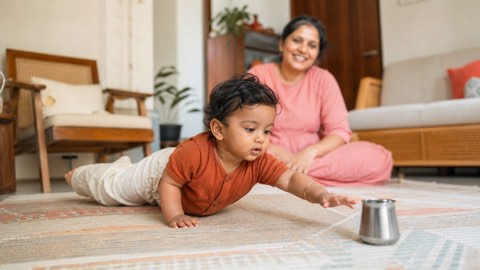
A new walker has a head that is large relative to the body, a high centre of gravity, feet that are still developing an arch, and a balance system that is being calibrated in real time. Falling is the calibration.
New walkers also walk with a wide stance, arms up, short quick steps and little ability to stop or turn — all of which is normal and gradually resolves over the following months.
Studies of toddlers learning to walk have counted them falling many dozens of times an hour of walking. Almost all of these are low, backwards onto a padded bottom, and completely unremarkable.
Being tired, being on an unfamiliar surface, wearing new shoes, carrying something, or being excited all increase falls temporarily.
Making a home safer without wrapping it in foam
The falls that matter are from a height or onto something hard and sharp, not the ordinary sit-downs. Focus there.
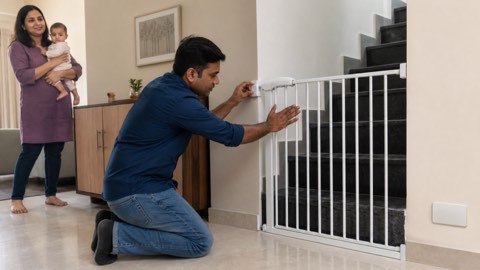
Stair gates at both the top and bottom, and never a sit-in walker anywhere near stairs.
Corner guards on low glass or stone table edges, and moving the sharpest piece of furniture out of the main walking route entirely — simpler than padding it.
Anchor anything that can be pulled over: bookshelves, the TV unit, a standing fan. Furniture tipping onto a child is a far bigger risk than the falls themselves.
Balconies and grilles: check the gap between bars, and never leave anything climbable next to a railing.
A rug or dhurrie in the main practice area gives grip and softens the landing. Bare feet indoors, always — they grip better than socks or shoes.
Bathrooms, buckets and any standing water: a toddler who falls into a bucket cannot get out. Empty them.
When to see a doctor
Go to hospital immediately after a fall if the child: lost consciousness even briefly, is drowsy or difficult to wake, vomits repeatedly, has a seizure, has clear or bloody fluid from the nose or ear, has unequal pupils, is not moving a limb, has a soft boggy swelling on the skull, or is inconsolable and not behaving like themselves. Call 108 if travel is difficult.
Also seek same-day care for: any fall from a height greater than the child's own height, a fall onto a hard edge, a fall down stairs, any fall in a baby under one year old, or a suspected fracture.
See a paediatrician if the child is falling far more than their peers well after the early weeks of walking, walks persistently on tiptoes, limps, tires very quickly, or seems to have gone backwards in steadiness.
This article is general information, not medical advice. When in doubt after a head injury, get the child seen.
This article is general information, not medical advice, and is no substitute for personal medical advice. For any decision about your or your child's health, please consult your doctor.
Frequently asked questions
My baby bumps their head almost daily. Is that normal?
Ordinary low bumps from standing height, with a quick recovery and normal behaviour afterwards, are a routine part of learning to walk. It is the behaviour after the fall that tells you whether it mattered.
Should I put a helmet or head cushion on them?
Generally unnecessary and they can affect balance. Padding the environment where it is genuinely hard beats padding the child.
Should I rush over every time?
Steady acknowledgement works better than alarm. A calm 'up you get' helps a child recover; a frightened reaction often turns a non-event into a long cry.
Do shoes make them steadier?
Indoors, no — bare feet are better. Outdoor shoes should be light and flexible; see our guide to first shoes.
Sources
Every clinical figure on this page is taken from the guidelines below. Where our numbers and your doctor's differ, ask which guideline they follow.
- AAP. Head Injury – HealthyChildren.org (2023)Supports the page's list of emergency signs after a fall — loss of consciousness, repeated vomiting, seizure, unequal pupils, bloody or clear fluid from nose or ear, inconsolability, and failure to move a limb — as indications for immediate hospital care.
- NICE. Head injury: assessment and early management (NG232) (2023)Supports the emergency red-flag signs listed on the page (loss of consciousness, repeated vomiting, seizure, boggy skull swelling, clear or bloody fluid from ear or nose, drowsiness) as criteria warranting immediate emergency assessment after a head injury.
Reviewed by
- Nakul Phatak — CEO, theAsianparent India & IndonesiaHead of theAsianparent India; father of one
- Roshni Chugani — Head of Marketing, theAsianparent India & Singapore12 years in the mother-and-baby space; mother of two
Published by: theAsianparent editorial team