Baby not crawling, pulling up or cruising: what it means

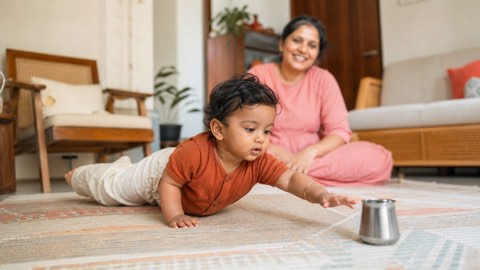
Crawling is the milestone parents worry about most and the one that matters least. What matters is whether a baby is finding some way to move.
The usual sequence, and its variations
Roughly: rolling from about 4 to 6 months, sitting unsupported around 6 to 8, some form of crawling from 7 to 10, pulling to stand around 8 to 11, cruising along furniture from about 9 to 12, and walking from 9 to 15 months.
Crawling has many legitimate versions. Classic hands-and-knees, commando crawling on the belly, bear crawling on hands and feet, rolling to get across a room, and bottom-shuffling are all normal ways of solving the same problem.
Around one baby in ten never crawls at all. Skipping it is not associated with later problems, despite what you will be told about crawling being essential for reading or brain development — that claim is not supported.
What matters is that a baby is mobile somehow by around 9 to 10 months, and increasingly interested in getting to things they want.
What holds it back
Not enough floor time on the tummy, which is by far the commonest reason. Babies who spend most of the day held, in a pram, a jhula, a walker or a car seat simply get less practice.
Slippery floors. Indian homes are often tiled or marble, and a baby who cannot get purchase will give up. A cotton dhurrie or a play mat fixes it immediately.
Clothing that restricts — long gowns, thick winter layers, and anything that catches under the knees.
Dislike of tummy time, which is very common and usually a habit rather than a problem. Short frequent sessions on a parent's chest work better than long ones on the floor.
Prematurity, which needs correcting for.
And being picked up the moment they want something. A baby who never has to move to get anything has less reason to.
When to see a doctor
See a paediatrician if your baby: is not sitting without support by 9 months, is not moving about in any way by 10 months, is not pulling to stand by 12 months, or is not bearing weight on their legs.
Also for: using only one arm or leg, or one side of the body consistently more than the other; arms or legs that feel stiff or unusually floppy; a baby who cannot bring both hands together or to their mouth; or persistent fisting of the hands after 4 months.
And for any loss of a skill the baby previously had — this always warrants prompt assessment.
Correct for prematurity when judging all of the above, and mention it at the appointment.
This article is general information, not medical advice. For any decision about your child's health, please consult your doctor.
This article is general information, not medical advice, and is no substitute for personal medical advice. For any decision about your or your child's health, please consult your doctor.
Frequently asked questions
My baby only bottom-shuffles.
A recognised normal variant. Bottom-shufflers tend to walk a little later and end up in the same place.
My baby hates tummy time.
Very common. Try it on your chest while you lie back, in short bursts several times a day, and immediately after a nappy change rather than after a feed.
Does a walker help them learn to move?
No, and sit-in walkers are a significant injury risk. Floor time is what builds movement.
Everyone says crawling is essential for the brain.
It is not. It is a useful skill and a lovely stage, and skipping it has no demonstrated effect on later development.
Sources
Every clinical figure on this page is taken from the guidelines below. Where our numbers and your doctor's differ, ask which guideline they follow.
- AAP. Back to Sleep, Tummy to Play (2022)Supports the page's advice that supervised tummy time on a caregiver's chest is an effective alternative to floor-based tummy time, and that insufficient tummy time reduces opportunity to develop movement skills.
- NICE. Developmental follow-up of children and young people born preterm (NG72) (2017)Supports the page's instruction to correct for prematurity when assessing developmental milestones and to mention prematurity at any paediatrician appointment.
Reviewed by
- Nakul Phatak — CEO, theAsianparent India & IndonesiaHead of theAsianparent India; father of one
- Roshni Chugani — Head of Marketing, theAsianparent India & Singapore12 years in the mother-and-baby space; mother of two
Published by: theAsianparent editorial team