Activities that build gross-motor skills, birth to three

None of this needs equipment. Floor space, a few household objects, and the willingness to let a child struggle a little are the whole method.
Birth to six months
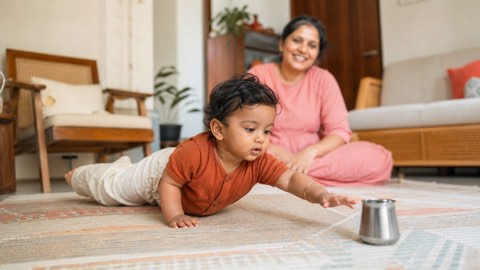
Tummy time, several short sessions a day from the first weeks. Start on your chest while you lie back — most babies who hate the floor accept this — and build up to a firm mat.
Put something worth looking at just out of reach during tummy time: a face is best, then a high-contrast cloth or a steel bowl that catches the light.
Let them kick freely without a nappy for a few minutes on a towel. Free leg movement is practice.
Encourage rolling by placing a toy to one side rather than turning them yourself.
Hold them upright against your shoulder often — head control is built by being upright.
Skip: propping in seats and bouncers for long stretches. A baby held in position is not practising getting into it.
Six to twelve months
Floor, floor, floor, on a dhurrie or mat rather than slippery tile. This is the single most useful thing in this entire article.
Put desirable things slightly out of reach so there is a reason to move. A baby handed everything has no reason to crawl.
Create a low obstacle course from cushions and rolled blankets to crawl over and around.
Sit them on the floor rather than in a chair, with a cushion behind, and let them topple safely — the recovery is the skill.
Stable furniture at chest height to pull up on, and a heavy stool or a weighted cardboard box to push along.
Sit facing them with legs apart and roll a ball back and forth — this builds trunk control as well as attention.
One to three years
Walking on different surfaces: grass, sand, a dhurrie, a slope. Varied ground builds balance faster than flat floor.
Stairs, with an adult beside them. Up first, then down, which is much harder and comes later.
Carrying things while walking — a small bucket of clothes pegs, a plate to the table. Load changes balance and children love the job.
Climbing something safe and low, because they will climb something regardless and it may as well be chosen.
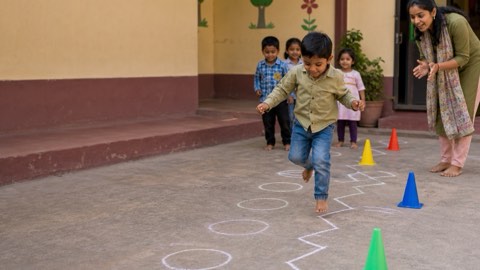
Jumping: from a low step onto a cushion, then two feet together on the spot, which usually appears around two.
Kicking and throwing a ball, riding a push-along or balance bike from around two, and dancing — traditional Indian games like langdi and stapoo are excellent gross-motor work and cost nothing.
Aim for plenty of active time spread through the day rather than one session, and remember that unstructured outdoor play does more than any class.
Frequently asked questions
How much tummy time does a baby need?
Little and often from birth, building up as they tolerate it. Total time matters less than doing it daily.
Do baby gyms and play mats help?
They are pleasant and not necessary. A cotton dhurrie and a few household objects do the same job.
My toddler will not sit still for activities.
That is the point at this age. Gross-motor development is not an activity to sit through; give them space and let them move.
Are baby swimming or gym classes worth it?
Enjoyable, and not necessary for development. Floor time at home does more, at no cost.
Reviewed by
- Nakul Phatak — CEO, theAsianparent India & IndonesiaHead of theAsianparent India; father of one
- Roshni Chugani — Head of Marketing, theAsianparent India & Singapore12 years in the mother-and-baby space; mother of two
Published by: theAsianparent editorial team