Head banging, thumb sucking and eight other things babies do that look alarming

Almost every one of these gets searched at midnight by a frightened parent, and almost every one has the same answer: common, self-soothing, and outgrown. Here is each of them, and the small number of signs that change the answer.
The self-soothing ones
Head banging at bedtime. Rhythmic banging or rocking against the cot as they fall asleep affects a substantial minority of toddlers, usually starting around six to nine months and typically outgrown by three or four. It looks awful and is almost always self-soothing rather than distress. Babies do not concuss themselves this way; they stop when it hurts. Pad the cot rails if the noise is unbearable, keep the cot away from the wall, and do not make it a big event, because attention prolongs it.
Hair pulling when tired. Twirling or tugging their own hair — or yours, or the feeding parent's — while falling asleep or feeding is common and rhythmic in the same way. It usually fades. Offer a muslin or a soft toy to hold instead, keep the child's nails short, and if they are pulling out enough hair to leave bare patches, mention it to your doctor.
Thumb sucking. Very common, entirely normal in the first years, and often present in the womb. It is a genuine self-soothing skill and there is no reason to stop it in a small child. Dental guidance suggests discouraging it beyond about four, and past school age it is worth addressing gently — never with bitter paint or shaming, which produce anxiety and rarely stop the habit.
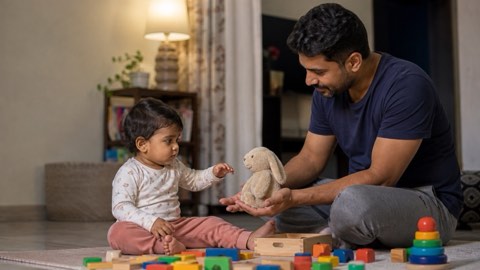
Attachment to a favourite toy or cloth. A comfort object is a developmental achievement, not a weakness — it is how a child carries a piece of security into a world without you in it. Buy a duplicate immediately and rotate them so both smell the same, and do not push a child to give it up. Almost all children retire them on their own between three and six.
The ones that look worse than they are
Playful biting. Babies bite while teething, while exploring, and because a mouth is a tool at that age. Toddlers bite from frustration and lack of words. Neither is aggression. Respond briefly and flatly — 'no biting, it hurts' — attend to the person bitten rather than lecturing the biter, and give them the word they were missing. Our page on hitting and biting covers the toddler version in detail.
Breath-holding spells. A child cries, then stops breathing, then goes blue or very pale and may briefly go limp or stiff, sometimes with a few jerks. These affect around one child in twenty, usually between six months and six years, and they are frightening beyond description the first time. They are not seizures, not fits of temper the child can control, and not harmful. Lay the child flat on their side, keep them safe, and do not shake, slap, splash water or blow on the face. They come round within a minute. Do tell your doctor after the first one — iron deficiency is associated with them and treating it reduces how often they happen, and a doctor will want to rule out anything cardiac.
Genital touching during nappy changes. Babies discover their bodies the way they discover their feet, and it carries none of the meaning adults attach to it. Do not slap the hand away or make a face; it is the reaction, not the act, that teaches shame. Redirect if it is happening somewhere public, and teach the language of private and public from around three.
Erections in baby boys. Entirely normal from birth, including in the womb, and often noticed at nappy changes or before a wee. They have no sexual meaning at all and need no response.
Sensitivity to sound, light, texture and smell
Some babies are simply more sensitive: they startle at the pressure cooker, hate certain fabrics or seams, refuse foods by texture rather than taste, dislike bright light or crowds, and are overwhelmed by Indian family functions in a way other children are not.
For most children this is temperament, not disorder. It is a real difference in how much input they can take, and it is worth accommodating rather than training out.
What helps: warning before loud things, ear defenders or cotton wool at functions and for fireworks, cutting labels out of clothes, offering new textures without pressure, and a quiet place to retreat to.
It becomes worth assessing when it is severe enough to limit daily life — a child who cannot tolerate being dressed, eats fewer than a handful of foods, cannot cope with any social setting, or melts down for long periods after ordinary sensory input.
The combination matters more than any one thing. Sensory sensitivity alongside delayed speech, limited eye contact, not responding to their name, repetitive movements or loss of skills is the picture that warrants a developmental assessment — not sensitivity by itself.
When to see a doctor
See a doctor promptly for: any breath-holding spell (after the first one, and again if the pattern changes), head banging that causes injury or happens when the child is awake and distressed rather than settling, hair pulling that leaves bald patches, or biting that is frequent, aggressive and not improving with age.
Urgent, same day: a limp or unresponsive child who does not come round quickly, a first episode of blue or pale colour with loss of consciousness that you have not seen before, any jerking that continues beyond a few seconds, or a head injury with vomiting or drowsiness. Call 108 if you cannot travel quickly.
Ask for a developmental assessment if any of these behaviours sit alongside: not responding to their name by 12 months, no words by 18 months, no two-word phrases by two years, loss of skills already gained, very limited eye contact, or repetitive movements that dominate the day.
Also raise sexualised behaviour that is beyond ordinary curiosity, or that appears suddenly alongside other changes in a child — this has many causes and deserves a proper conversation rather than assumptions in either direction.
This article is general information, not medical advice, and is no substitute for personal medical advice. For any decision about your child's health, please consult your doctor.
Frequently asked questions
Is head banging a sign of autism?
On its own, no. It is common in typically developing toddlers. It is the combination with communication and social differences that matters.
Should I stop my child sucking their thumb?
Not in the early years. From around four, discourage gently and involve the child. Never use bitter paint, gloves or shaming.
Are breath-holding spells dangerous?
They are terrifying and not harmful in themselves. Tell your doctor, and ask specifically about checking for iron deficiency.
My mother-in-law says the comfort cloth must be taken away.
There is no reason to. Children give them up themselves, and forcing it usually creates a more anxious child rather than a more independent one.
When is fussiness about texture a problem?
When it narrows the diet enough to affect growth or nutrition, or when it is one of several signs. A child who eats a limited but adequate range is usually fine and will widen it slowly.
Sources
Every clinical figure on this page is taken from the guidelines below. Where our numbers and your doctor's differ, ask which guideline they follow.
- WHO. Nurturing care for early childhood development: A framework for helping children survive and thrive to transform health and human potentialBacks the developmental framing that comfort-seeking behaviours and sensory sensitivity are part of normal early childhood development, and that responsive caregiving rather than suppression of self-soothing supports healthy development.
- AAP. Developmental Milestones: 12 Months, 18 Months, 2 YearsSupports the developmental red-flag thresholds cited on the page: not responding to name by 12 months, no words by 18 months, and no two-word phrases by two years as triggers for requesting a developmental assessment.
- WHO. Guidelines on the management of health conditions specifically related to sexual violence (and developmental milestones guidance within Caring for Children's Development)Supports the recommendation that sexualised behaviour appearing suddenly or beyond ordinary curiosity in a child warrants a careful professional assessment rather than assumptions.
- NICE. Autism spectrum disorder in under 19s: recognition, referral and diagnosis (NG3)Supports the claim that it is the combination of sensory sensitivity with limited eye contact, failure to respond to name, delayed or absent speech, repetitive movements, and loss of skills — rather than any one behaviour alone — that warrants a referral for developmental assessment.
- NIH. Breath-holding spell — MedlinePlus Medical EncyclopediaSupports the description of breath-holding spells (cyanotic and pallid types, onset 6 months to 6 years, self-limiting within one minute) and the association with iron-deficiency anaemia, reinforcing the advice to ask the doctor about checking iron levels.
Reviewed by
- Nakul Phatak — CEO, theAsianparent India & IndonesiaHead of theAsianparent India; father of one
- Roshni Chugani — Head of Marketing, theAsianparent India & Singapore12 years in the mother-and-baby space; mother of two
Published by: theAsianparent editorial team