Hitting, biting and pushing: why toddlers do it and how to stop it

Hitting and biting are normal in the second and third year, alarming to watch, and entirely fixable — but not by hitting back. Here is what works.
Why they do it
A toddler wants something, has no words fast enough, and the body acts before the brain can stop it. Hitting and biting are communication failures, not moral failures — and they peak exactly when wants outrun language, around eighteen months to three years.
Common triggers: someone took a toy, being crowded, over-excitement, tiredness, hunger, teething discomfort, jealousy of a sibling, or getting a big reaction last time (attention, even angry attention, is reinforcing).
It is also copied. A child who is smacked at home hits at school; a child who watches adults settle arguments loudly learns that too. This is worth an honest look before blaming the school or the friends.
What to do in the moment
Move in immediately, calmly, and attend to the child who was hurt first — this removes the audience reward and models where concern belongs. Then, briefly and firmly to your child: 'no hitting, hitting hurts.' Five words, flat tone, no lecture.
Remove them from the situation for a minute or two, sit with them, and once they are calm, give the words they needed: 'you can say — my turn'. Then help them make a repair: bring the toy back, fetch water for the child who was hurt, or pat gently.
What not to do: bite them back or hit them back to 'show how it feels'. It teaches that big people hit small people, which is exactly the lesson to avoid. Also skip long explanations mid-episode, shaming in front of others, and labels like 'bad boy' or 'you are so aggressive'.
Prevention and teaching alternatives
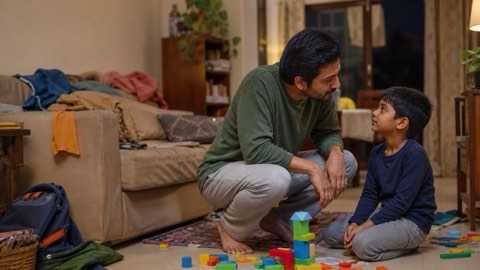
Watch for the pattern — most families can predict the flashpoints within a week. Then intervene early: shadow the child in group play, step in at the tense moment rather than after, and keep sessions short before tiredness arrives.
Teach the replacement behaviour explicitly and repeatedly: words ('mine', 'my turn', 'stop'), stamping feet, squeezing hands, coming to an adult. Practise it in calm moments through play and simple role-play with toys.
Give the physical energy somewhere to go: running, climbing, pushing, jumping, playdough, water play. An under-exercised toddler indoors all day hits more, especially in flats and cities where outdoor play is limited.
And praise the alternatives out loud when they happen: 'you waited for your turn — that was hard and you did it.' Attention given to the wanted behaviour reduces the unwanted one faster than any punishment.
At playschool, and with cousins
Work with the school rather than defending or panicking. Ask what happens just before the incidents, agree the same words and consequences at home and school, and ask for shadowing during high-risk activities. Consistency across settings is what shifts the behaviour.
If your child is the one being bitten, expect the school to keep the children's names private, treat the injury, and tell you what they are doing — that is standard practice, not evasion. Repeated incidents with no plan is a reason to press harder.
With cousins and family gatherings, supervise closely rather than hoping, intervene at the flashpoint, and take breaks before the meltdown. Do not let relatives extract a public apology by force — a shamed toddler learns to hide, not to stop.
Frequently asked questions
How long does it take to stop?
With a consistent response, most biting settles within a few weeks and hitting fades over months as language grows. Inconsistency — laughing sometimes, exploding other times — makes it last much longer.
My child only hits me, never anyone else. Why?
Because you are safe. Children release their worst feelings where they trust the relationship most. Respond the same way: calm, firm, brief, then reconnect. Do not take it as rejection.
When is aggression a sign of something more?
Discuss with a doctor if aggression is frequent and intense beyond age four or five, causes real injury, comes with speech delay or loss of skills, appears alongside a sudden change in behaviour, or if the child seems unable to calm at all. Also seek help if there is violence at home the child is witnessing.
The grandparents say a slap will settle it in one day.
It may suppress it in front of them and increase it elsewhere. Every large study of physical punishment shows more aggression, not less, over time. Offer them a job instead: they are excellent at redirecting a toddler and at praising the good moments, and that is the part that actually works.
Reviewed by
- Nakul Phatak — CEO, theAsianparent India & IndonesiaHead of theAsianparent India; father of one
- Roshni Chugani — Head of Marketing, theAsianparent India & Singapore12 years in the mother-and-baby space; mother of two
Published by: theAsianparent editorial team