Improving a child's concentration without pressure or punishment

Most children described as unable to concentrate are being asked to sit for longer than their age allows, on an empty stomach, after four hours of school.
What is normal at each age
A rough guide: about ten minutes of focused attention per year of age for a task the child did not choose. That is twenty minutes at six, forty at twelve — and considerably longer for something they love, which is why a child who cannot do fifteen minutes of maths will build with blocks for an hour.
That difference is not evidence of laziness. Attention for chosen activities and attention for imposed ones develop separately, and the second matures slowly through childhood.
So the first fix is usually structural: shorter blocks with real breaks, rather than longer sessions with more supervision.
Rule out the physical causes first
Sleep. A primary-age child needs nine to twelve hours, and most Indian children of that age get less because bedtime is late. Sleep debt looks exactly like an attention problem.
Hunger and anaemia. A child who leaves without breakfast is unfocused by mid-morning, and iron deficiency — very common in Indian children — directly impairs concentration. Get haemoglobin checked if a child is pale, tired and inattentive.
Hearing and vision. A child who cannot hear the teacher or see the board switches off, and it is read as inattention for months. Both are cheap to test, and both should be checked before anything else is concluded.
Screens and sleep timing: late-evening screen use delays sleep and fragments attention the next day. Worms, which itch at night and disturb sleep, are worth deworming for routinely.
Study habits that actually build focus
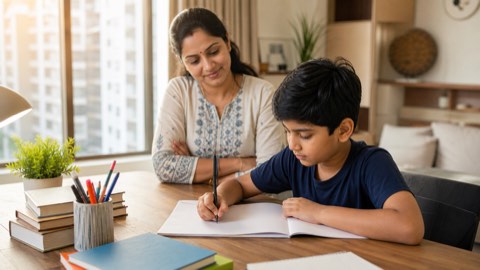
Fixed time, fixed place, cleared surface, phone and television out of the room — including yours. Children cannot focus in a room where a screen is on, and asking them to is unfair.
Work in blocks with real breaks: roughly ten minutes per year of age, then five minutes of movement — not a screen, which does not rest the brain in the way a walk or a stretch does.
One task at a time, written down, and crossed off. A visible list reduces the load of remembering what comes next, which is itself a drain on attention.
Hardest subject first, when attention is freshest, and after a snack rather than before.
Physical activity daily. Exercise improves attention measurably, and it is the first thing cut when a child is struggling academically — which is exactly backwards.
And drop the running commentary. 'Concentrate', repeated every two minutes, is itself an interruption.
When to see a doctor
Book an assessment if: inattention is present in more than one setting — school and home and activities — and has lasted more than six months; the child cannot sustain attention far beyond what peers of the same age manage; there is significant impulsivity or restlessness; academic progress is affected despite support; or there is difficulty with reading, writing or maths specifically, which can indicate a learning difficulty presenting as inattention.
Also check first: hearing, vision, haemoglobin, thyroid, and sleep. Anxiety and low mood both present as poor concentration in children and are frequently missed.
ADHD is a real diagnosis with real treatment, made by a paediatrician or child psychiatrist after proper assessment across settings — not by a school's opinion or an online quiz. If it is raised, ask for a formal assessment rather than accepting a label or dismissing it.
This article is general information, not medical advice, and is no substitute for personal medical advice. For any decision about your or your child's health, please consult your doctor.
Frequently asked questions
He concentrates for hours on games but not on studies.
Common, and it does not rule out an attention difficulty. Games provide constant feedback and novelty; homework does not. Judge by whether he can sustain effort on ordinary imposed tasks compared with peers.
Do brain tonics or supplements help?
No, unless a deficiency is found and treated. Sleep, iron, food and exercise are the interventions with evidence.
Is yoga or meditation useful?
Mindfulness and breathing practice have modest evidence for attention in children and are harmless. Treat them as an addition to sleep and structure, not a substitute.
Should I sit with him while he studies?
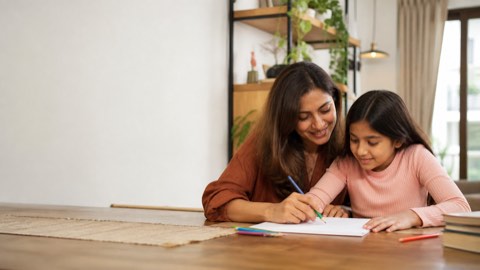
In primary school, nearby and available rather than hovering. The aim is to fade out over the years: at the table at seven, in the room at ten, on call at thirteen.
Sources
Every clinical figure on this page is taken from the guidelines below. Where our numbers and your doctor's differ, ask which guideline they follow.
- WHO. WHO guidelines on physical activity, sedentary behaviour and sleep for children under 5 years of age (2019)Backs the recommendation that adequate sleep is essential for children's health and that screen use affects sleep quality and timing.
- AAP. Sleep Duration Recommendations for Children (Healthy Children) (2016)Supports the claim that primary-age children need nine to twelve hours of sleep and that sleep deficiency presents like an attention problem.
- CDC. ADHD Diagnosis and Treatment (2023)Supports the guidance that ADHD diagnosis requires formal assessment by a qualified clinician across multiple settings, not school opinion or online quizzes, and that inattention present in more than one setting for more than six months warrants referral.
- ICMR. Dietary Guidelines for Indians (2024)Supports the claim that iron deficiency is common in Indian children and impairs concentration, and that breakfast and adequate nutrition affect cognitive function.
Reviewed by
- Nakul Phatak — CEO, theAsianparent India & IndonesiaHead of theAsianparent India; father of one
- Roshni Chugani — Head of Marketing, theAsianparent India & Singapore12 years in the mother-and-baby space; mother of two
Published by: theAsianparent editorial team