Homework battles: how to stop fighting and build study habits that last

The homework hour destroys more Indian evenings than anything else. Most of the fixes are structural — the time, the place, the parent's role — rather than motivational.
Set the structure, not the mood
Fix a time and keep it. Most children do better after a snack and some physical play than immediately after school; the worst slot is late evening when everyone is tired. Same time daily beats negotiation daily.
Fix a place: a table, decent light, the same spot, nothing else on the surface, and the phone and TV out of the room — including yours. Children cannot focus in a room where a television is running, and asking them to is unfair.
Break it up by age. Rough guide: about ten minutes of focused work per year of age before a short break — twenty minutes at seven, forty at twelve. Longer stretches produce staring, not studying.
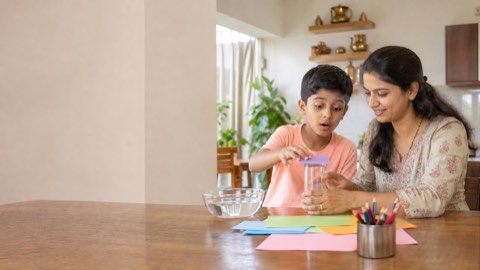
Sit nearby, doing your own quiet work. Presence without hovering is the most effective parental position — available for questions, not policing every line.
How much help is too much
Explain, do not do. If you are writing answers or correcting every mistake before the teacher sees it, the teacher loses the information they need and the child loses the learning.
Let them submit imperfect work. A child who hands in their own honest attempt learns more than one who submits a parent's polished version — and the teacher can then teach to the actual gap.
When they are stuck, ask questions rather than giving answers: what does the question want, what have you tried, where did it stop making sense. If they are stuck for more than a few minutes on most sums, that is a signal to talk to the teacher.
Watch your own frustration. Homework help that ends in shouting teaches a child that studying is dangerous, and creates avoidance that lasts years. If it is going badly, stop, write a note to the teacher, and try again tomorrow.

When homework becomes a fight
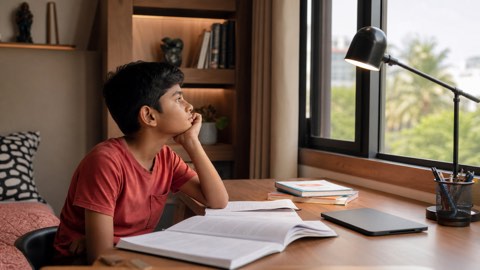
Look underneath the refusal. Common causes: the work is too hard (a genuine learning gap), too easy and boring, too long, illegible instructions, fear of the teacher's reaction, or simple exhaustion after school plus tuition plus classes.
Reduce the total load before adding motivation techniques. A child doing school, two tuitions and an activity every day has no capacity left, and no reward chart will manufacture some.
Use short, concrete incentives at first if you must — finish this page, then fifteen minutes of play — and fade them. Long-term threats ('you will fail in life') do nothing except raise anxiety.
Talk to the school if homework routinely takes far longer than the school says it should, if your child cannot do it independently, or if the volume is unreasonable. Teachers usually do not know how long it is taking at home, and the information changes what they set.
Building study habits that outlast supervision
Teach planning: a weekly wall chart with tests, submissions and activities, filled in by the child. From about age ten, they should manage their own timetable with you checking, not the reverse.
Teach how to study, which most children are never shown: reading a passage and saying it back from memory, self-testing with the book closed, spacing practice across days rather than cramming, and doing past questions. Rereading and highlighting feel productive and do least.
Build independence deliberately: by the end of primary school, a child should be packing their own bag, knowing their own deadlines and asking for help when needed. Parents who run the system into Class 8 are usually still running it in Class 10.
And protect sleep over homework in a straight fight. A tired child learns less the next day than the homework was worth. Write the note to the teacher and put them to bed.
Frequently asked questions
My child says he has no homework, and it turns out he does.
Establish a paper trail rather than an interrogation: a school diary checked daily, or the class group. Then treat it as a system problem, not a character one — and check whether he is avoiding it because it is too hard.
Is it wrong to sit with my child every day?
Not at all in primary school, if you are present rather than controlling. The aim is to fade over the years: sitting at the table at seven, in the room at ten, available on call at thirteen.
Should we get a tutor for homework?
A tutor for a specific weak subject can help. A tutor who does the homework so it is neat and complete is expensive and harmful — the school then teaches to a level the child has not reached.
My child is bright but careless and loses marks on silly mistakes.
Very common. Teach checking as a separate step with its own time, get them to explain the answer aloud, and stop reacting strongly to careless errors — anxiety produces more of them, not fewer.
Reviewed by
- Nakul Phatak — CEO, theAsianparent India & IndonesiaHead of theAsianparent India; father of one
- Roshni Chugani — Head of Marketing, theAsianparent India & Singapore12 years in the mother-and-baby space; mother of two
Published by: theAsianparent editorial team