Montessori, play-based or traditional: which preschool approach?

Every preschool in India now describes itself as one of these, and the label on the gate tells you very little about what happens inside.
What each one actually looks like
Montessori. Mixed-age classrooms, long uninterrupted work periods, and specific self-correcting materials that a child chooses and works with alone — the pink tower, the sandpaper letters, the practical-life trays for pouring and buttoning. The teacher observes and introduces materials rather than leading the class. Real Montessori is quiet, orderly and surprisingly unfussy.
Play-based. Learning through directed and free play, with the room organised into areas — blocks, water, dressing-up, books, art — and the teacher extending play into counting, language and problem-solving as it happens. Noisier, messier, and more social than Montessori by design.
Traditional. Whole-class teaching, worksheets, alphabet and number drill, a fixed timetable, and formal readiness for class 1. Still the most common approach in India, and the one most parents recognise from their own childhood.
In practice most Indian preschools are a blend, and many that advertise Montessori are running a traditional programme with a shelf of Montessori materials in the corner.
What the evidence supports
The research is clearer about quality than about method. Across studies, the things that predict good outcomes are warm responsive teachers, low child-to-adult ratios, staff who stay, plenty of talk directed at children, and time for sustained play. Those matter more than which philosophy the school names.
Play-based approaches have good evidence for language, social skills and self-regulation in the preschool years. Montessori has reasonable evidence, strongest where programmes are implemented faithfully rather than partially.
Early formal instruction — worksheets and drill at three and four — does produce children who recognise letters sooner. The advantage generally disappears within a few years, and the cost is time not spent on the language and social skills that matter more at that age.
India's National Education Policy explicitly frames the ages of three to eight as a foundational stage built on play and activity rather than formal instruction, which is worth quoting back to a school that puts a four-year-old in front of worksheets all morning.
How to tell what you are actually looking at
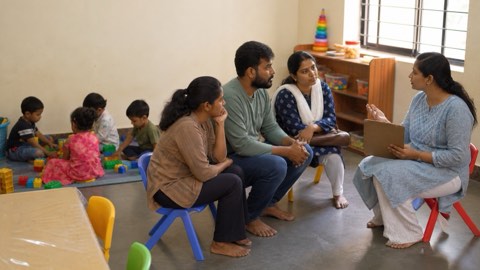
Visit during a working session, not at a demonstration. Ten minutes in a real classroom tells you more than any brochure.
For a Montessori claim: are the materials complete and in use, or decorative? Are the age groups mixed? Do children choose their work and stay with it, or is the class doing the same thing at the same time? Is a teacher trained by a recognised body — AMI or a comparable programme — actually in the room?
For a play-based claim: is there sustained play or a rotation of short activities? Are adults joining play and talking with children, or supervising from the edge?
For any school: count adults per child, watch how a crying child is handled, and see whether the children look at ease with the staff.
Ask what a typical day contains hour by hour, and ask how much of it is worksheets. In many Indian preschools the honest answer is most of it.
Frequently asked questions
Which is best?
Quality within a method beats the choice between methods. A warm, well-staffed traditional school is better for a child than a poor Montessori one.
Will play-based leave my child behind for class 1?
No. Children from play-based programmes generally arrive with better language and self-regulation, and catch up on formal skills quickly.
Is Montessori good for a very active child?
Sometimes, because the long work periods and freedom of movement suit some active children well. Others find the quiet order difficult. Watch your own child in the room before deciding.
Does the preschool method affect school admission?
Not meaningfully. What schools assess at admission is the child's comfort talking to an adult, basic independence, and the parents' interaction.
Reviewed by
- Nakul Phatak — CEO, theAsianparent India & IndonesiaHead of theAsianparent India; father of one
- Roshni Chugani — Head of Marketing, theAsianparent India & Singapore12 years in the mother-and-baby space; mother of two
Published by: theAsianparent editorial team