Your child at 6: reading, rules and the first taste of pressure

Six is when school stops being play and starts being work — and when the family's attitude to marks starts shaping how a child feels about learning.
What changes this year
Reading becomes fluent for many, and writing moves from letters to sentences. Maths moves to addition, subtraction and place value.
Teeth: the first milk teeth fall out and the permanent ones arrive, usually starting with the bottom front. Gaps and crooked new teeth are normal; the age-seven orthodontic check is the one to plan for.
Social: best friends, groups, and a strong sense of fairness — 'that's not fair' becomes the year's refrain. Rules in games are taken very seriously.
Emotional: better self-control, more worry, and awareness of comparison — who reads best, who is fastest, who got a star.
School, marks and pressure
This is where Indian academic pressure usually starts, and where a family's habits are set for a decade. Ask about the process — what was hard, what worked — rather than only the score, and never compare with siblings, cousins or neighbours.
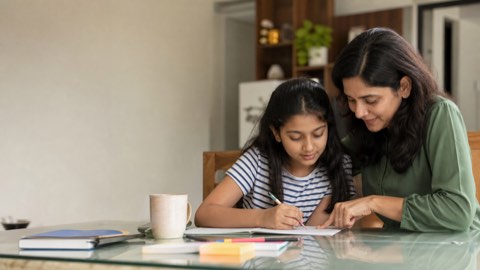
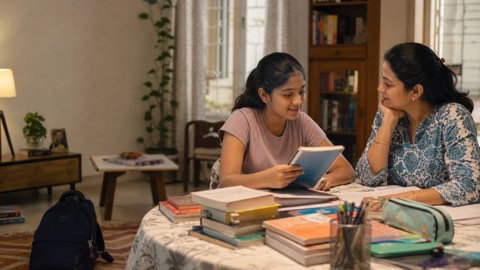
Homework: a fixed time and place, phones and television off in the room, an adult nearby doing their own quiet work, and help by explaining rather than by doing. Twenty to thirty minutes is plenty at six.
Protect play and sleep over extra worksheets. Children with enough of both do better academically, not worse.
Watch for specific learning difficulties: persistent trouble with letter sounds, reading, spelling or number sense beyond this year is worth assessing rather than treating with more tuition.
Health, safety and screens
Health: annual growth check, haemoglobin, vision and hearing, dental visits every six months, deworming twice yearly, and the first orthodontic assessment around seven.
Sleep: 9-12 hours. Screens out of the bedroom and off an hour before bed. Agree screen rules now, before the phone question arrives in a few years.
Safety: road rules, swimming lessons if available, body safety revisited in older language, and the beginnings of online safety if any device is used — never share personal details, tell an adult if anything is frightening.
Independence: packing their own bag, remembering their own homework, and small chores. Doing it for them at six means doing it at twelve.
When to see a doctor
Same-day at any age: fast or laboured breathing, the chest sucking in, blue lips; a fit; a child who is floppy, drowsy or hard to wake; dehydration or no urine for eight hours; a rash that does not fade when pressed; repeated forceful or green vomiting; blood in stool or vomit; severe abdominal pain; or a head injury with vomiting, drowsiness or confusion. Call 108 for breathing difficulty.
At six to seven specifically: persistent difficulty learning letter sounds or reading, trouble being understood, frequent headaches or eye-rubbing while reading (get vision checked), inability to sit or attend at school compared with peers, daytime wetting or soiling, or a marked change in mood or behaviour.
And at any age, the loss of a skill a child already had needs assessment rather than a wait.
This article is general information, not medical advice, and is no substitute for personal medical advice. For any decision about your or your child's health, please consult your doctor.
Frequently asked questions
A permanent tooth is coming in behind the milk tooth.
Common, and usually the milk tooth loosens and falls on its own. See a dentist if it does not within a few weeks.
He says he is bad at maths already.
Address it before it hardens: find where the gap actually is, practise briefly and often rather than in long sessions, and stop labelling — including 'he's not a maths person' said in his hearing.
How much homework is reasonable?
Twenty to thirty minutes at six. Significantly more is worth raising with the school.
She is anxious about tests already.
Take it seriously. Ask what specifically worries her, reduce the load if it is genuinely excessive, and say plainly that your affection does not depend on marks — then behave that way when the marks are bad.
Sources
Every clinical figure on this page is taken from the guidelines below. Where our numbers and your doctor's differ, ask which guideline they follow.
- WHO. WHO guidelines on physical activity, sedentary behaviour and sleep for children under 5 years of age / Guidelines on physical activity and sedentary behaviour (2020) (2020)The recommendation that children have adequate sleep for health and academic wellbeing, and guidance on limiting sedentary screen time, underpins the page's advice on 9–12 hours of sleep and screens off before bed.
- ADA. Mouth Healthy: Eruption Charts (2023)The page's claims that milk teeth begin falling out around age 6 starting with the bottom front teeth, and that dental visits every six months are recommended, align with ADA guidance on tooth eruption and recall intervals.
- NHS. NHS: Children's teeth (2023)The page's advice on six-monthly dental visits and the normal sequence of milk tooth loss and permanent tooth eruption around age 6 is consistent with NHS guidance on children's dental care.
- IAP. IAP Immunization Timetable and Preventive Pediatric Health Care Recommendations (2020)The page's health checklist items for 6-year-olds — including annual growth monitoring, haemoglobin check, vision and hearing screening, and twice-yearly deworming — are consistent with IAP's preventive child health care schedule.
- NICE. NICE guideline NG203: Suspected neurological conditions — recognition and referral (2022)The page's advice to assess rather than wait when a child loses a previously acquired skill, and to evaluate persistent learning difficulties in reading and number sense, reflects NICE guidance on recognising and referring children with possible developmental or neurological concerns.
Reviewed by
- Nakul Phatak — CEO, theAsianparent India & IndonesiaHead of theAsianparent India; father of one
- Roshni Chugani — Head of Marketing, theAsianparent India & Singapore12 years in the mother-and-baby space; mother of two
Published by: theAsianparent editorial team