Annaprashan: the first-food ceremony, and how to do it safely

The rice ceremony marks a baby's first solid food — and it usually happens exactly when paediatricians say solids should start, which is a rare and pleasing agreement between tradition and medicine.
When it is held
Usually in the sixth month for boys and often the fifth or seventh for girls, depending on community custom — and the sixth month is exactly when the World Health Organization and Indian paediatric guidance say solids should begin.
Names change with the region: annaprashan across the north and east, mukhe bhaat in Bengal, choroonu in Kerala, and annaprasana in the south. Muslim and Christian families generally have no equivalent ceremony and start solids on the same medical schedule.
If your family's custom falls earlier than six months, talk to your paediatrician. Many families hold the ceremony on the traditional date with a token taste, and begin real solids at six months.
What happens
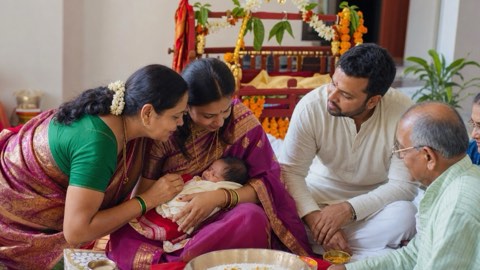
A puja, the baby dressed in new clothes, and the first spoon of food — usually kheer or plain rice with ghee — given by the maternal uncle in many communities, or by the grandparents.
Then the tray ritual that everyone photographs: objects placed before the baby — a book, a pen, money, a musical instrument, a spoon — and whatever the baby grabs is said to indicate their future. It predicts nothing and it is enormous fun.
Gifts, blessings and a family meal follow. The baby's part of the ceremony takes about a minute; everything else is for the adults.
Read next
What the baby should actually eat
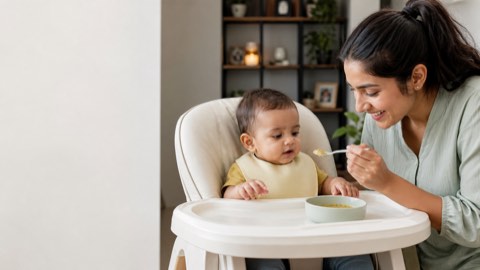
A tiny taste is the ceremony. The real first foods start the same week: smooth, thick, single foods, two or three spoons once a day — mashed dal, ragi porridge, mashed rice with ghee, or a steamed and mashed vegetable.
Ceremonial kheer is usually made with milk and sugar, both of which are not recommended before one year. A token half-spoon is not a disaster; a bowl of it is. Ask for the baby's portion to be made without sugar and with less milk.
The absolute rules that no ceremony overrides: no honey before one year, no whole nuts or dry fruit pieces, no chunks that can block a small airway, and nothing spicy or salty.
Keep the tasting to one person, with clean hands and a clean spoon, and do not let a dozen relatives each feed the baby a bite of something.
When to see a doctor
Same-day, and emergency where breathing is involved: swelling of the lips or face, difficulty breathing, hives with vomiting after a new food, or any choking episode that needed intervention. Call 108 for breathing difficulty.
Also same-day: repeated vomiting, blood in the stool, or a baby who becomes floppy or unusually sleepy after eating something at a gathering.
This article is general information, not medical advice, and is no substitute for personal medical advice. For any decision about your or your child's health, please consult your doctor.
Frequently asked questions
The ceremony is set for five months. Can we start solids then?
Not routinely. Hold the ceremony with a token taste and start real solids at six months, or ask your paediatrician if there is a reason to start a little earlier in your baby's case.
What should we serve the guests?
Whatever the family enjoys — the menu is for them. Keep the baby's own food separate, freshly made, unsalted and unsweetened.
Is the object-choosing tray a real prediction?
No, and it is one of the best photographs you will ever take. Enjoy it as a game.
Do we need a priest?
Only if your family wants one. Many families now do a simple version at home with grandparents and no priest at all.
Sources
Every clinical figure on this page is taken from the guidelines below. Where our numbers and your doctor's differ, ask which guideline they follow.
- WHO. Infant and young child feeding: Model Chapter for textbooks for medical students and allied health professionals (2009)Backs the claim that solids should begin at six months, consistent with WHO guidance that exclusive breastfeeding is recommended for the first six months and complementary feeding should start at six months of age.
- IAP. IAP Guidelines on Infant and Young Child Feeding (2010)Backs the reference to 'Indian paediatric guidance' recommending solids begin at six months, and supports advice on introducing smooth, single-ingredient foods starting with small quantities.
- NHS. Your baby's first solid foods (2023)Supports the advice that added salt and sugar should not be given to babies, cow's milk should not be used as a main drink before one year, and that first foods should be smooth and offered in small amounts.
Reviewed by
- Nakul Phatak — CEO, theAsianparent India & IndonesiaHead of theAsianparent India; father of one
- Roshni Chugani — Head of Marketing, theAsianparent India & Singapore12 years in the mother-and-baby space; mother of two
Published by: theAsianparent editorial team