Namkaran: planning the naming ceremony, community by community

The naming ceremony is the baby's first public appearance, and the first family negotiation about the baby's name. Here is how it is done, and how to plan it without exhausting a new mother.
When it is held
Traditionally the naming ceremony falls on the eleventh or twelfth day after birth in many Hindu communities, and it has quietly moved later in modern practice — often to the end of the first month or later — because a mother eleven days after delivery is in no condition to host anything.
Regional practice varies: barsa in Maharashtra and Goa, namakarana in the south, chatti in parts of the north on the sixth day, and a cradle ceremony where the baby is placed in a decorated jhula. Muslim families hold the aqiqah, usually on the seventh day, with the name given then. Christian families name at baptism, weeks or months later.
If a priest is fixing a muhurat, most will offer options that avoid the earliest days. Say plainly what the mother can manage — the ceremony can be small, and it can be later.
The name, and the panchang
In many families the birth nakshatra decides the syllable the name should begin with. The star and its pada come from the date, time and place of birth, and our birth star calculator gives you both, along with the traditional syllable.
Two names are common: the formal one used on documents, chosen for meaning, and the ghar ka naam that the family will actually use forever. Both are worth deciding deliberately.
Whatever the ceremony, the registration name is the one that must be consistent across the birth certificate, school records, passport and Aadhaar. Fix the spelling before you register and do not change it afterwards.
And a legal note that belongs here: the birth must be registered within 21 days at the local municipal office or panchayat, and the hospital usually files it. Chase the certificate rather than assuming it will arrive.
Read next

What usually happens
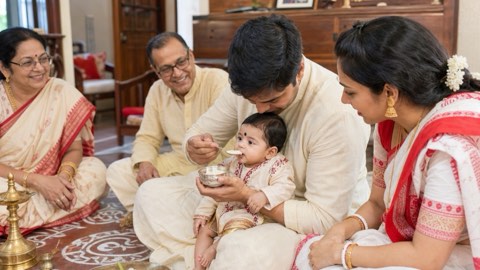
A common shape: a small puja or prayer, the baby dressed in new clothes, the name whispered in the baby's ear by the father or grandfather, the name announced to the gathering, the baby placed in a cradle, blessings and gifts, and food.
Modern additions that families enjoy: a name-reveal moment, a decorated backdrop for photographs, and a short note read out about why the name was chosen.
Costs run from almost nothing at home to a hall and caterer. There is no religious requirement for scale — the ceremony is the naming, not the guest list.
Planning it around a newborn
Keep it short — 90 minutes is plenty — and hold it in the morning if the baby is calmer then. Have a quiet room for feeding and changing, and one person whose only job is the baby.
Limit the crowd, particularly in the first six weeks and in cold and flu season. Ask that anyone with a cough stays away, that nobody kisses the baby's face or hands, and that hands are washed before holding.
Nothing goes into the baby's mouth as part of a ritual — no honey, no ghutti, no sugar water. Before six months a baby has only milk, and honey is unsafe before one year. Agree this with the elders before the day, not during it.
Protect the mother: a chair rather than the floor, food kept aside for her, and permission to disappear for an hour. Guests will understand far better than the family fears.
Frequently asked questions
Can we hold the namkaran later than the twelfth day?
Yes, and most families now do. Ask the priest for a later muhurat; the ceremony's meaning does not change with the date.
Do we have to use the nakshatra syllable?
It is a tradition rather than a rule. Many families use it for the pet name and choose the official name freely, and that is entirely accepted.
What should we gift at someone else's namkaran?
Silver, clothes a size up, a savings deposit for the child, books, or something for the mother — which almost nobody thinks of and every new mother remembers.
Is a ceremony necessary at all?
No. Plenty of families register the name, tell the relatives and skip the event, particularly for a second child. The naming is what matters.
Reviewed by
- Nakul Phatak — CEO, theAsianparent India & IndonesiaHead of theAsianparent India; father of one
- Roshni Chugani — Head of Marketing, theAsianparent India & Singapore12 years in the mother-and-baby space; mother of two
Published by: theAsianparent editorial team