Starting solids at six months: the Indian first-foods guide

Six months, give or take readiness — that's when the spoon enters the story. Here is the Indian kitchen's version of weaning done right: what to start with, how to progress, and the short never-before-one list.
When — and the readiness signs
Around six months is the answer — not because a birthday performs magic, but because that is when most babies' guts, kidneys and mouths are ready, and when milk alone stops covering the iron requirement. Before six months, milk (breast or formula) is the complete menu; starting solids early does not fatten a thin baby, it displaces better food and adds infection risk.
The baby announces readiness alongside the calendar: sits with support and holds the head steady; watches your plate with intent and reaches for food; opens the mouth for the spoon; and has lost the tongue-thrust reflex that pushes everything back out. A baby who fails these signs at six months gets a couple of weeks and a doctor's opinion, not force.
One thing solids do not change for months: milk remains the main food through most of the first year. Solids begin as practice and addition — breastfeeding continues alongside, on demand, ideally into the second year.
First foods from the Indian kitchen
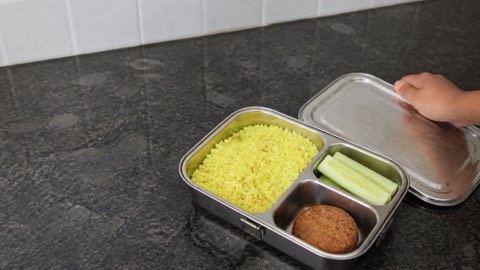
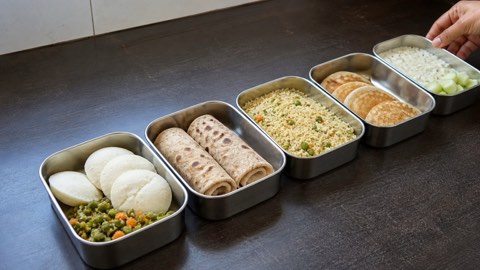
Start with single foods, one at a time, two-three days apart — so any reaction has a clear culprit. The Indian kitchen's classics are exactly right: well-mashed dal (the dal itself, not just the water — the protein and iron are in the dal), rice mashed soft with ghee, suji or ragi porridge, mashed banana, chikoo, steamed and mashed carrot, pumpkin, potato, and well-cooked mashed egg yolk.
Think iron first when choosing: by six months the baby's iron stores are running down, and iron-rich choices — dal, ragi, egg, meat where the family eats it, green vegetables pureed into khichdi — matter more than fruit-only menus. Vitamin-C foods alongside (a little tomato in the dal, fruit after) multiply iron absorption.
Texture is a ladder, not a leap: smooth mash at six months, thicker mash with soft lumps by seven-eight, chopped soft finger foods by nine-ten, family food (less spice, no whole nuts) around one year. Staying on watery purees for months delays chewing — thickness is the point; a spoon that stands in the bowl beats soup.
Quantity expectations, honestly: the first weeks are two-three spoons once or twice a day, most of it worn rather than eaten. Build to two-three small meals plus a snack by eight-nine months. The baby's fist is the portion guide, and appetite varies wildly by day — the week's intake matters, not the meal's.

The never-before-one list, and the salt-sugar rule
Never before one year: honey (risk of infant botulism — this one is absolute, and it includes honey on the tongue 'for taste'), cow's milk as the main drink (fine in cooking; not as the milk), whole nuts and other choking shapes (grapes and tomatoes go quartered, nuts go as smooth paste), and unpasteurised milk.
No added salt and no added sugar for the whole first year — baby kidneys don't want the salt, and sugar trains the palate it will then demand. The family's food tastes bland to you, not to a baby who has never met salt. This also quietly rules out biscuits dissolved in milk, packaged 'baby' juices, and sharing your chai — the commonest sugar deliveries in Indian babyhood.
Chai deserves its own sentence: no tea or coffee for babies or toddlers — the tannins block the very iron you're working to feed, and the caffeine has no place. The biscuit-in-chai starter pack is tradition; it is not nutrition.
How to feed: the habits that prevent battles
Feed responsively: offer, watch, follow. The baby turning away, sealing lips or batting the spoon means done — respect it. Force-feeding, distraction-feeding with screens, and chase-feeding around the house all teach a child to ignore its own fullness, and they build the very battles they try to solve. Your job is what and when; the baby's job is whether and how much.
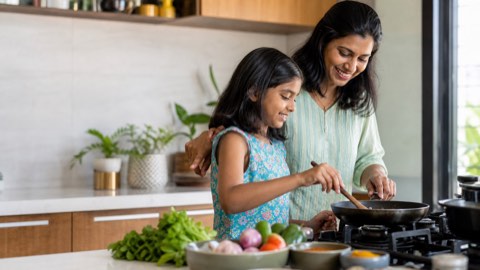
Make one meal a family meal from the start — babies learn eating by watching it. A steel bowl and spoon of their own, a place in the circle, and tolerance for mess (the floor cloth is part of the equipment) build an eater faster than any aeroplane spoon.
Hygiene does heavy lifting at this age: washed hands, freshly cooked food, boiled water for any mixing, and no leftovers reheated for babies. Diarrhoea season and weaning season overlap in the same months — cleanliness is the difference.
When to see a doctor at once
Same-day: any allergic reaction beyond a mild rash — swelling of lips or face, vomiting immediately after a food, breathing difficulty (emergency, 108), or hives spreading. Also same-day: choking that needed intervention, blood in stool, or diarrhoea with signs of dehydration (dry mouth, no urine for 6-8 hours, sunken eyes, listlessness). Discuss at the next visit: repeated gagging that isn't improving, weight faltering on the chart, or a baby still refusing all solids weeks after starting.
This article is general information, not medical advice, and is no substitute for personal medical advice. For any decision about your or your child's health, please consult your doctor.
Frequently asked questions
Khichdi every day
is that enough? — Khichdi is a fine base, but 'enough' needs variety riding in it: rotate the dals, stir in a different mashed vegetable daily, add ghee, and alternate with ragi porridge, curd, egg, fruit. Same-pot-daily is how iron and variety quietly fall short — the pot can stay; the contents should rotate.
When can my baby have eggs, fish, and our regular masala food?
Egg from six months (well-cooked, yolk first is the old advice but whole well-cooked egg is fine); fish for fish-eating families from around seven-eight months, boneless and well-cooked. Mild home spices (haldi, jeera, hing) are welcome from early on — flavour is not the enemy, salt and chilli-heat are. By one year the baby should broadly eat the family's food, toned down.
Packaged baby cereals versus homemade
the ads say fortified? — Fortification is real and helpful where home iron sources are thin, and packet cereal is fine as part of the rotation. But it should not replace the home menu — dal, ragi, egg and vegetables bring texture, variety and family-food training that boxes don't. If budget forces a choice, the home kitchen plus the Anganwadi's supplementary nutrition wins.
My mother-in-law wants to start rice water and janam ghutti at four months
how do I hold the line? — Borrow authority and offer a date: 'the doctor said milk only till six months — and at six months, you get to cook the first khichdi.' Assigning the honour usually converts the opposition. On ghutti, hold firm; anything given before six months displaces milk, and honey-based ghutti is on the never list outright.
Sources
Every clinical figure on this page is taken from the guidelines below. Where our numbers and your doctor's differ, ask which guideline they follow.
- WHO. Complementary feeding: family foods for breastfed children (2000)Supports guidance on progressive texture advancement from smooth mash to soft lumps to chopped finger foods, the principle of responsive feeding (offering and respecting satiety cues), and the recommendation to introduce single foods one at a time to identify reactions.
- IAP. IAP Guidelines on Complementary Feeding (2014)Supports India-specific first food recommendations including dal, rice with ghee, ragi porridge, mashed fruits and vegetables, and egg yolk as appropriate early complementary foods; also supports no added salt or sugar in the first year and no honey before one year.
- AAP. Infant Food and Feeding (2023)Supports the recommendation to prioritise iron-rich foods at six months as infant iron stores decline, the advice that cow's milk should not be used as the main drink before one year, and the responsive feeding principle that parents decide what and when while the child decides whether and how much.
Reviewed by
- Nakul Phatak — CEO, theAsianparent India & IndonesiaHead of theAsianparent India; father of one
- Roshni Chugani — Head of Marketing, theAsianparent India & Singapore12 years in the mother-and-baby space; mother of two
Published by: theAsianparent editorial team