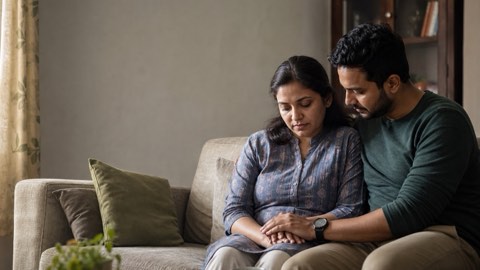
Supporting your partner after a pregnancy loss

Two people lost the same baby and are grieving differently, usually without saying so. The gap between them is where the damage happens.
Different grief, same loss
One of you was physically pregnant and physically gave birth or miscarried, with hormones, pain, recovery and a body that changed and changed back. The other watched, could do nothing, and usually handled the practical arrangements.
Partners — and in Indian families this falls hardest on men — are expected to hold everything together, manage the relatives, deal with the hospital, and return to work. So they grieve later, privately, or not visibly at all.
The result is a painful mismatch: one crying daily while the other appears fine, and each drawing a conclusion about the other that is not true.
Grief also arrives in waves that are rarely synchronised. On the days one of you is functioning, the other may not be, and vice versa.
None of this means the relationship is failing. It means two people are doing the same difficult thing at different speeds.
What actually helps
Say the difference out loud instead of interpreting it. 'You seem fine and I'm not, and it makes me feel alone' opens a conversation; silence turns it into a verdict.
Ask what would help and believe the answer. Some want to talk, some want distraction, some want to be left alone and then talked to later.
Do not compete over who is more affected, and do not measure grief in tears.
Take practical load off without being asked — food, laundry, the older children, the phone calls.
Handle the outside world jointly. Agree what is being told to whom, and who is telling them, so neither of you is ambushed at a family gathering.
Mark it together in some small way if that suits you both: a name, a lamp, a day. Shared ritual gives grief somewhere to go.
Protect sleep and food. Exhaustion turns ordinary differences into fights.
And keep some contact that is not about the loss — a walk, a meal, sitting together. Couples who only ever discuss the loss stop being able to discuss anything.


Intimacy, and trying again
Physical intimacy often takes time to return, and sex can feel loaded — associated with the pregnancy, with the loss, or with pressure to conceive again. Medically, follow your doctor's advice on timing after a birth or a procedure; emotionally, take as long as you need and say so.
Closeness without sex is worth keeping going in the meantime. Withdrawal from all physical contact is where couples most often lose each other.
Readiness to try again almost never arrives for both people at once, and it is the commonest source of conflict afterwards. The one who is ready is not callous; the one who is not is not obstructing.
Say where you are without pressure and revisit it in a few weeks rather than settling it in one conversation.
If one of you does not want to try again at all, that deserves proper time and probably outside help, rather than an argument.
When to see a doctor
Seek help — together or separately — if either of you cannot function after several weeks, if one of you is drinking to cope, if the relationship has gone silent or hostile, or if either of you feels hopeless.
Same day for any thought of self-harm, for either of you. Tele-MANAS on 14416 is free, confidential and answers round the clock in Indian languages. If you are having thoughts of harming yourself, call now — 112 is the emergency number. It answers men too, which is worth saying because most people assume otherwise.
Couples counselling is available in most Indian cities and is worth considering before resentment settles rather than after.
Also see a doctor about the physical recovery, contraception, and the six-week check, which covers mood as well as healing.
This article is general information, not medical advice, and has not been reviewed by a clinician.
This article is general information, not medical advice, and is no substitute for personal medical advice. For any decision about your or your child's health, please consult your doctor.
Frequently asked questions
My partner has not cried once.
That is not evidence of not caring. Ask directly what it has been like rather than concluding from the surface.
My partner will not talk about it.
Do not force it. Stay present, take practical load off, and say clearly that you are there whenever they want. Repeat it in a month.
We are fighting about everything.
Common, and usually grief plus exhaustion rather than the relationship. Address sleep and the practical load first.
Should we try again to feel better?
A new pregnancy will not resolve grief. Many couples try again while still grieving, which is fine — what matters is that both of you want to, rather than one agreeing to fix the other's sadness.
Sources
Every clinical figure on this page is taken from the guidelines below. Where our numbers and your doctor's differ, ask which guideline they follow.
- WHO. Improving the quality of care for small and sick newborns: bereavement support (2023)Backs the page's recognition that grief after pregnancy loss is a genuine clinical concern requiring support, and that partners are affected alongside the person who was physically pregnant.
- NICE. Ectopic pregnancy and miscarriage: diagnosis and initial management (NG126) (2019)Backs the page's advice that a doctor should be seen for physical recovery and the follow-up check after miscarriage or pregnancy loss, covering both physical healing and emotional wellbeing.
- NHS. Miscarriage – overview: your feelings after a miscarriage (2023)Backs the page's guidance on the six-week follow-up check covering mood as well as physical healing, the return of physical intimacy taking time, and seeking help if either partner cannot function after several weeks.
- WHO. Mental Health Gap Action Programme (mhGAP) Intervention Guide (2016)Backs the page's instruction to seek same-day help for any thought of self-harm, and the listing of a free, round-the-clock confidential helpline (Tele-MANAS) as an appropriate first point of contact.
Reviewed by
- Nakul Phatak — CEO, theAsianparent India & IndonesiaHead of theAsianparent India; father of one
- Roshni Chugani — Head of Marketing, theAsianparent India & Singapore12 years in the mother-and-baby space; mother of two
Published by: theAsianparent editorial team