Pregnancy loss and fathers: the grief nobody asks about

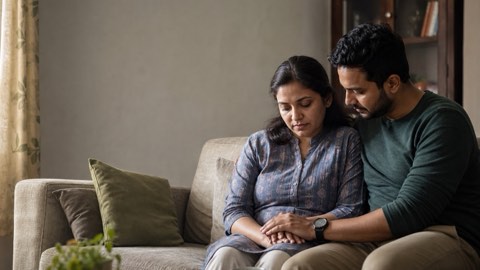
Everyone asks how she is. Almost nobody asks him — including, often, himself.
Why it goes unrecognised
The loss is physically hers, and the sympathy follows the body. Fathers are asked how their wife is doing, repeatedly, and rarely how they are.
Indian expectations add to it: be strong, hold the family together, manage the relatives, deal with the hospital paperwork, go back to work on Monday. There is often no space in which to be sad.
Many men also decide, quite deliberately, to grieve later or elsewhere so as not to add to their wife's distress. That is not avoidance in the ordinary sense; it is a choice, and it has a cost.
How it shows
Often not as crying. More commonly: irritability, withdrawal, throwing himself into work, drinking more, sleeping badly, being short with the children, or an inability to concentrate.
Sometimes a delayed reaction weeks or months later, when the practical activity stops and everyone else has moved on.
Some men describe guilt at not having been able to protect or fix anything, and a specific loneliness in not being seen as a bereaved parent.
None of that is weakness, and naming it is what stops it turning into distance from a partner who needs him.

What helps
Tell one person — a friend, a brother, a colleague — that it happened to you as well. That single sentence does more than any amount of managing.
Say it to your partner, carefully. 'I am struggling too' is not a burden added to her grief; more often it is a relief, because it explains the distance she has been feeling.
Take part in whatever marking happens: naming, a ritual, seeing the baby in a later loss. Fathers who are excluded, or who exclude themselves, frequently regret it.
Keep the physical basics going, and be honest about alcohol, which is the commonest way Indian men manage this and the one that makes everything worse.
And keep supporting her without disappearing yourself. Both are possible, and doing only the first is how couples end up strangers.
When to see a doctor
Seek help if, after several weeks: you cannot function or concentrate, you are drinking more, you feel numb or angry most of the time, your sleep has gone, or you have withdrawn from everyone.
Urgently, the same day: any thought of harming yourself. Tele-MANAS on 14416 is free, confidential, round the clock, and it answers men — despite the widespread assumption that these services are for women.
Counselling and bereavement support are available in most Indian cities, and going does not take anything away from your wife.
This article is general information, not medical advice, and is no substitute for personal medical advice. For any decision about your or your child's health, please consult your doctor.
Frequently asked questions
Is it selfish to grieve when she went through it physically?
No. You lost the same pregnancy. Her physical experience does not cancel your loss.
She is much worse than me and I feel guilty about that.
Grief is not a competition and people run on different timetables. Yours may arrive later; hers may ease first. Neither is a failure.
Should I take time off work?
If you can, take at least a few days. Going straight back is the default in India and it often means the grief simply waits.
How do I support her when I am not okay either?
By doing the practical things, staying present, and being honest that you are struggling too. Pretending to be fine is what creates the distance.
Sources
Every clinical figure on this page is taken from the guidelines below. Where our numbers and your doctor's differ, ask which guideline they follow.
- MoHFW. Tele-MANAS: National Tele Mental Health Programme (2022)Confirms that Tele-MANAS on 14416 is a free, confidential, round-the-clock national mental health helpline available to all callers including men, as stated on the page.
- NICE. Ectopic pregnancy and miscarriage: diagnosis and initial management (NG126) (2021)Supports the page's advice that both partners should be offered information and follow-up after pregnancy loss, and that psychological impact on partners is recognised and should not be ignored.
- NIH. Paternal bereavement after perinatal loss: a systematic review (NCBI/PMC) (2019)Supports the page's specific descriptions of how male grief manifests — irritability, withdrawal, overwork, alcohol use, delayed reaction weeks or months later — and the guilt men report at not being able to protect or 'fix' the situation.
Reviewed by
- Nakul Phatak — CEO, theAsianparent India & IndonesiaHead of theAsianparent India; father of one
- Roshni Chugani — Head of Marketing, theAsianparent India & Singapore12 years in the mother-and-baby space; mother of two
Published by: theAsianparent editorial team