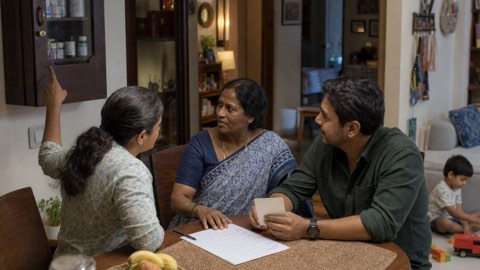
How partners and family can help someone quit smoking

The people around a smoker have real influence and almost always use it in the way least likely to work.
What does not work
Nagging. Repeated reminders reliably produce secrecy rather than quitting, and secrecy makes everything else harder.
Ultimatums, unless you genuinely intend to follow through — and even then they are a last resort rather than an opening move.
Guilt about the baby. Almost every smoker already feels it, and adding more usually produces avoidance of the topic altogether.
Policing: counting cigarettes, checking pockets, smelling their clothes. It turns the relationship into surveillance and makes them better at hiding it.
Treating a lapse as a betrayal, which is the most common way a quit attempt collapses entirely rather than resuming.
What does
Ask what would actually help, and believe the answer. Some people want company and distraction; some want it not mentioned at all. Both are workable if you know which.
Quit alongside them if you also smoke. This is by some distance the most effective thing a household can do, and a smoker whose partner keeps smoking rarely succeeds.
Take practical load off during the first fortnight, which is the hardest. Fewer arguments, fewer errands, more sleep. Irritability during withdrawal is chemical, not personal.
Change the household routines that carry the habit: the tea on the balcony, the after-dinner walk to the shop, the friend who visits to smoke.
Make the house and car smoke-free as a household rule that applies to everyone, so it is not a personal restriction.
Notice progress out loud, including small progress. Three days is genuinely hard.
And handle the relatives — the uncle who offers one at a wedding, the friend who says one won't hurt. Being the person who deflects that is one of the most useful roles available.
India's National Tobacco Quitline is free on 1800-11-2356, and the government mCessation programme sends support by SMS. Your obstetrician can also refer you to a tobacco cessation centre — there are hundreds attached to hospitals across India, and they are free.

When they relapse
Expect it. Most successful quitters relapsed several times first, and how the household responds to a lapse largely determines whether it becomes a return to smoking.
Say something short and neutral, and then let it go. 'Okay. Starting again tomorrow?' does more than an argument.
Help identify the trigger rather than the failure — stress, alcohol, a particular person, a particular hour.
Do not withdraw affection over it, and do not bring it up as ammunition later in an unrelated argument.
If the smoking is tied to something bigger — stress, drinking, low mood, a difficult job — the smoking is the symptom, and pushing on it alone will not work.
And look after yourself in this. Living with someone else's addiction is wearing, and resentment builds quietly. If it is affecting the relationship, that is worth talking about openly rather than through the cigarettes.
When to see a doctor
Encourage them to see a doctor for cessation support and to ask about nicotine replacement — it roughly doubles the chance of success and most people never ask.
In pregnancy, tell your obstetrician about household smoking so growth monitoring accounts for it.
See a doctor if quitting is accompanied by significant low mood, agitation or sleeplessness that is not settling — this is treatable and it derails many attempts.
Tele-MANAS on 14416 is free, confidential and round the clock, and it answers men, which is worth saying because most such services are assumed not to.
This article is general information, not medical advice, and has not been reviewed by a cessation specialist.
This article is general information, not medical advice, and is no substitute for personal medical advice. For any decision about your or your child's health, please consult your doctor.
Frequently asked questions
Should I give an ultimatum?
Only if you mean it, and rarely as a first step. It tends to produce compliance in front of you rather than quitting.
They say they will stop before the baby arrives.
Common, and better than not stopping. Encourage an earlier date, because the first trimester is when the benefit is greatest.
They get angry when I raise it.
Raise it once, calmly, and then focus on the house rule rather than the person. If anger about this is part of a wider pattern in how you are treated, that is a separate and more important conversation.
Can I help if I smoke too?
The most helpful thing is to quit together. A smoking household is the hardest place to stop.
Sources
Every clinical figure on this page is taken from the guidelines below. Where our numbers and your doctor's differ, ask which guideline they follow.
- WHO. WHO recommendations for the prevention and management of tobacco use and second-hand smoke exposure in pregnancy (2013)Backs the claim that smoking in pregnancy warrants cessation support from an obstetrician, that household smoke exposure affects fetal growth and should be disclosed to a clinician, and the general framing that quitting in the first trimester carries the greatest benefit.
- NICE. Stop smoking interventions and services (NG209) (2023)Supports the claims that lapses are a normal part of the quit journey rather than failures, that household smoking by a partner significantly reduces quit success rates, and that behavioural support combined with NRT improves outcomes.
- NIH. Smoking cessation — MedlinePlus (2023)Backs the claim that withdrawal symptoms including irritability, agitation, low mood, and sleep disruption are recognised physiological effects of nicotine withdrawal that are clinically treatable.
Reviewed by
- Nakul Phatak — CEO, theAsianparent India & IndonesiaHead of theAsianparent India; father of one
- Roshni Chugani — Head of Marketing, theAsianparent India & Singapore12 years in the mother-and-baby space; mother of two
Published by: theAsianparent editorial team