Baby week 6: the first big vaccines — and the mother's own check-up

Two dates on this week's calendar — the baby's and the mother's. The vaccine visit is the baby's shield; the six-week check is the mother's. Neither is optional.
The week of two dates
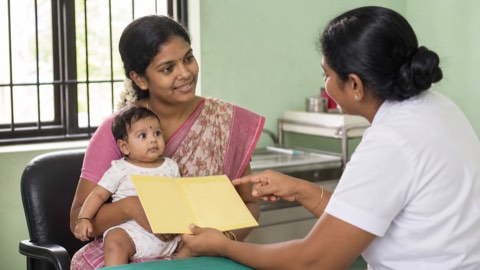
The queue at the health centre on a six-week morning is one of the country's best queues — six-week-olds on hips, MCP cards in hands. Today is the first big vaccine day: Pentavalent-1, OPV-1, Rota-1, PCV-1, fIPV-1.
Parents' hearts lurch at the needles — let them lurch, and go anyway. The diseases these vaccines block (diphtheria, whooping cough, tetanus, pneumonia, severe diarrhoea) are at their most dangerous at exactly this age. Everything is free at the government centre.
And this same week, the second date is the mother's — the six-week postnatal check. It is not a formality; body and mind are both audited in that chair.
Your baby this week
How the vaccine day goes well: arrive fed, and put the baby to the breast immediately after the shots — sucking is the best-proven pain relief there is. Rota is drops by mouth; the rest are injections in the thigh.
The day after: mild fever, a sore swollen thigh, crankiness — all normal, one-two day guests. A cool clean compress on the swelling is fine; fever medicine only at the dose the centre or doctor specified. High fever, inconsolable screaming, fits or floppiness — that is not the normal list; same-day visit.
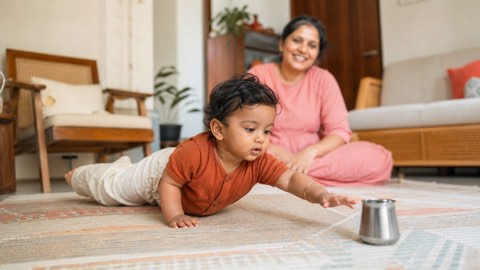
Development rolls on: smiles now daily, coo-conversations longer, the 45° tummy-time hold steadier. Colic is at its peak in this stretch — worth repeating: a peak means the descent starts here.
Sleep may bring its first good news — one long night stretch (4-5 hours). If it hasn't come, equally normal; every baby keeps its own clock.
Read next

The mother matters too
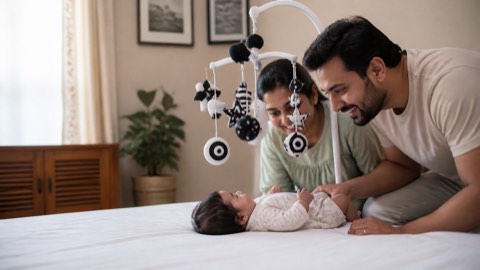
The six-week check's list: stitches and uterus, BP and haemoglobin, thyroid if symptomatic, and the mind — sadness, sleep, dark thoughts. The last question often goes unasked; raise it yourself. This check is not a rubber stamp — it is the chair where questions get asked.
The family-planning decision belongs to this visit. There are methods safe alongside breastfeeding (including the copper-T); 'I'm still feeding' is not a method. A two-to-three-year gap before the next pregnancy is the cheapest investment in the health of all three people involved.
If the check clears you, light exercise gets its clearance here too — walking, pelvic-floor work (Kegels), breathing. Chasing the belly's old shape is not the goal; preventing back pain and rebuilding strength is.
What to do this week
Get the next vaccine date (10 weeks — Penta-2, OPV-2, Rota-2) written on the MCP card before you leave. Tick today's in the tracker — the red overdue flag is exactly what it's for.
Arrange the vaccine-day evening in advance: no guests, food already cooked, the rocking duty shared. A cranky evening halves when the roster is set.
Take a question slip to the mother's check — bleeding, stitches, back, mind, contraception, exercise. Half the questions vanish in the chair; the slip doesn't.
Start one cheap habit this week: one photo at the same time every day. In three months that album is the sweetest receipt of change — and proof against the elders' 'nothing has changed'.
Week 6 at a glance
The week's essentials in one place. Your doctor may adjust these for your baby.
| Item | In week 6 |
|---|---|
| Baby's date | Penta-1, OPV-1, Rota-1, PCV-1, fIPV-1 — free, MCP card along |
| After the shots | Mild fever/swelling normal; medicine only as dosed |
| Pain relief | The breast, immediately after the shots |
| Mother's date | Postnatal check — body + mind + contraception |
| Colic | The peak — which means the descent starts |
| Sleep | First long night stretch possible (4-5 h) |
| Next date | 10-week vaccines — written down before leaving |
When to see a doctor at once
The firm list — fever under three months (beyond the vaccines' mild, short one, or lasting past 24-48 hours), refusing feeds, fast breathing, lethargy, fits: hospital immediately.
The separate post-vaccine line: inconsolable screaming beyond three hours, very high fever, fits, or a limp unresponsive baby — very rare, but if it happens, hospital immediately. And that fear is never a reason to skip vaccines — the diseases they block are a thousand times deadlier than these rare reactions.
This article is general information only and no substitute for personal medical advice. The people who can guide you knowing your baby's health, birth history and test results are your paediatrician or the doctor at your nearest health centre.
Work out the vaccine dates
Enter the date of birth — every vaccine on the national schedule becomes a calendar date, and anything missed surfaces by name. The big 6-week visit falls in exactly these weeks.
This is the Government of India's National Immunization Schedule. Everything on it is free at primary health centres, anganwadis and government hospitals. Your ticks stay on your phone — nothing is sent to us. This is not a substitute for the immunisation card; carry the card every time.
- Private paediatricians may recommend additional vaccines beyond these. Which ones, and whether your child needs them, is a question for your doctor — we don't reproduce that list here.
- If the baby was premature, very low birth weight, or has a medical condition — the doctor sets the schedule.
- A mild cold or slight fever is usually no reason to postpone a vaccine. Still, show the child at the centre and let them decide.
- Mild fever, swelling or soreness at the injection site is normal afterwards. Persistent crying, high fever, fits, or unusual drowsiness — see a doctor at once. Never dose the child on your own.
Frequently asked questions
So many vaccines at once
isn't it a burden? — No. This schedule has been tested on billions of children worldwide; a baby's immune system handles far more daily. Splitting the doses adds needles and trips, not safety.
The baby has a cold
postpone? — A mild cold or cough is usually no reason. If there's fever, tell the centre — they decide. Postponing on your own judgement is the most common error.
Private clinics advertise 'painless' vaccines
are they better? — 'Painless' is a marketing name for one DPT variant; both types are proven safe, and the government schedule's vaccine is second to none for long protection. Choose by wallet and convenience — 'good parenting' is not measured here.
The check said all normal, but my mind still feels heavy
who do I tell now? — The same chair, in plainer words — don't walk out quiet because you heard 'all normal'. And there is Tele-MANAS, 14416 — free, round the clock. Asking is the first step of a treatment that works.
Sources
Every clinical figure on this page is taken from the guidelines below. Where our numbers and your doctor's differ, ask which guideline they follow.
- WHO. WHO Recommendations for Routine Immunization — Summary Tables (2024)Supports the claim that splitting vaccine doses does not add safety, that the global schedule has been tested across billions of children, and that the diseases targeted (diphtheria, pertussis, tetanus, pneumonia, severe diarrhoea) are most dangerous in early infancy.
- WHO. WHO Guideline: Recommendations on Postnatal Care of the Mother and Newborn (2013)Backs the six-week postnatal check covering uterine involution, blood pressure, haemoglobin, mental health screening for postnatal depression, and the recommendation to discuss family planning at this visit.
- ACOG. ACOG Committee Opinion No. 820: Breastfeeding Challenges — Contraception During Breastfeeding (2021)Supports the page's statement that copper-T (intrauterine device) is safe for use alongside breastfeeding, and that breastfeeding alone ('I'm still feeding') is not a reliable contraceptive method.
- NICE. NICE Guideline NG194: Postnatal Care (2021)Supports the six-week postnatal check agenda including wound and perineal assessment, BP monitoring, mental health screening for postnatal depression and dark thoughts, pelvic-floor (Kegel) exercises, and return to light exercise after clearance.
Reviewed by
- Nakul Phatak — CEO, theAsianparent India & IndonesiaHead of theAsianparent India; father of one
- Roshni Chugani — Head of Marketing, theAsianparent India & Singapore12 years in the mother-and-baby space; mother of two
Published by: theAsianparent editorial team