Your child at 5: starting school properly, and learning to read

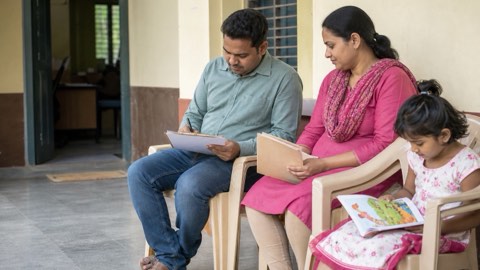
Five is the year school becomes real: longer days, a register, homework of a sort, and the beginning of reading.
What changes this year
Reading begins: letter sounds, blending, then simple words and sentences. The range is wide — some five-year-olds read fluently and some are only starting, and both are normal.
Language: complex sentences, storytelling, following multi-step instructions, and using language to negotiate rather than only to demand.
Movement: skipping, hopping, riding a bicycle with or without training wheels, catching and throwing well, writing letters, and drawing recognisable pictures.
Social and emotional: close friendships, awareness of fairness, sensitivity to being left out, and better self-control — though not much of it under tiredness.
School and homework
Full school days are tiring. Expect hunger, irritability and meltdowns after pick-up for the first term — feed them early and keep afternoons unstructured.
Homework at five should be minimal, and many boards discourage it entirely at this stage. If your child has an hour of written homework, that is a policy question for the school, not a failing in your child.
Support reading rather than drilling it: read aloud daily, let them re-read easy books, use books in the home language too, and do not correct every mistake — fluency and enjoyment matter more than accuracy at first.
Talk to the class teacher early and specifically about anything relevant: health conditions, home language, a recent upheaval, or any concern about hearing, vision or attention.
Read next

Health, food and screens
Health: annual growth check, haemoglobin, vision and hearing tests, dental visits every six months, deworming twice yearly, and the vaccination card checked for the 4-6 year boosters where your schedule includes them.
Sleep: 10-13 hours. Screens out of the bedroom, off an hour before bed, and none during meals. A five-year-old short of sleep looks like a five-year-old with a behaviour problem.
Food: three meals, two snacks, a proper breakfast before school, and a tiffin that is actually eaten — see our lunchbox guide. Keep water in the bottle rather than juice.
Body safety and road safety both need explicit teaching now: the swimsuit rule, secrets, safe adults, crossing roads, and never going anywhere with anyone without telling you.
When to see a doctor
Same-day at any age: fast or laboured breathing, the chest sucking in, blue lips; a fit; a child who is floppy, drowsy or hard to wake; dehydration or no urine for eight hours; a rash that does not fade when pressed; repeated forceful or green vomiting; blood in stool or vomit; severe abdominal pain; or a head injury with vomiting, drowsiness or confusion. Call 108 for breathing difficulty.
At five to six specifically: difficulty being understood by strangers, not following two- or three-part instructions, no interest in letters or books at all, extreme difficulty separating at school beyond a few weeks, marked clumsiness, frequent daytime wetting after being trained, or the loss of any skill.
And at any age, the loss of a skill a child already had needs assessment rather than a wait.
This article is general information, not medical advice, and is no substitute for personal medical advice. For any decision about your or your child's health, please consult your doctor.
Frequently asked questions
He reverses letters like b and d.
Common up to about seven or eight. Persistent difficulty with letter sounds, reading and spelling beyond that, especially with a family history, deserves a dyslexia assessment.
She cries every morning before school.
Look for a specific cause — a teacher, a toilet, a friendship, a bus — before treating it as general anxiety. Talk to the school and keep mornings calm and matter-of-fact.
Should I start tuition?
Not routinely at five. If there is a specific learning difficulty, get it assessed rather than adding hours.
How much sleep does he really need?
Ten to thirteen hours. Most Indian five-year-olds get less because bedtime is late, and it shows in behaviour and concentration.
Sources
Every clinical figure on this page is taken from the guidelines below. Where our numbers and your doctor's differ, ask which guideline they follow.
- WHO. WHO guidelines on physical activity, sedentary behaviour and sleep for children under 5 years of age (2019)Backs the recommendation of 10–13 hours of sleep for this age group and the guidance on limiting screen time before bed.
- WHO. Integrated Management of Childhood Illness (IMCI) chart booklet (2014)Backs the same-day emergency warning signs listed on the page, including fast or laboured breathing, chest in-drawing, blue lips, a non-blanching rash, a child who is floppy or hard to wake, and severe dehydration.
Reviewed by
- Nakul Phatak — CEO, theAsianparent India & IndonesiaHead of theAsianparent India; father of one
- Roshni Chugani — Head of Marketing, theAsianparent India & Singapore12 years in the mother-and-baby space; mother of two
Published by: theAsianparent editorial team