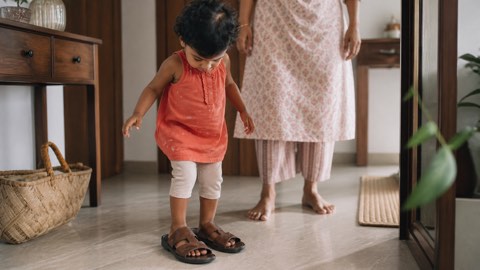
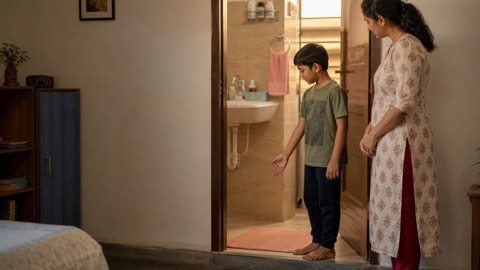
Your child at 4: confidence, questions about everything, and the year before school

Four-year-olds are talkative, confident, funny and exhausting — and the year is mostly about preparing for the school that follows it.
What changes this year
Language: long sentences, retelling events, endless questions, jokes (bad ones), and the beginnings of arguing a case. Vocabulary grows by the week.
Thinking: counting, sorting, matching, recognising some letters and their sounds, drawing a person with a head, body and limbs, and following three-part instructions.
Movement: hopping, balancing on one foot, climbing well, catching a ball, using scissors, and dressing largely unaided.
Social: strong friendships and dramatic fallouts, rules in games, and the beginnings of understanding that other people feel differently.
School readiness
What matters is not reading and writing. It is self-care — the toilet unaided, opening a tiffin, managing shoes — communication, sitting for short structured periods, and separating from you without prolonged distress.
Check your state's age rule for Class 1, which is now commonly six by a cut-off date under the National Education Policy. Do not push a child in early; being the youngest in the class carries through school.
Read aloud daily. It is the single highest-value thing you can do for later school success, and it works far better than drilling letters.
Read next


Behaviour, food and health
Lying appears around now — usually to avoid trouble, and transparently. Do not set traps; state what you know, reward the truth visibly, and keep the consequence small.
Boasting, bossiness and toilet humour are all standard at four. Give the humour a place rather than banning it, and address the bossiness in play by coaching rather than lecturing.
Food: family meals, structured snacks, and eating together. Fussiness usually improves this year. Keep sugary drinks and packet snacks occasional rather than daily.
Health: growth check, haemoglobin, vision and hearing checks before school, dental visit, and deworming twice yearly. Sleep 10-13 hours; most children have dropped the nap by five.
When to see a doctor
Same-day at any age: fast or laboured breathing, the chest sucking in, blue lips; a fit; a child who is floppy, drowsy or hard to wake; dehydration or no urine for eight hours; a rash that does not fade when pressed; repeated forceful or green vomiting; blood in stool or vomit; severe abdominal pain; or a head injury with vomiting, drowsiness or confusion. Call 108 for breathing difficulty.
At four to five specifically: speech that is hard for strangers to understand, not speaking in sentences, no interest in playing with other children, unable to follow a two-part instruction, frequent falls or clumsiness beyond the ordinary, no interest in stories or pretend play, or the loss of any skill.
And at any age, the loss of a skill a child already had needs assessment rather than a wait.
This article is general information, not medical advice, and is no substitute for personal medical advice. For any decision about your or your child's health, please consult your doctor.
Frequently asked questions
He lies about small things constantly.
Normal at four, and the response decides whether it continues. Do not interrogate; state what happened, thank him when he tells the truth, and keep consequences proportionate.
She says nobody wants to play with her.
Ask specifics, coach one skill at a time (joining a game, asking for a turn), and build one friendship outside school. Do not phone the other parent.
Should he be reading by now?
No. Reading develops between five and seven for most children. Being read to daily matters far more at four than decoding.
Is a tutor needed before Class 1?
No. Play, stories, conversation and sleep prepare a child better than tuition at this age.
Sources
Every clinical figure on this page is taken from the guidelines below. Where our numbers and your doctor's differ, ask which guideline they follow.
- WHO. WHO guidelines on physical activity, sedentary behaviour and sleep for children under 5 years of age (2019)Backs the recommendation that 4–5-year-old children sleep 10–13 hours per day.
- AAP. Developmental Milestones: 4 to 5 Year Olds (HealthyChildren.org) (2023)Backs the cognitive, motor, and social milestones listed (hopping, balancing, catching, scissors, dressing, counting, sorting, drawing a person, three-part instructions, imaginative play) and the red-flag list for ages 4–5.
- IAP. IAP Immunization & Child Health Schedule / Recommended Preventive Health Checks (2023)Backs the health check recommendations at this age including growth monitoring, haemoglobin, vision and hearing screening, dental visit, and deworming twice yearly.
- WHO. Integrated Management of Childhood Illness (IMCI) — Danger Signs (2014)Backs the same-day emergency signs listed: fast or laboured breathing, chest in-drawing, blue lips, fits, floppiness or difficulty waking, dehydration, a non-blanching rash, repeated forceful or green vomiting, blood in stool or vomit, and severe abdominal pain.
- UNICEF. Early Childhood Development — Reading aloud and early literacy (2019)Backs the claim that reading aloud daily is the highest-value activity for later school success at this age, and that play, stories and conversation prepare children better than academic drilling or tuition.
Reviewed by
- Nakul Phatak — CEO, theAsianparent India & IndonesiaHead of theAsianparent India; father of one
- Roshni Chugani — Head of Marketing, theAsianparent India & Singapore12 years in the mother-and-baby space; mother of two
Published by: theAsianparent editorial team