Marks, tuitions and comparison: managing academic pressure without breaking your child

Indian children carry one of the heaviest academic loads in the world, and the cost shows up in anxiety, sleep loss and worse. Supporting a child's education and pressuring them are not the same thing.
What pressure actually does
A little challenge improves performance; sustained fear degrades it. Anxious children remember less, think less flexibly and freeze in exams — so pressure applied to raise marks frequently lowers them.
The costs beyond marks are well documented in Indian adolescents: sleep deprivation, anxiety, depression, and a suicide rate around exam seasons that makes this a public-health matter rather than a parenting preference.
The deepest damage is to motivation. Children who study to avoid punishment and comparison stop as soon as the supervision does — usually in the first year away from home.
How much is too much
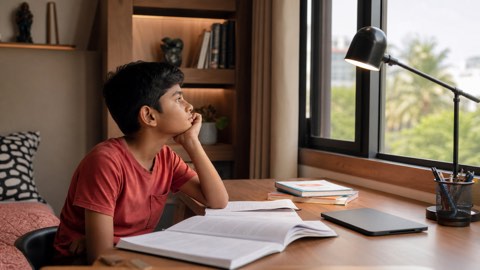
Count the hours honestly across school, travel, homework, tuition and classes. If a ten-year-old has no free unstructured time on a weekday, or a fourteen-year-old is finishing homework at midnight, the load is too high whatever the exam calendar says.
Protect the non-negotiables: sleep by age (primary children need 9-11 hours, teenagers 8-10), an hour of physical play or sport, meals with the family, and some time that belongs to nobody. Children with these do better academically, not worse.
Tuition is worth questioning individually: is it fixing a specific gap, or is it a default because everyone in the class attends? Two hours of good teaching a week for a weak subject is useful; four tuitions across all subjects usually means the child is being taught nothing well and rested not at all.
Read next
What to say about marks
Ask about the process, not just the number: what was hard, what worked, what will you do differently. Then respond to effort and strategy rather than to the score, which the child cannot fully control.
Never compare — with siblings, cousins, the neighbour's child, or your own childhood. Compare with the child's own previous work. 'You improved in maths since last term' motivates; 'your cousin got 95' does not.
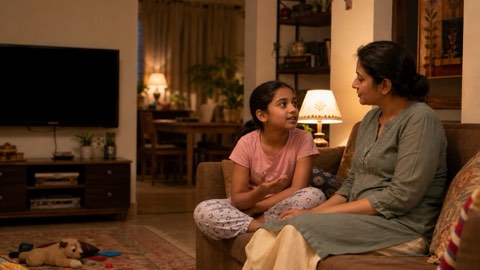
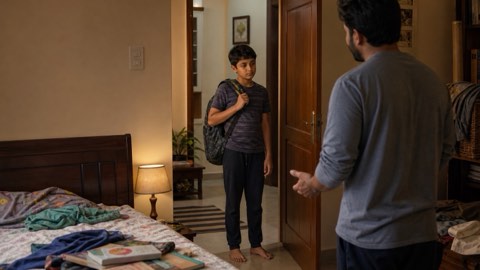
Handle a bad result calmly, because that reaction is the one that decides whether you hear about the next one. Sit together, find out what happened, make a plan, and say the sentence explicitly: 'marks don't change how I feel about you.'
Watch what the family says in public. A child hearing their marks announced and judged in front of relatives learns that their worth is a family performance metric.
The bigger conversation: careers and choice
The engineering-or-medicine default has narrowed for the better, and there are now real, well-paid paths through design, law, technology, business, sport, media, the armed forces, hospitality, teaching and the civil services. Look at what actually exists before deciding what your child must do.
Involve the child in the decision — a course chosen for a child is one they will resent and often abandon. Ask what they are good at, what they enjoy, and what work looks like in that field, and get information from people doing that job.
Say plainly that failure is survivable. Missing a competitive exam cut-off is a setback, not the end of a life, and the children who believe otherwise are the ones most at risk. That belief is installed at home.
When to see a doctor
Act urgently on: talk of not wanting to live, self-harm, hopelessness, giving away possessions, or a sudden calm after a period of distress. These are emergencies — stay with the child, remove access to means of harm, and get help the same day. Tele-MANAS on 14416 is free and round the clock; 112 is the emergency number; Childline is 1098.
Book help for: persistent low mood or anxiety, panic before exams, sleep problems lasting weeks, refusing school, withdrawal from friends, unexplained physical complaints, appetite or weight changes, or a marked drop in functioning. School counsellors, paediatricians, child psychologists and the District Mental Health Programme are all routes in.
This article is general information, not medical advice, and is no substitute for personal medical advice. For any decision about your or your child's health, please consult your doctor.
Frequently asked questions
If I do not push, my child will not study at all.
Structure is not pressure. Fixed study times, a quiet space, phones away, sitting nearby, and help when stuck — that is support. Threats, insults, comparison and withdrawal of affection are pressure, and they buy short-term compliance at a long-term cost.
Everyone in the class takes tuition. Are we handicapping our child by refusing?
Judge by need, not by the neighbourhood: a specific weak subject, a teacher who is not teaching, or a board year may justify it. Blanket tuition across all subjects is usually a sign that school teaching or study skills need addressing instead.
My child is average, and I am worried about their future.
Average is where most people are, and it does not predict a poor life. Skills, work habits, communication and persistence matter more over a career than school ranks. Help them find something they are willing to work hard at.
How do I resist the pressure from relatives about my child's results?
Decline the comparison in one sentence — 'we are happy with how she is doing' — and stop supplying data. Families that stop publishing their children's marks find the conversation dies quickly.
Sources
Every clinical figure on this page is taken from the guidelines below. Where our numbers and your doctor's differ, ask which guideline they follow.
- WHO. Guidelines on physical activity, sedentary behaviour and sleep for children under 5 years of age / WHO guidelines on physical activity and sedentary behaviour (2019)Backs the article's emphasis on physical activity as a non-negotiable for children's wellbeing and the framing of sleep and activity as foundational to healthy development.
- WHO. Mental health of adolescents (Fact sheet) (2021)Supports the article's claims that sustained academic pressure contributes to anxiety, depression, and sleep deprivation in adolescents, and that adolescent mental health is a public-health concern.
- UNICEF. The State of the World's Children 2021: On My Mind – Promoting, protecting and caring for children's mental health (2021)Supports the article's broader framing that children's mental health — including anxiety, hopelessness, and the effects of chronic stress — warrants urgent attention from families and public-health systems.
- NICE. Depression in children and young people: identification and management (NG134) (2019)Supports the article's guidance to seek professional help for persistent low mood, withdrawal from friends, sleep problems, appetite or weight changes, and a marked drop in functioning in children and adolescents.
- ICMR. National Suicide Prevention Strategy / ICMR data on adolescent suicide and mental health burden in India (2022)Supports the article's assertion that suicide rates around exam seasons make academic pressure a public-health matter, and the recommendation to act urgently on warning signs such as talk of not wanting to live or giving away possessions.
Reviewed by
- Nakul Phatak — CEO, theAsianparent India & IndonesiaHead of theAsianparent India; father of one
- Roshni Chugani — Head of Marketing, theAsianparent India & Singapore12 years in the mother-and-baby space; mother of two
Published by: theAsianparent editorial team