Shapes and pre-writing: what comes before letters

Children learn to draw nine shapes in a fixed order, and every letter of every Indian script is built from them. Teach the shapes and the letters follow.
The nine shapes, in order
Children develop these in a predictable sequence, roughly between two and five: vertical line, horizontal line, circle, cross, square, diagonal line, X, triangle, and finally diagonal shapes combined.
Every letter in the Latin alphabet and in Devanagari, Tamil and other Indian scripts is a combination of these. A child who cannot yet draw a diagonal cannot form a letter that needs one — and no amount of practice on the letter will fix it, because the missing skill is the shape.
So the useful question is not 'can my child write A' but 'which shapes can my child draw'. Work at the next shape in the sequence and the letters arrive without a fight.
Activities for each stage
Lines: drawing rain falling, roads for toy cars, the bars of a cage. On a vertical surface where possible — paper taped to a wall or a chalkboard — because vertical work builds the shoulder and wrist strength that writing needs.
Circles: tracing round lids, drawing wheels, chapati shapes, rangoli spirals, laddoos.
Cross and square: ladders, windows, tic-tac-toe grids, boxes for treasure.
Diagonals and triangles: roofs, mountains, samosas, kites, a star made of two triangles. Diagonals are genuinely harder and come later — do not expect them at three.
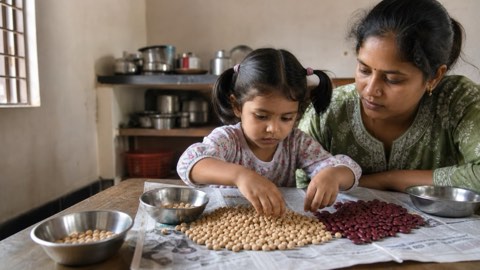
In every case, do it big first: in the air, in a tray of rice or sand, with a wet finger on a slate, with chalk on the floor, in dough — before ever doing it small on paper. Big movements build the pattern that small ones then refine.
Grip, and when to start letters
Grips develop in stages too: a fist grip at two, fingers pointing down at three, and the mature tripod grip — thumb, index and middle finger — usually between four and six. Forcing a tripod grip early does not speed it up.
Use short, fat crayons and broken chalk. A short crayon cannot be held in a fist, so it teaches the grip by itself, which works far better than correction.
Start letters when the child can draw the shapes that letter needs and shows interest — commonly around four and a half to five and a half. Begin with the letters of their own name, which is the one word every child wants to write.
Formal writing before the hand is ready produces a poor grip, hand fatigue, avoidance and, quite often, a child who decides they are bad at writing at four. Many Indian preschools push it early; you are entitled to ask them not to.
Frequently asked questions
His preschool sends writing homework at three and a half.
Ask what the goal is, and say plainly what you have been told about hand readiness. Many schools will accept drawing and tracing instead for a young child.
My daughter holds the pencil in a fist at four.
Common and usually fine. Use short crayons, do plenty of vertical and big-movement work, and expect the tripod grip between four and six.
Should we use tracing books?
Sparingly. They are useful once the shape is nearly there and dull before that. Trays of rice, chalk and dough do more at the early stages.
She writes letters backwards.
Reversals are normal to about seven or eight. Persistent difficulty with letters, sounds and spelling beyond that deserves an assessment.
Reviewed by
- Nakul Phatak — CEO, theAsianparent India & IndonesiaHead of theAsianparent India; father of one
- Roshni Chugani — Head of Marketing, theAsianparent India & Singapore12 years in the mother-and-baby space; mother of two
Published by: theAsianparent editorial team