35 activities for four-year-olds, sorted by what they build

Thirty-five things to do with a four-year-old, grouped by what each one is actually building, and almost all using what is already in the house.
What a four-year-old is working on
Four-year-olds are building four things at once: a body that can hop, balance and climb; hands ready for writing; language complex enough to tell a story; and the social skills to play with others rather than beside them.
None of that needs worksheets. It needs materials, space, time and an adult who occasionally joins in and mostly does not.
Keep sessions short — fifteen to twenty minutes is a long time at four — and stop while it is still going well.
Movement and balance (1-8)
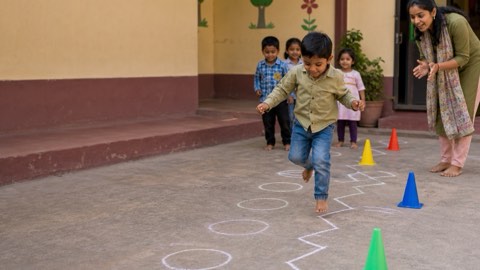
1. Hopscotch with chalk. 2. Balance beam along a line of tape on the floor. 3. Obstacle course: under the table, around the chair, hop to the door. 4. Animal walks — bear, crab, frog — across the room.
5. Ball games: throwing at a bucket, kicking at a wall target, catching a large soft ball. 6. Dancing to film songs with freeze moments. 7. Climbing at the park, as high as they can manage alone. 8. Skipping practice, which most four-year-olds cannot do and enjoy failing at.
Hands and pre-writing (9-16)
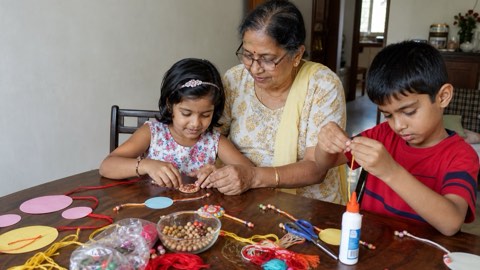
9. Playdough: rolling, pinching, cutting. 10. Threading beads or pasta on a lace. 11. Pegs onto the edge of a box or a line. 12. Tearing paper into a collage.
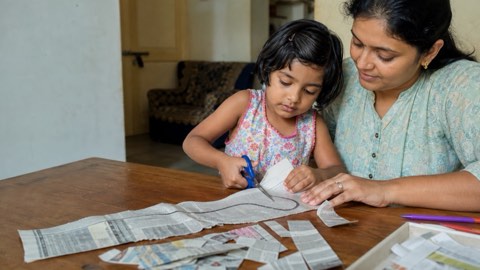
13. Cutting with child scissors along drawn lines. 14. Tweezers or chimta transferring rajma between bowls. 15. Drawing on a vertical surface — paper taped to a wall — which builds the shoulder strength writing needs. 16. Tracing shapes in a tray of rice, dal or sand.
Thinking, language and social (17-35)
17. Sorting buttons, dals or blocks by colour, size and shape. 18. Simple jigsaw puzzles, upgraded every few months. 19. Matching pairs from memory with home-made cards. 20. Counting objects while setting the table. 21. Measuring with cups while cooking.
22. Sequencing three pictures into an order. 23. Building with blocks, boxes and cushions. 24. Planting seeds in a pot and checking daily. 25. Sink or float in a bucket of water.
26. Story from a picture: what happened before this, what happens next. 27. Rhyming games in any language. 28. I-spy with sounds rather than letters. 29. Retelling a familiar story with the child correcting your deliberate mistakes. 30. Puppets from socks, with a proper show.
31. Pretend shop with real vegetables and paper money. 32. Doctor or kitchen play. 33. Board games with simple rules — snakes and ladders, ludo — which teach turn-taking and losing. 34. Helping with real chores: sweeping, folding, watering, carrying. 35. Being bored, without a screen, for twenty minutes — which is where imaginative play actually begins.
Frequently asked questions
Should a four-year-old be writing letters?
Some are ready and many are not. Drawing, cutting, threading and building are what prepare the hand; formal writing before the hand is ready produces frustration and a bad grip.
How much screen time at four?
About an hour a day of good content, watched together where possible, and none at meals or in the hour before bed.
My child gets bored of everything in five minutes.
Normal at four. Rotate toys rather than adding them — put half away and swap monthly — and expect concentration to grow with age.
Do we need educational toys?
Rarely. Blocks, dough, boxes, paper, utensils and a few good puzzles cover almost everything on this list.
Reviewed by
- Nakul Phatak — CEO, theAsianparent India & IndonesiaHead of theAsianparent India; father of one
- Roshni Chugani — Head of Marketing, theAsianparent India & Singapore12 years in the mother-and-baby space; mother of two
Published by: theAsianparent editorial team