Sequencing activities: teaching what comes first, next and last

First, next, last. It sounds trivial and it underpins storytelling, following instructions, reading comprehension and every multi-step task a child will ever be given.
Why it matters
Sequencing is holding an order in mind. Reading depends on it — letters in a word, events in a story. Maths depends on it. Following a two-step instruction depends on it. So does getting dressed.
Children who struggle with multi-step instructions often have a sequencing gap rather than a listening problem, and it responds well to practice.
It is also one of the easiest things to build, because daily life is made of sequences.
Everyday sequences
Narrate the routine in order: 'first shoes, then bag, then door.' Then ask them to say it back, then to lead it.
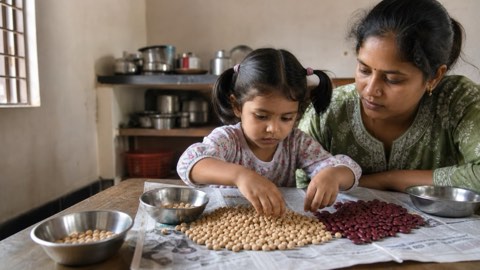
Cooking: 'what did we do first?' — a recipe is a sequence with a delicious ending, which is why it works so well.
Getting dressed and the bedtime routine, said aloud in order and eventually run by the child from a picture chart.
Recounting the day at dinner in order — morning, school, evening — which is harder than it sounds at four and is excellent practice.
Planting a seed and tracking what happened over a week, which teaches sequence across days rather than minutes.
Games and activities
Three-picture stories: draw or cut out three pictures and have the child order them, then tell the story. Move to four and five pictures as it gets easy.
Retell a familiar story and deliberately get the order wrong — children love correcting an adult, and correcting requires holding the right order in mind.
Photo sequences of the child's own day, printed or on a phone, put in order.
Beading patterns: red, blue, red, blue — which is sequencing and early algebra at once.
Obstacle courses where the child must remember three steps in order, then four.
'What happens next?' with a story paused before the ending.
Instructions with a twist: 'clap twice, then touch your nose, then sit down' — and increase the number of steps as they succeed.
Frequently asked questions
How many steps should a child manage?
Roughly one step at three, two at four, three at five, and more as they get older. If a child manages far fewer than their peers, mention it to the doctor and get hearing checked.
My child tells stories in a jumble.
Normal at three and four. Use pictures to anchor the order, ask 'and then what?' and retell it back to them correctly without criticising.
Do sequencing worksheets help?
A little, and the everyday versions above do more because the sequence is real and the outcome matters.
Is this connected to time concepts?
Yes. First, next and last come before yesterday, today and tomorrow, which most children grasp between four and six.
Reviewed by
- Nakul Phatak — CEO, theAsianparent India & IndonesiaHead of theAsianparent India; father of one
- Roshni Chugani — Head of Marketing, theAsianparent India & Singapore12 years in the mother-and-baby space; mother of two
Published by: theAsianparent editorial team