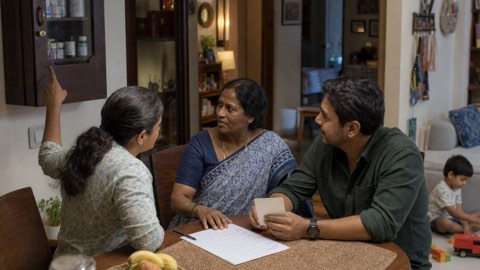
How to explain a pregnancy loss to a child

Children know something has happened. What they invent to explain it is almost always worse than the truth, and often has themselves at the centre of it.
What to say, by age
Use plain words at every age. 'Died' and 'dead'. Not 'gone to sleep', not 'we lost the baby', not 'gone away' or 'gone to a better place'. Young children are literal: a child told the baby went to sleep can become terrified of sleeping, and one told the baby was lost may wonder why nobody is looking.
Under three: very simple and repeated. 'The baby died. The baby is not coming home. It is nobody's fault. Mumma is sad, and Mumma is okay.' They will ask again many times, which is how they process it.
Three to six: they understand the words and often not the permanence, and they are the most likely to think they caused it — by not wanting a sibling, by something they said. Say explicitly and more than once that nothing they did, said, thought or wished made this happen.
Six to ten: more questions, often blunt medical ones. Answer honestly at the level asked. It is fine to say you do not know why.
Teenagers: tell them properly and treat them as part of the family's grief rather than as someone to be protected from it. They often grieve privately and worry about their parents.
And tell them early rather than waiting until you can do it well. Children fill silence with their own explanations.
What to expect afterwards
Grief in children shows up in behaviour rather than words: clinginess, regression in toilet training or sleep, tantrums, aggression, nightmares, or apparent indifference followed weeks later by a wave of it.
Repeated questioning is normal and not morbid. Children return to a fact many times to make it solid.
Some children seem entirely unaffected and then raise it months later. That is also normal.
Expect questions at inconvenient moments, and answer them anyway — in the car, at bedtime, in front of guests.
Tell the school or preschool. A teacher who knows can interpret a difficult week correctly.
And let them see you sad. A child who sees a parent cry and be okay afterwards learns that sadness is survivable; one who sees a parent hide it learns that grief must be concealed.


Rituals, memory and the questions that follow
Include them if they want to be included. Children who take part in a ritual — lighting a lamp, drawing a picture, planting something, being at the ceremony — generally cope better than those excluded to protect them.
Give the choice rather than deciding for them, and make it genuinely fine to decline.
Let them keep something if they want to, and let the baby be spoken about by name.
Answer the sibling question honestly when it comes later: yes, you had a brother or sister who died before they were born.
In Indian households, expect relatives to tell children not to talk about it. Decide as parents what your family does, and tell the child directly that they may always talk to you about it.
And be careful with religious explanations that sound like the baby was chosen or taken — for a small child that can turn into a fear that they might be next.
When to see a doctor
See a doctor or school counsellor if, after several weeks: a child is not sleeping, has stopped eating, will not go to school, has withdrawn entirely, is persistently aggressive, or has regressed significantly and is not recovering.
Also for a child who repeatedly says the loss was their fault despite being reassured, or who becomes very anxious about a parent dying.
Urgently, the same day, for any child or teenager who talks about not wanting to be alive or about harming themselves. Tele-MANAS on 14416 is free, confidential and answers round the clock in Indian languages. If you are having thoughts of harming yourself, call now — 112 is the emergency number.
And look after yourself: parents grieving a baby while parenting other children are carrying two full loads, and support for you is support for them.
This article is general information, not medical advice, and has not been reviewed by a clinician.
This article is general information, not medical advice, and is no substitute for personal medical advice. For any decision about your or your child's health, please consult your doctor.
Frequently asked questions
Should we tell a three-year-old at all?
Yes. They know something has changed, and the version they invent is usually worse and often has them at fault.
Can they come to the funeral or ceremony?
If they want to, and if they are prepared for what they will see. Children who attend rarely regret it; those excluded sometimes do.
My child seems fine.
Common, and not a problem. Grief in children comes in waves with long normal stretches between them.
What if I cry in front of them?
Let them see it. Name it: 'I'm sad about the baby. I'll be alright.' That teaches more than composure does.
Sources
Every clinical figure on this page is taken from the guidelines below. Where our numbers and your doctor's differ, ask which guideline they follow.
- NICE. Ectopic pregnancy and miscarriage: diagnosis and initial management (NG126) (2021)Supports the recommendation that parents and families affected by pregnancy loss should be offered information about sources of psychological support and counselling.
- WHO. Mental Health and Psychosocial Support: Bereavement (2022)Supports the article's advice to seek professional help for a child showing persistent sleep loss, withdrawal, refusal to eat, or self-harm ideation, and the recommendation to call emergency services urgently when a child or teenager expresses thoughts of not wanting to be alive.
- NHS. Miscarriage – Afterwards: Emotional impact and support (2023)Supports the advice that grief after pregnancy loss is normal for the whole family, that parents should seek help for themselves, and that professional counselling should be considered when grief is not resolving.
Reviewed by
- Nakul Phatak — CEO, theAsianparent India & IndonesiaHead of theAsianparent India; father of one
- Roshni Chugani — Head of Marketing, theAsianparent India & Singapore12 years in the mother-and-baby space; mother of two
Published by: theAsianparent editorial team