Coping emotionally after a pregnancy loss

There is no correct way to grieve a pregnancy, and no timetable. What there is: some things that genuinely help, and a clear line at which to ask for help.
What grief after loss looks like
It does not track the number of weeks. A woman who lost a pregnancy at six weeks may be devastated and one who lost at twelve may feel mainly relief, and both are normal.
Common: waves rather than a steady decline; anger, at the body, at other pregnant women, at people who say the wrong thing; guilt, almost always unfounded; numbness; and a physical ache that surprises people who expected only sadness.
Hormones fall sharply after a loss, which adds a biological layer to the emotional one for the first weeks.
Dates become difficult: the due date, the anniversary, the month the baby would have been born. Many women mark them quietly for years, and that is not being stuck.
What helps
Naming it. Whether that means a name, a small ritual, a note kept somewhere, or simply saying 'I had a miscarriage in March' out loud to one person. The Indian silence around this is the single biggest obstacle to grieving it.
One person who lets it be a loss without trying to fix it. Not necessarily a partner — often a friend, a sister, or another woman who has been through it.
Practical permission: to not attend the family function, to not hold the new baby, to leave the room when the conversation turns to pregnancies. You are allowed.
Physical care: eating, sleeping, walking. Grief is exhausting and the body is also recovering.
Time, and the knowledge that it does not stay at this intensity. Most people describe it easing over months rather than weeks, with the sharp days becoming further apart.
And professional support if you want it, which is not a sign that the grief is abnormal.

Other people
You will be told: it was god's will, at least it was early, you can have another, you must have been careless, you should not have travelled. Almost all of it is meant kindly and almost none of it helps.
You are not obliged to educate anyone. 'I'd rather not discuss it' is a complete sentence, and so is walking away.
The pressure to try again quickly is intense in Indian families and it is not a reason to try again before you want to.
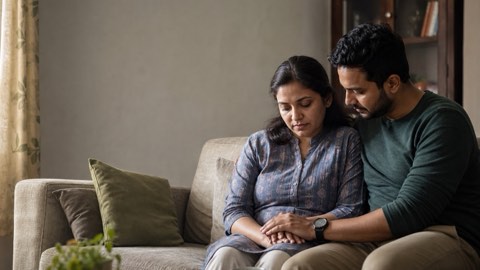
And your partner may grieve differently — often quieter, often later, often by returning to work. That difference is not indifference, and it is worth talking about before it becomes distance. Our page on supporting each other covers it.
When to see a doctor
Seek help if, after several weeks: you cannot function, cannot sleep even when you have the chance, feel hopeless most of the day, are having panic attacks, are drinking to cope, or feel disconnected from everyone.
Urgently, the same day: any thought of harming yourself, or a feeling that you cannot go on. Tele-MANAS on 14416 is free, confidential and round the clock; 112 is the emergency number.
Also see your doctor for the physical follow-up — bleeding that continues, fever, pain — and for the six-week check, which covers mood as well as healing.
This article is general information, not medical advice, and is no substitute for personal medical advice. For any decision about your or your child's health, please consult your doctor.
Frequently asked questions
How long should this take?
There is no schedule. Most people find the intensity eases over months. Grief that is not shifting at all after several months, or that is stopping you functioning, deserves support.
I feel nothing. Is that wrong?
No. Numbness is a common response and often protective. It usually gives way in its own time.
Should I go to the baby shower?
Only if you want to. Declining is allowed and needs no explanation beyond 'I can't right now'.
My family says we should not talk about it.
That convention protects everyone else's comfort rather than yours. Find one person outside it, or a counsellor, or a support group. Silence is not the same as healing.
Sources
Every clinical figure on this page is taken from the guidelines below. Where our numbers and your doctor's differ, ask which guideline they follow.
- WHO. Abortion care guideline (2022)Backs the page's framing that psychological support and follow-up care are a standard part of post-pregnancy-loss management, and that emotional responses vary widely and are all normal.
- NICE. Ectopic pregnancy and miscarriage: diagnosis and initial management (NG126) (2023)Supports the recommendation that women receive a follow-up appointment after pregnancy loss covering both physical recovery (bleeding, fever, pain) and emotional wellbeing, consistent with the article's advice to see a doctor for the six-week check.
- NHS. Miscarriage – afterwards (2023)Backs the advice to seek urgent help for thoughts of self-harm, to watch for prolonged inability to function or sleep, and to attend a physical follow-up if bleeding, fever or pain continues after pregnancy loss.
- NIH. Miscarriage: MedlinePlus (2023)Backs the article's explanation that hormone levels fall sharply after pregnancy loss, adding a biological component to emotional distress in the first weeks.
Reviewed by
- Nakul Phatak — CEO, theAsianparent India & IndonesiaHead of theAsianparent India; father of one
- Roshni Chugani — Head of Marketing, theAsianparent India & Singapore12 years in the mother-and-baby space; mother of two
Published by: theAsianparent editorial team