Teaching children about money: pocket money, saving and the honest conversations

Indian children are taught to study hard and told nothing about money — then handed a salary and a credit card at twenty-two. Here is how to build financial sense from primary school onward.
Start with cash, early
From about five or six, children can handle small amounts of real money — counting it, paying at a shop, receiving change. Digital payments make money abstract; physical cash makes the arithmetic of spending visible.
Pocket money works best when it is regular, modest, predictable and not tied to good behaviour or marks. Paying for marks turns learning into a transaction; paying for basic household chores does the same to family responsibility. Extra paid work for extra jobs is fine.
How much depends entirely on the household's finances. What matters is that it is enough to make a real choice with and not enough to make choices painless. Increase it with age and add responsibility — from sweets money at seven to a monthly allowance covering outings and small purchases at fifteen.
Saving, spending, giving
Teach the three-jar split: save, spend, give. Even at seven, dividing pocket money into three parts makes the concepts concrete, and the giving part matters — children who never see money used for others learn a narrow lesson.
Let them buy something bad and regret it. A toy that breaks in a day teaches more than any warning, and the lesson costs fifty rupees at eight instead of fifty thousand at twenty-five. Do not rescue every purchase.
Teach waiting for something bigger: a goal, a visible chart, and weeks of saving. Delayed gratification is the financial skill that predicts most others, and it is learnt by practice rather than instruction.
Open a minor's savings account with a bank around ten to twelve, and let them see the passbook and the interest. A physical record of savings growing is a better teacher than an explanation of compound interest.
Talking about the family's money
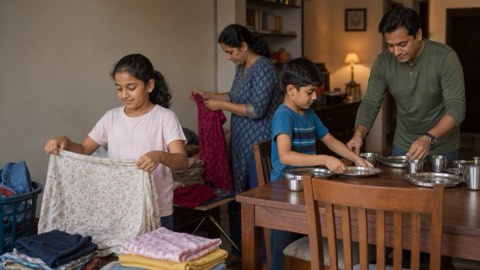
Be honest at an age-appropriate level. Children who are told nothing invent a version, and it is usually either 'we are rich' or 'we are in trouble'. A simple truth — 'we have enough for what we need, and we choose carefully' — does more than a refusal to discuss.
Involve them in real decisions: the grocery list within a budget, comparing prices, choosing between two outings, planning a festival within a set amount. Practical involvement teaches trade-offs that lectures do not.
Do not use money as an emotional instrument — neither guilt ('do you know how hard I work for this?') nor bribery. And avoid making a child the audience for financial anxiety; they cannot solve it and they will carry it.
Teach both sons and daughters equally. Financial dependence is a serious vulnerability, and girls in Indian families are still routinely kept out of money conversations — with consequences that appear decades later.
Teenagers, digital money and the traps
By the teens, teach the real mechanics: how a bank account works, what UPI actually does, what interest means on both sides, what a credit card costs when unpaid, and how EMIs make things look cheaper than they are.
Watch the specific Indian traps: in-app and in-game purchases on a linked card, real-money gaming and betting apps advertised heavily to young people, instant-loan apps, and online scams targeting teenagers. Turn off saved payment methods, keep card details off shared devices, and check statements.
Give a monthly allowance rather than money on demand from about fifteen, and let them manage it — including running out. Managing a small budget for two years is the best preparation for a first salary.
Talk about earning: tutoring, small freelance work, helping in a family business. Earning money changes the way it is spent, permanently.
Frequently asked questions
Should pocket money be linked to chores?
Basic household chores are a family responsibility, not paid work — separate the two. Give a regular unconditional allowance for learning to manage money, and offer paid extra jobs separately if you want to teach earning.
My child spends everything the day he gets it.
Normal at first. Do not top up, do not rescue, and let the empty pocket teach the lesson. Introduce a goal worth saving for; wanting something specific is what makes saving make sense.
How do I handle demands for expensive phones and shoes because friends have them?
Be honest about the family's priorities rather than pretending it is unaffordable when it is not, or vice versa. Offer a contribution and let them save the rest — the item's value changes completely when part of it is their money.
Is gifting money at festivals a good time to teach saving?
Excellent: shagun and festival cash is often a child's largest income of the year. Agree a split — some to spend now, most into the bank account — and show them the balance afterwards.
Reviewed by
- Nakul Phatak — CEO, theAsianparent India & IndonesiaHead of theAsianparent India; father of one
- Roshni Chugani — Head of Marketing, theAsianparent India & Singapore12 years in the mother-and-baby space; mother of two
Published by: theAsianparent editorial team