Junk food, cold drinks and packet snacks: setting rules that actually hold

No Indian child is going to grow up without chips, cold drinks and instant noodles. The aim is not banning them — it is keeping them at the edges of the diet rather than at the centre.
Why it matters more here than it looks
India now carries both problems at once: undernutrition and rising childhood obesity, often in the same city and occasionally in the same family. Packet snacks are cheap, everywhere, heavily advertised to children, and engineered to be hard to stop eating.
The specific harms are unglamorous but real: sugary drinks and snacks displace iron- and protein-rich food, drive tooth decay, and set up taste preferences that last decades. Early type-2 diabetes and fatty liver in Indian teenagers are no longer rare.
The other half of the equation is snacking with screens — a child eating chips while watching a phone eats far past fullness because nobody is paying attention, including them.
Rules that hold
Decide the rule at the shop, not at the till. Agree in advance — 'one packet on Saturdays', 'cold drinks at parties only' — and stick to it calmly. Children argue with inconsistency, not with rules.
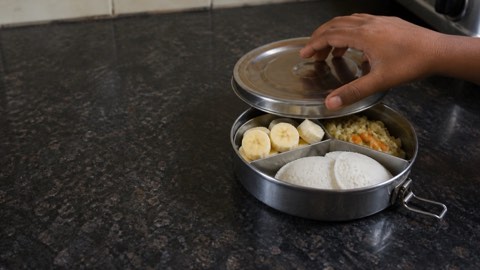
Keep it out of the house. Availability beats willpower at every age: if chips are in the cupboard, chips get eaten. Stock the snack shelf instead with roasted chana, murmura, makhana, nuts (age-appropriate), fruit, boiled corn, khakhra, home-made chivda, dry fruits and curd.
Never use food as reward or punishment ('finish your food and you get chocolate') — it makes the junk more desirable and the meal a chore. And keep meals screen-free, adults included; that single rule cuts mindless eating more than any lecture.
Teach rather than forbid. Read the label together with an older child: sugar per 100 g, the oil, the sodium, the length of the ingredients list. A child who understands why chooses better when you are not there — which is the actual goal.
Drinks, the easiest win
Water is the default drink; make it visible and available. A soft drink is roughly eight to ten teaspoons of sugar in a bottle and has no place in a small child's day. Packaged fruit juices are barely better — mostly sugar with the fibre stripped out.
Better options: plain water, nimbu pani lightly sweetened, chaas, coconut water, milk within the daily limit, and whole fruit instead of juice. Energy drinks are for nobody under 18 — the caffeine load is genuinely unsafe for children.
For teenagers, the sugar arrives as bubble tea, frappes and iced coffees. Same principle: occasional treat, not a daily habit, and let them do the maths on the sugar themselves.
Relatives, parties and pester power
Grandparents and visiting relatives express love through sweets and chips, and fighting that head-on rarely works. Redirect instead: keep an approved treat in the house for them to hand over, ask for fruit or dry fruit as the gift of choice, and let the occasional indulgence go without a scene — the pattern matters, not the incident.
Birthdays and festivals are meant to be exceptions. A child who eats freely at a party and normally the rest of the week is doing fine. Restricting hard at parties produces sneaking and shame, which cause more long-term trouble than the cake ever did.
For pester power in shops: shop after meals, agree the one item before entering, and hold the line the first three times — it is a short battle that ends the war. Never negotiate at the checkout; that is where children win.
Frequently asked questions
Is home-made fried food
samosa, puri, pakoda — also junk? — Not in the same category. Home food made with fresh oil, eaten occasionally as part of a varied diet, is fine. Packaged snacks bring refined oils, high salt and additives, and are eaten daily. Frequency is the difference.
My underweight child eats junk but nothing else
should I let him, for the calories? — Calories from chips do not fix undernutrition; they crowd out iron, protein and vitamins and keep a child both underweight and poorly nourished. Get the child assessed, then rebuild appetite with structured meals — see our fussy-eating guide.
Are 'baked, not fried' and 'atta' versions healthier?
Marginally, and mostly not enough to matter. Read the salt and sugar per 100 g rather than the claim on the front; the health-halo wording is designed to make a packet feel like a plate.
How do I handle a teenager who buys their own snacks?
Stop policing and start negotiating. Set expectations about what is at home, talk honestly about energy, skin, sleep and sport rather than weight, and model the behaviour yourself. Control ends around this age; influence does not.
Sources
Every clinical figure on this page is taken from the guidelines below. Where our numbers and your doctor's differ, ask which guideline they follow.
- WHO. Guideline: Sugars intake for adults and children (2015)Backs the claim that sugary drinks and snacks are harmful to children's health and the recommendation that water be the default drink, with soft drinks containing around 8–10 teaspoons of sugar per serving posing a real dietary risk.
- WHO. Report of the Commission on Ending Childhood Obesity (2016)Supports the article's framing of rising childhood obesity alongside undernutrition in low- and middle-income settings, and the role of heavily marketed, energy-dense packaged snacks in driving this dual burden.
- IAP. IAP Guidelines on Prevention of Obesity in Children and Adolescents (2015)Supports the advice to limit sugar-sweetened beverages, restrict screen-associated eating, avoid using food as reward or punishment, and promote healthier snack alternatives for Indian children.
- ICMR. Dietary Guidelines for Indians (2024)Backs the recommendation to prefer whole fruit over packaged juice, choose water and traditional drinks such as chaas and nimbu pani, read nutrition labels for salt and sugar content, and limit high-salt, high-fat packaged snacks in children's diets.
Reviewed by
- Nakul Phatak — CEO, theAsianparent India & IndonesiaHead of theAsianparent India; father of one
- Roshni Chugani — Head of Marketing, theAsianparent India & Singapore12 years in the mother-and-baby space; mother of two
Published by: theAsianparent editorial team