Visitors and your newborn: hands, kisses and saying no

The infection risk is real and the social difficulty is the harder part. Both have practical answers.
Why it matters
A newborn's immune system is immature, and infections that give an adult a mild cold can make a newborn seriously ill. Any fever of 38C or above in a baby under three months is an emergency and usually means admission and investigation.
Kissing on the face carries a specific risk: herpes simplex — the virus behind cold sores — can cause neonatal herpes, which is rare and can be devastating. An adult with an active or developing cold sore should not go near a newborn's face, and many adults carry the virus without visible symptoms.
Respiratory viruses, especially RSV, are the commonest reason young babies are admitted with breathing difficulty. Whooping cough is dangerous in the first months and is often brought in by an adult with a lingering cough.
Hands are the main route. Hand-washing before holding is the single most effective thing you can ask for.
Vaccination matters too: whooping cough vaccination in pregnancy protects the baby in the early weeks, and adults in close contact being up to date with flu and pertussis vaccination reduces what comes into the house. Ask your doctor about your own household.
What to ask visitors to do
Wash hands before holding. Say it at the door, to everyone, every time. If it is a rule for all, it is not an accusation against one.
No kissing the baby, especially the face and hands — and hands go straight into the mouth. Suggest the feet or the top of the head, which lets people feel included.
Not to visit if they have any cold, cough, fever, sore throat, stomach upset or a cold sore. Ask people to postpone rather than to come and be careful.
Sit down before being handed the baby, and hand back rather than passing between people.
No smoking before or during a visit, and change the outer layer if they have been smoking.
Not to wake a sleeping baby, and not to pass the baby around a room of people.
Keep visits short in the first weeks, and ask people to come at a set time rather than dropping in.
And do not post photographs without asking, which is a small thing that causes a surprising amount of friction.

Saying it, in an Indian family
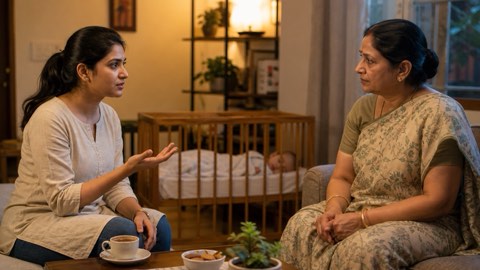
The difficulty is rarely the rule and almost always the relationship. A few things make it easier.
Make the doctor the author. 'The paediatrician asked us to keep visitors to a minimum for the first month' ends most conversations that 'we would prefer' does not.
Let the person from that side of the family deliver it. A request about his relatives should come from him; about hers, from her. This one change prevents most of the resentment.
Put it in the announcement message: when you are welcoming visitors, from what date, for how long, and the hand-washing and no-kissing rules. Setting it once in writing is easier than defending it fifteen times.
Have one designated gatekeeper — often a sister or a mother — whose job is to answer the door and manage the room.
For the postpartum period specifically: a mother who has just given birth is recovering and feeding around the clock, and is entitled to not receive guests. In many households she is expected to sit and host. She should not have to.
Strangers in public — in a lift, at a shop, at a wedding — reaching to touch a baby's face or hands is common in India. 'Sorry, doctor's orders, no touching' with a smile works, and turning the pram or your body away works even better. A muslin over the carrier stops most of it before it starts.
And you are allowed to simply say no. You will not be the first person in your family to be thought difficult about this, and the baby is not the one who has to manage everyone's feelings.
When to see a doctor
Call 108 or go to the nearest hospital immediately if your baby: is breathing fast, grunting, or drawing in beneath the ribs; has blue or grey lips, tongue or face; is floppy, unresponsive or very difficult to wake; has a fit; has a temperature of 38C or above at under three months; is not feeding at all; or has a rash that does not fade when pressed with a glass.
Any fever of 38C or above in a baby under three months is an emergency, and the commonest source is a visitor.
See a doctor the same day if a newborn who has been around an unwell adult develops: a cough, a runny nose with feeding difficulty, fast breathing, unusual sleepiness, poor feeding, or blisters or sores anywhere — particularly around the mouth or eyes, which needs urgent assessment for herpes.
Tell the doctor about the exposure. 'An adult with a cold sore kissed the baby' or 'someone with a cough visited' changes what they look for.
This article is general information, not medical advice, and has not been reviewed by a paediatrician. It is no substitute for personal medical advice.
Frequently asked questions
Is it rude to ask people not to kiss the baby?
No. Neonatal herpes and RSV are real and the request is standard paediatric advice. Frame it as the doctor's instruction if that is easier.
How long should we limit visitors?
Many families keep it small for the first four to six weeks, which is when the risk is highest and the mother most needs rest.
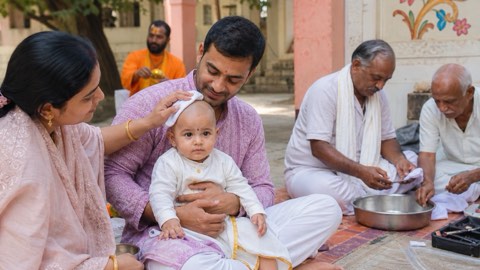
What about the ceremony where everyone holds the baby?
Talk to the elders beforehand, agree hand-washing and no face-kissing, and keep it short. It is a negotiation, not a refusal.
Someone came with a cough and held the baby.
Watch for fever, feeding difficulty and fast breathing, and go straight to hospital for any fever of 38C or above under three months.
Sources
Every clinical figure on this page is taken from the guidelines below. Where our numbers and your doctor's differ, ask which guideline they follow.
- WHO. Newborn health — Key facts and recommendationsBacks the general claim that newborns have immature immune systems and are highly vulnerable to infections that are mild in adults.
- NHS. High temperature (fever) in babies and childrenBacks the specific threshold stated on the page: any temperature of 38°C or above in a baby under three months is a medical emergency requiring immediate hospital assessment.
- NHS. Whooping cough — Vaccination in pregnancyBacks the page's claim that whooping cough vaccination during pregnancy protects the baby in the early weeks before they can be immunised.
- CDC. RSV (Respiratory Syncytial Virus) — For healthcare providersBacks the claim that RSV is the most common cause of serious breathing difficulty and hospital admission in young infants.
Reviewed by
- Nakul Phatak — CEO, theAsianparent India & IndonesiaHead of theAsianparent India; father of one
- Roshni Chugani — Head of Marketing, theAsianparent India & Singapore12 years in the mother-and-baby space; mother of two
Published by: theAsianparent editorial team