Welcoming a newborn: Aqiqah, cradle ceremonies and regional traditions

India welcomes babies in a great many ways. This covers the ones that get least written about, and the practical planning that applies to all of them.
Aqiqah
Aqiqah is the Islamic ceremony welcoming a newborn, traditionally held on the seventh day after birth, though it may be held later if that is not possible.
It usually involves the sacrifice of an animal — customarily two for a boy and one for a girl, though practice varies across communities and schools of thought — with the meat divided between the family, relatives and those in need. Many families now arrange this through a butcher or a charitable organisation rather than at home.
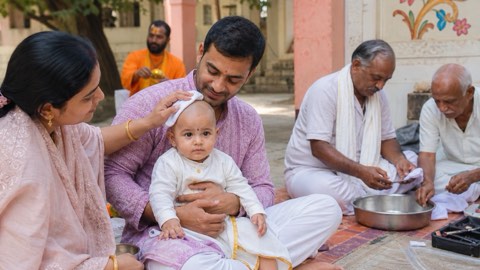
The baby's head is often shaved on the same day, with a charitable donation traditionally made corresponding to the weight of the hair in silver.
The name is usually announced, and the adhan may be recited in the baby's ear — often done shortly after birth rather than at the Aqiqah itself.
Practices differ between Sunni and Shia families and across regions, and between families within the same community. Ask the elders in your own family rather than assuming a single correct form.
For the head shaving, the same safety points apply as for any mundan: a clean blade used once, no shared razors, an experienced person, and the baby's skin treated gently afterwards.
Other traditions across India
Sikh: the naam karan is held at the gurdwara, often within the first weeks. The Guru Granth Sahib is opened at random and the first letter of the hukamnama determines the first letter of the baby's name, after which 'Singh' or 'Kaur' is added. Karah prasad is distributed.
Christian: practice varies by denomination. Catholic and Orthodox families usually hold a baptism in the first weeks or months; many Protestant and evangelical churches hold a dedication or thanksgiving instead, with baptism later. Godparents are chosen in many traditions, and the baby is usually named formally at the service.
Parsi: the navjote is the initiation ceremony but comes much later in childhood, not in infancy. In the newborn period the emphasis is on the mother's rest and on family blessings.
Jain and Buddhist families often follow regional naming and cradle customs similar to those around them, with their own religious observances.
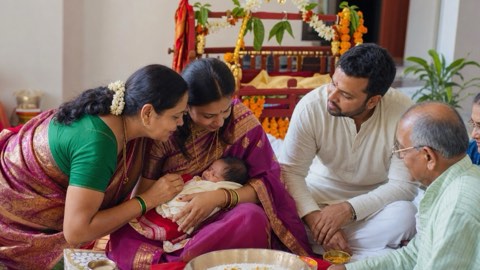
Cradle ceremonies go by many names — barsa in Maharashtra, thottil in Tamil Nadu and Kerala, and various forms elsewhere — and typically involve placing the baby in a decorated cradle, announcing the name, and the women of the family singing. Our page on namkaran covers the Hindu naming traditions community by community.
And many families now do something entirely their own, or nothing at all, and that is a complete answer too.
Planning one around a newborn
Timing: most of these fall in the first weeks, which is exactly when the mother is recovering and the baby is most vulnerable to infection. Both are reasons to keep it shorter and smaller than the family would like.
Talk to the elders early rather than the night before. Most negotiations about scale, timing and who holds the baby go better with two weeks' notice.
Agree the ground rules in advance: hand-washing, no kissing the baby's face, nobody unwell attends, and the baby is not passed around a room. Our visitors page covers how to say it.
Have a quiet room set aside for feeding and for the baby to sleep, and keep the baby out of the loudest part of the gathering.
Noise: sustained loud sound is uncomfortable for a newborn. Keep them away from speakers and dhol, and cotton wool in the ears is reasonable at a loud function.
Heat: a decorated cradle in a hot hall with a baby in heavy clothes is the commonest practical problem. Dress the baby lightly, and add the ornamental layer only for the photographs.
Plan an exit. Agree beforehand that the mother and baby leave at a set time, and have someone whose job it is to make that happen.
And it is fine to postpone. A ceremony held at six weeks with a rested mother is better than one at seven days that nobody enjoyed.
Frequently asked questions
Can Aqiqah be delayed?
Yes. The seventh day is traditional; families hold it later where circumstances require, and many scholars accept this.
Is head shaving safe for a newborn?
With a clean single-use blade and an experienced person, yes. Avoid shared razors entirely, and keep the scalp clean afterwards.
We are an interfaith family.
Many families hold both ceremonies, or combine elements. Agreeing it between the two sets of parents before either is planned prevents most of the difficulty.
Can we skip it?
Yes. These are family and community traditions, not obligations you owe anyone, and plenty of families do something small or nothing.
Reviewed by
- Nakul Phatak — CEO, theAsianparent India & IndonesiaHead of theAsianparent India; father of one
- Roshni Chugani — Head of Marketing, theAsianparent India & Singapore12 years in the mother-and-baby space; mother of two
Published by: theAsianparent editorial team