20 Indian lunch-box recipes that come back empty

Twenty recipes chosen for one quality above all: they are still good at eleven o'clock, at room temperature, eaten fast with one hand.
What makes a tiffin work
Three tests: does it taste good at room temperature, can it be eaten quickly with a spoon or fingers, and does it stay dry rather than leaking. Anything failing all three comes home uneaten however healthy it is.
Build each box on a grain, a protein and something fresh. That is the whole formula, and the twenty recipes below are variations on it.
Portion to the child rather than the ambition. A small box finished builds a good eater; a large box returned makes everyone feel bad.
Rolls and parathas (1-6)
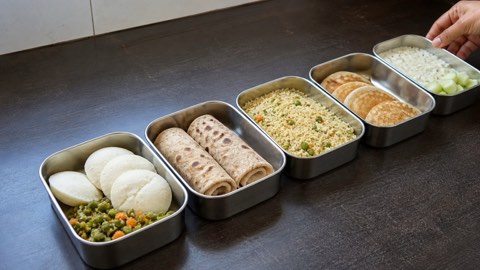
1. Paneer bhurji roll. Crumble paneer, sauté with onion, tomato, haldi and jeera, roll in a roti. Protein-heavy and good cold.
2. Aloo-methi paratha. Boiled potato, chopped methi, ajwain, stuffed and roasted with ghee. Add curd in a separate box in winter.
3. Egg bhurji roll. Scrambled with onion and a pinch of turmeric, rolled tight. One of the highest-protein tiffins available.
4. Dal paratha. Leftover thick dal kneaded into the dough — it disappears into the roti and the child never knows.
5. Rajma or chana roll. Mash cooked rajma with a little chaat masala and roll. Fibre and protein in one.
6. Sattu paratha. Roasted gram flour with onion, ajwain and lemon, stuffed. Traditional, cheap and genuinely nutritious.
Rice and grain dishes (7-13)
7. Lemon rice with peanuts. Tempered with mustard, curry leaves and haldi. Excellent at room temperature.
8. Curd rice with a little pomegranate. Best in winter and cooler months; add a small ice pack in summer.
9. Vegetable pulao with peas and carrot, a spoon of ghee stirred through.
10. Tomato rice, tempered, with roasted chana on the side.
11. Poha with peas, potato and lemon. Stays soft, eats fast.
12. Upma with vegetables, made a little wetter than usual so it does not dry out.
13. Vegetable khichdi with ghee, packed hot in an insulated box. The most complete single-box meal on this list.
Chillas, steamed and sandwiches (14-20)
14. Besan chilla with grated carrot and coriander, rolled. Cooks in four minutes.
15. Moong dal chilla with a paneer filling.
16. Ragi dosa, cut into strips, with dry podi in a small pouch.
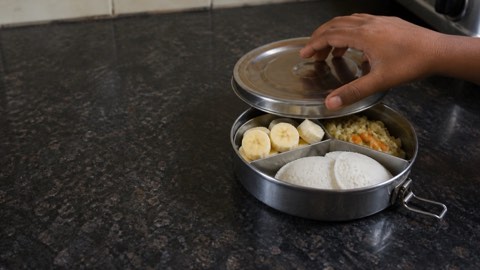
17. Idli with podi and a spoon of ghee — dry, portable and reliably eaten.
18. Dhokla, cut into cubes. Steamed, light, and good for a hot day.
19. Paneer or egg sandwich with a dry filling — chutney rather than sauce, so the bread does not go soggy.
20. Corn and cheese sandwich, grilled and cut into fingers.
Alongside any of these: cucumber or carrot sticks, an orange or banana, a small box of curd in winter, and water rather than juice in the bottle.
Frequently asked questions
How do I keep food warm until lunchtime?
An insulated steel tiffin, food packed hot, and the box wrapped in a cloth inside the bag. Or choose the many Indian dishes that are designed to be good at room temperature.
Everything comes back uneaten.
Ask before concluding: is there enough time, is the box hard to open, is he playing instead of eating. Test the box at home for one-handed opening, and send smaller portions of things you know he likes for a fortnight.
Can I send last night's leftovers?
If refrigerated properly and reheated thoroughly in the morning, yes. Be more careful with rice dishes in hot weather.
My child's school is nut-free.
See our nut-free classroom snacks page; several recipes here adapt by dropping the peanut tempering and using roasted chana or til instead where permitted.
Sources
Every clinical figure on this page is taken from the guidelines below. Where our numbers and your doctor's differ, ask which guideline they follow.
- WHO. Healthy diet – Key facts (2020)Backs the page's core principle of building each meal around a grain, a protein, and something fresh as a balanced dietary pattern for children.
- IAP. IAP Guidelines on Infant and Young Child Feeding (2016)Supports the emphasis on protein-rich foods (paneer, eggs, dal, legumes) and whole-grain staples as key components of school-age children's daily meals in the Indian context.
- ICMR. Dietary Guidelines for Indians (2024)Supports inclusion of traditional whole-grain and legume-based preparations (ragi dosa, khichdi, sattu paratha, rajma, chana) and the recommendation to send water rather than juice in the bottle.
- MoHFW. National Guidelines for School Health Programme (2018)Backs the advice to include fresh fruits and vegetables (cucumber, carrot, orange, banana) alongside the main lunch-box meal as part of a balanced school-day diet.
Reviewed by
- Nakul Phatak — CEO, theAsianparent India & IndonesiaHead of theAsianparent India; father of one
- Roshni Chugani — Head of Marketing, theAsianparent India & Singapore12 years in the mother-and-baby space; mother of two
Published by: theAsianparent editorial team