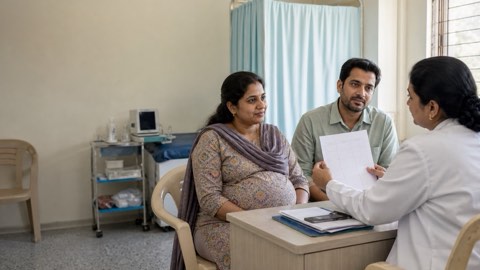
Getting pregnant after 40 — and what 'pregnancy in your fifties' actually involves

Conceiving after 40 happens naturally every day, and it gets harder every year. Here are the honest numbers, the risks worth planning for, and what pregnancy in the fifties actually requires.
The numbers, honestly
Female fertility declines with the number and quality of eggs, and the decline steepens after about 37. Per-cycle chances of conceiving naturally fall from roughly one in four in the twenties to a low single-digit percentage by the early forties, and lower again after 43. Miscarriage rates rise across the same period, largely because of chromosomal errors in older eggs.
This is about egg quality rather than health or fitness. A very fit 44-year-old and an unfit one have similar egg profiles — which is why the standard advice to 'just be healthy and it will happen' is incomplete at this age.
Male age matters too, more gradually: sperm quality declines and some risks rise with paternal age, which is worth knowing when both partners are older.
What to do differently after 40
Do not wait a year. Seek assessment after three to six months of trying — earlier if periods are irregular or there is any known problem. Time is the scarce resource here and investigations take months of their own.
Ask for: AMH and an antral follicle count (markers of ovarian reserve), thyroid, prolactin and sugar tests, a tubal test, and a semen analysis for your partner. Get them done in parallel rather than sequentially.
Pre-pregnancy health matters more at this age: blood pressure, blood sugar, weight, thyroid, and folic acid at least a month before conceiving. Existing conditions should be stable and their medicines reviewed for pregnancy safety before you conceive.
If treatment is needed, the honest conversation is about live-birth rates by age with your own eggs — which fall substantially through the forties — and about the alternatives, including donor eggs and adoption. A clinic that will not discuss those numbers plainly is not the right clinic.
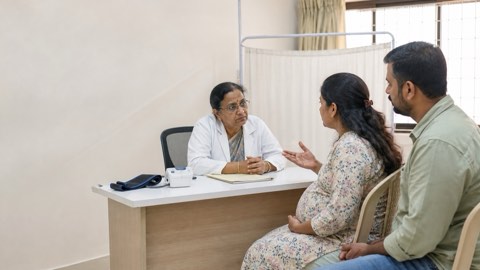

Pregnancy in the forties and fifties
Pregnancy after 40 is classed as high-risk and monitored accordingly: raised rates of gestational diabetes, high blood pressure and pre-eclampsia, placental problems, growth restriction, preterm birth, chromosomal conditions and caesarean delivery, and a higher risk of stillbirth that is the reason for closer monitoring near term.
'Pregnancy in your fifties' in almost every case means donor eggs. Natural conception after menopause does not happen, and natural conception in the years immediately before it is very rare. What makes such pregnancies possible is a donated egg fertilised and transferred into a hormonally prepared uterus.
Those pregnancies carry the highest rates of hypertensive disease, diabetes, caesarean delivery and preterm birth of any age group, and they need specialist care from the start. They are also, in India, subject to law.
The ART (Regulation) Act 2021 sets age limits for assisted reproduction in India — broadly up to 50 years for women and 55 for men — and requires clinics to be registered on the national registry. Sex selection remains a separate criminal offence under the PCPNDT Act. Any clinic offering treatment outside these limits, or promising a boy, is breaking the law.
When to see a doctor
Seek fertility assessment after three to six months of trying if you are over 40, and before trying if you have irregular periods, known PCOS or endometriosis, previous pelvic surgery or infection, or a medical condition on regular medication.
In pregnancy at this age, the standard warning signs carry extra weight: bleeding, severe headache with visual changes, sudden swelling of face and hands, reduced fetal movements, severe abdominal pain, or contractions before 37 weeks — all same-day, without exception.
This article is general information, not medical advice, and is no substitute for personal medical advice. For any decision about your or your child's health, please consult your doctor.
Frequently asked questions
My periods are regular at 44, so my fertility must be fine?
Regular periods are reassuring about ovulation but say little about egg quality, which is what declines with age. Ovarian reserve testing gives a fuller picture.
Should I freeze my eggs?
Egg freezing is more effective the younger it is done — before 35 gives materially better outcomes than after 38. It is available in Indian cities, regulated under the ART Act, expensive, and no guarantee. Worth a specialist consultation rather than a package decision.
Are donor eggs legal and available in India?
Yes, under the ART Act, with rules on donor eligibility, compensation, anonymity and record-keeping, and only through registered clinics. Success rates depend largely on the donor's age rather than the recipient's, which is why they are offered at older ages.
We already have children and want one more at 43.
Secondary subfertility at this age is common and is worth the same investigation. Do not accept the assumption that because it happened before, it will happen again — the constraint is age, not history.
Sources
Every clinical figure on this page is taken from the guidelines below. Where our numbers and your doctor's differ, ask which guideline they follow.
- WHO. Infertility prevalence estimates, 1990–2021 (2023)Backs the general framework that infertility requires clinical assessment and that both male and female factors contribute, supporting the page's advice to investigate both partners and seek assessment promptly.
- ACOG. Committee Opinion 762: Prepregnancy Counseling (2019)Supports the page's advice on pre-pregnancy optimisation of blood pressure, blood sugar, weight, thyroid function, medication review, and folic acid supplementation at least one month before conception.
- ACOG. Practice Bulletin 223: Care of Women with Advanced Maternal Age (2020)Supports the page's claims that pregnancy after 40 is high-risk with raised rates of gestational diabetes, pre-eclampsia, placental problems, preterm birth, chromosomal conditions, caesarean delivery, and higher stillbirth risk requiring closer near-term monitoring.
- ACOG. Committee Opinion 589: Female Age-Related Fertility Decline (2014)Supports the claims about age-related decline in egg quality and quantity, the steepening of fertility decline after the mid-thirties, rising miscarriage rates due to chromosomal errors, and the recommendation to seek fertility assessment after three to six months of trying rather than one year for women over 35–40.
- NICE. Fertility problems: assessment and treatment (CG156) (2013)Supports the page's recommended fertility investigations (ovarian reserve markers including AMH and antral follicle count, thyroid, prolactin, glucose, tubal assessment, and semen analysis) and the advice to seek assessment sooner than 12 months when age or clinical factors are present.
Reviewed by
- Nakul Phatak — CEO, theAsianparent India & IndonesiaHead of theAsianparent India; father of one
- Roshni Chugani — Head of Marketing, theAsianparent India & Singapore12 years in the mother-and-baby space; mother of two
Published by: theAsianparent editorial team