How to choose toys that actually develop skills

The best-evidenced toys are the boring-looking ones. A set of blocks does more for a child than almost anything with a battery in it.
Open-ended beats electronic
The general finding across research: the more a toy does, the less the child does. Toys that talk, light up and provide the answer produce shorter play and less language than simple ones.
Electronic toys in particular reduce the amount parents talk during play, and parent talk is the single strongest driver of early language. A toy that narrates leaves nothing for the adult to say.
Open-ended toys — blocks, dolls, animal figures, vehicles, containers, cloth, art materials — can be anything, so the child supplies the story, the problem and the solution. Those are the skills being built.
Fewer toys, available at once, produces longer and deeper play than a room full of them. Rotating a small selection weekly works better than access to everything.
This is not an argument against ever buying anything with a battery. It is an argument for the ratio.
By age, and the skill each builds
0-6 months — high-contrast cloth, a light rattle, a wooden ring, an unbreakable mirror, a soft ball. Builds: visual tracking, grasp, cause and effect.
6-12 months — stacking cups, containers to fill and empty, soft blocks, a ball, board books, a wooden spoon and a steel bowl. Builds: pincer grip, object permanence, early problem-solving. Filling and emptying is the most absorbing activity of this year and requires nothing bought.
1-2 years — chunky blocks, shape sorter, push-along toy, simple puzzles, crayons, dolls and soft animals, a small bag or basket for carrying. Builds: gross motor, fine motor, early pretend play, language through naming.
2-3 years — play dough, threading beads, larger construction sets, toy kitchen and vessels, animal figures, balls, ride-on. Builds: hand strength, sequencing, imaginative play, social play.
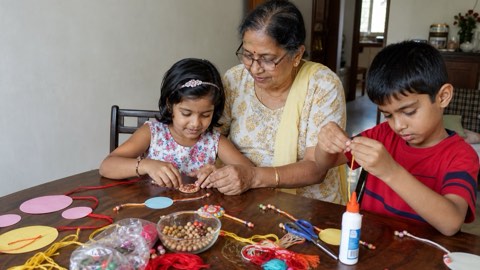
3-5 years — construction sets, dress-up, art materials, board games with simple rules, jigsaw puzzles, doctor and shop sets. Builds: turn-taking, planning, storytelling, pre-writing strength, negotiation.
5-8 years — construction and building sets, craft kits, strategy and card games, sports equipment, science and nature kits, books. Builds: rule-following, persistence, logic, teamwork.
Across all ages: language grows most from anything that invites talk — pretend play, books, and figures with names.
What not to buy, and what to use instead
Skip: sit-in baby walkers, which delay walking and cause serious injuries; screen-based 'learning' toys for under-twos; single-function electronic toys; branded merchandise tied to a show; and large toys with one purpose that a child outgrows in a month.
Skip the second and third of anything. Children play with the same few things.
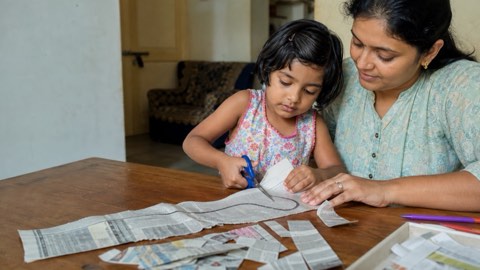
Indian household alternatives that genuinely work: steel katoris and dabbas for stacking and nesting; a chapatti roller and dough; dals and rajma for sorting and threading, supervised; old bangles on a stick; a bedsheet over two chairs; cardboard boxes; a dhurrie for a floor plan; and chalk on a floor.
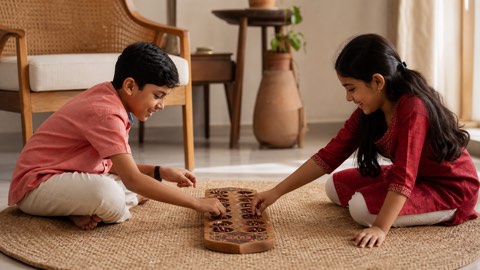
Traditional Indian games cost nothing and build a great deal: stapoo, langdi, gilli-danda, kancha, five stones, and lattoo.
Second-hand is excellent for toys, with two exceptions: never buy a second-hand car seat or helmet, and check that anything painted before modern standards does not shed.
Safety: nothing smaller than about 3.5cm for under-threes; no button batteries or magnets within reach, both of which are surgical emergencies if swallowed; no long cords or strings; and check the age marking, which is a safety rating rather than an ability rating.
Frequently asked questions
Are expensive wooden toys better?
The material matters less than whether the toy is open-ended. Cheap blocks do the same job as expensive ones.
How many toys does a child need?
Fewer than you think. A small rotating selection produces longer, deeper play than a full room.
Are educational tablets worth it?
Not for under-twos, for whom screen-based learning has little support. For older children they are a supplement at best, and no substitute for talk and play.
My child only wants the toy with lights and sound.
Common. Keep it, and make sure it is not the only thing available. Novelty fades fastest on exactly those toys.
Reviewed by
- Nakul Phatak — CEO, theAsianparent India & IndonesiaHead of theAsianparent India; father of one
- Roshni Chugani — Head of Marketing, theAsianparent India & Singapore12 years in the mother-and-baby space; mother of two
Published by: theAsianparent editorial team