Activities that build fine-motor skills, birth to three

Fine-motor skill is built with dal, tongs and old bangles long before it needs a pencil. The kitchen is better stocked for this than any toy shop.
How grasp develops
Newborns grasp reflexively and cannot let go on purpose. Voluntary reaching appears around three to four months, and both hands come to the middle to hold something around four to five.
Passing an object from hand to hand comes around five to seven months. The raking grasp — using the whole hand to sweep something in — appears around six.
The pincer grip, thumb and forefinger together, develops around nine to twelve months and is the milestone that matters most. It is also why everything on the floor goes in the mouth at that age.
Two- and three-year-olds build strength and control: stacking, threading, unscrewing, tearing, and eventually holding a crayon with the fingers rather than the fist.
A mature pencil grip is not expected until around four to six years, and pushing it earlier does not help.
What to offer, by stage
Three to six months: things that are easy to hold and safe to mouth — a soft cloth, a light rattle, a wooden ring, a steel katori. Let them bat at hanging objects.
Six to twelve months: containers to fill and empty, which is the most reliably absorbing activity of the whole first year. A box and some large safe objects will occupy a baby longer than any toy. Add crumpling paper, banging two objects together, and finger foods, which are excellent pincer practice.
One to two years: stacking cups and blocks, posting objects through a slot cut in a box lid, opening and closing containers, large chunky puzzles, and scribbling with a fat crayon.
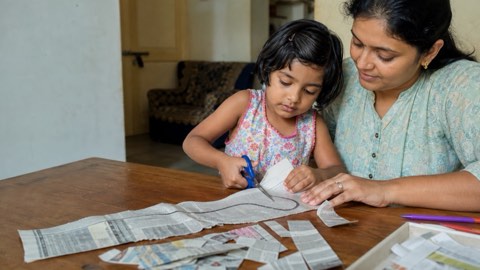
Two to three years: threading — large beads, penne on a shoelace, old bangles on a stick; tongs and spoons to move dal or chana between bowls; play dough; unscrewing bottle caps; and tearing paper, which builds exactly the muscles handwriting needs.
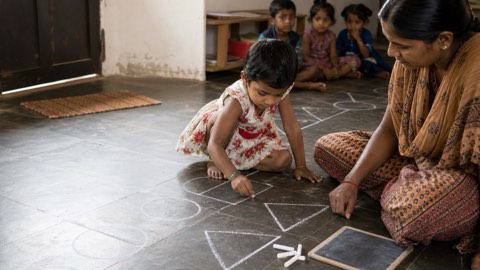
From the Indian kitchen: rajma and chana for sorting, a chapatti roller and dough, katoris for pouring, a tea strainer, clothes pegs on a bucket rim, and rangoli powder or rice for tracing shapes in a tray.
Everyday practice counts most: buttons, zips, taps, chappal straps, and being allowed to feed themselves — self-feeding is the single best fine-motor activity there is.
Safety, and what to skip
Anything smaller than about 3.5 centimetres across is a choking hazard for a child under three. Beads, pulses, coins and small caps need close supervision and are for supervised activity only, never left out.
Button batteries and magnets are medical emergencies if swallowed. Keep them entirely out of reach.
Skip worksheets and formal pencil work for children under four. Strength and control come first; letters come later, and early drilling produces a tight uncomfortable grip.
Skip expensive fine-motor kits. Almost everything sold in one is already in the kitchen.
Do not correct a young child's grip constantly. Offer short fat crayons and broken pieces of chalk, which naturally encourage a better grip, and let it develop.
Frequently asked questions
When should my child hold a pencil properly?
Somewhere between four and six years for a mature grip. Before that, focus on strength — tearing, threading, dough, self-feeding.
My two-year-old is not interested in any of this.
Follow what they already do. A child who loves water will pour; one who loves food will use tongs. The material matters less than the interest.
Is my child left-handed?
Hand preference often settles between three and five. Do not push a child to switch hands, which is still common in Indian families and makes writing harder.
Should I be worried if they cannot pick up small things at one year?
Raise it with your paediatrician if there is no pincer grip by around twelve months, particularly alongside other delays.
Reviewed by
- Nakul Phatak — CEO, theAsianparent India & IndonesiaHead of theAsianparent India; father of one
- Roshni Chugani — Head of Marketing, theAsianparent India & Singapore12 years in the mother-and-baby space; mother of two
Published by: theAsianparent editorial team