Recipes children can make themselves, with an adult nearby

Cooking teaches maths, sequencing, patience and a life skill — and children eat what they made, which is the part that surprises parents most.
What is safe at each age
Three to four: washing vegetables, tearing leaves, stirring cold mixtures, kneading dough, arranging things on a plate, pouring from a small jug.
Five to six: spreading with a butter knife, cutting soft things with a plastic or butter knife, measuring, cracking eggs, rolling rotis badly, using a grater with supervision and a guard.
Seven to nine: using a small sharp knife under close supervision with the claw grip taught properly, using the tawa or gas with an adult beside them, using a mixer with an adult switching it on.
Ten and above: cooking a simple dish start to finish with an adult in the room, including the stove — supervision rather than assistance.
The non-negotiables at every age: hair tied, hands washed, sleeves up, no phone, an adult in the room whenever heat is involved, pan handles turned inward, and a cloth rather than fingers for anything hot.
No-heat recipes (1-6)
1. Fruit chaat: cut fruit, lemon, a pinch of chaat masala, mixed in a bowl.
2. Sprouts salad: steamed sprouts (adult), then onion, tomato, lemon and coriander added by the child.
3. Curd rice: cooked rice, curd, salt, and a tempering the adult pours over at the end.
4. Sandwiches: chutney, cucumber, paneer, cheese — spread, layer, cut.
5. Energy balls: dates and roasted nuts ground by an adult, rolled by the child.
6. Lassi or chaas: curd, water, salt or gud, whisked. A four-year-old can do this entirely alone.
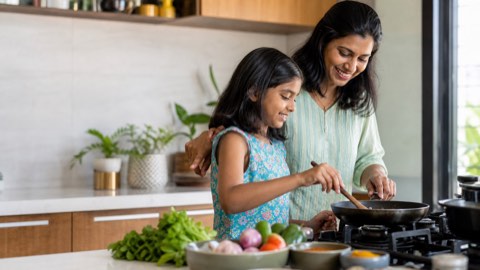

With a stove and an adult (7-12)
7. Besan chilla: mix the batter, pour, flip with help. One of the best first stove recipes there is.
8. Scrambled egg or egg bhurji.
9. Poha: the child does the soaking, chopping and stirring; the adult manages the tempering.
10. Upma, same division of labour.
11. Roti or paratha: rolling is the child's job long before cooking is.
12. Instant dosa or uttapam from ready batter, with vegetables the child chops and arranges.
And a rule that makes all of it work: they cook it, everyone eats it, and nobody criticises the shape.
When to see a doctor
Burns: cool under running water for twenty minutes, do not apply toothpaste, haldi, oil or ice, cover with a clean cloth, and go to hospital for anything larger than the child's palm, any blistering, or any burn to the face or hands.
Cuts: press with a clean cloth for ten minutes; deep cuts, cuts that will not stop bleeding, or any wound from a dirty blade need medical care and a tetanus check.
And keep the kitchen rules that prevent both: no running, no reaching over a hot pan, and no child alone with a lit stove at any age.
This article is general information, not medical advice, and is no substitute for personal medical advice. For any decision about your or your child's health, please consult your doctor.
Frequently asked questions
At what age can a child use a real knife?
Around seven with a small sharp knife, close supervision and the claw grip taught properly. A blunt knife is more dangerous than a sharp one because it slips.
Will this actually help with fussy eating?
Often, yes. Children who chop, stir and serve a dish are markedly more likely to eat it, and it works better than any negotiation at the table.
The mess is unbearable.
Set the boundary in advance: one recipe, one work surface, and they help clean. The mess is the price of the skill, and it reduces sharply after the first month.
Gas stove or induction?
Induction is easier to supervise for a beginner because there is no flame; the surface still burns. Either is fine with an adult in the room.
Sources
Every clinical figure on this page is taken from the guidelines below. Where our numbers and your doctor's differ, ask which guideline they follow.
- NHS. Burns and scalds (2022)Backs the burn first-aid instructions: cool under running water for twenty minutes, do not apply toothpaste, turmeric, oil or ice, cover with a clean cloth, and seek hospital care for burns larger than the child's palm, any blistering, or burns to the face or hands.
- NHS. Cuts and grazes (2022)Backs the cut first-aid instruction to press with a clean cloth and seek medical care for deep cuts, cuts that will not stop bleeding, or wounds from a dirty blade.
- WHO. Burns fact sheet (2023)Supports the burn first-aid guidance (cool with running water, avoid home remedies such as toothpaste or oil) and the safety principle that no child should be left alone with a heat source.
Reviewed by
- Nakul Phatak — CEO, theAsianparent India & IndonesiaHead of theAsianparent India; father of one
- Roshni Chugani — Head of Marketing, theAsianparent India & Singapore12 years in the mother-and-baby space; mother of two
Published by: theAsianparent editorial team