Pregnancy week 28: the third trimester opens — counting begins

The last season opens. From today the baby's movements are a daily register, the clinic visits double in rhythm, and every week is a weight-gain week. The home stretch — twelve weeks of it.
The register opens
Twenty-eight weeks — the third trimester's first day, and the day the movement register opens. From now until birth, once a day: after a meal, lying on your left, count distinct movements. Ten inside two hours is the pass mark; most babies clear it in twenty minutes.
Why the ceremony? Because from here, movements are the baby's daily telegram — the one health report that needs no machine and no appointment. A baby moving on pattern is a baby doing well; a real slump is caught a day early instead of a day late.
The clinic rhythm tightens too — typically every two weeks until thirty-six, then weekly. Each visit now reads the same dashboard: BP, urine, fundal height, the heartbeat, your report on the movements.
Your baby this week
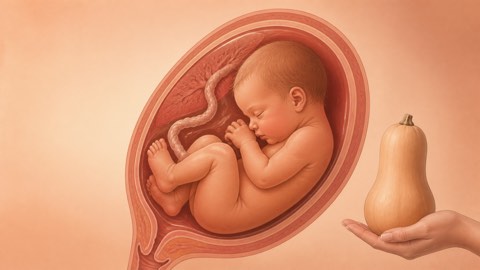
The baby has crossed a kilo — about thirty-seven centimetres, eleven hundred grams. From here to birth it will roughly triple. The fattening season is open.
Eyes open in waking hours now; lashes blink; the first eye colour is in (it may change over infancy). The brain's folding accelerates — billions of connections a week.
The baby may begin settling head-down in the coming weeks — no concern yet if not; there's room and time to turn. The position becomes a real question only around thirty-four to thirty-six.
Read next

Changes in your body
Week 28 is a paperwork visit: the anti-D injection for Rh-negative mothers lands now; a haemoglobin recheck is standard; sugar management (if GTT was high) gets its review.
The bump now announces itself in every position — sitting, breathing, bending and shoe-tying are all negotiations. Heartburn peaks as the stomach loses floor space: small meals, early dinner, head end raised.
Colostrum — the first thick yellowish milk — may leak from now. It's the baby's designated first meal, arriving months early; a breast pad handles the laundry side.
What to do this week
Start the daily count today and give it a fixed slot — after dinner works for most. Use the kick-counter tool or a notebook; the record's value is in its dailiness.
At this visit: anti-D (if Rh-negative), haemoglobin, BP, and ask the doctor to talk through 'when to come to hospital' — the early-labour signs list, in their words, for your specific situation.
Begin the birth-preparedness sheet the national programme recommends: delivery hospital's number, 108 for ambulance, two escorts named, transport plan for odd hours, blood group noted, papers pouch location known to the whole house.
If a baby-moon or the godh bharai is planned, this fortnight is its comfortable window — after thirty-two, near home is the rule.
Week 28 at a glance
The week's essentials in one place. Your doctor may adjust these for your situation.
| Item | In week 28 |
|---|---|
| Main event | Third trimester opens; daily counts begin |
| Baby's size | ~37 cm, 1.1 kg — will triple by birth |
| The count | Post-meal, left side, 10 moves in 2 hours |
| This visit | Anti-D (Rh-neg), haemoglobin, BP, labour-signs talk |
| Visit rhythm | Every 2 weeks to 36, then weekly |
| Paperwork | Birth-preparedness sheet — numbers, escorts, transport |
| Body notes | Heartburn peak, colostrum may leak |
When to see a doctor at once
The standing list, now with movement at its head: a failed or clearly slumped count is a same-day heartbeat check — no waiting for morning, no 'let's see tomorrow'. Everything else rides along: bleeding, rhythmic tightening, watery discharge, the triad, fever, burning, calf swelling, night itch.
From this trimester, sleep position gets one rule: settle on your side (left preferred), not flat on your back — the back position lets the uterus press the big vein. Waking up on your back happens to everyone; roll over and carry on — the rule is about settling, not policing sleep.
This article is general information only and no substitute for personal medical advice. The person who can advise you knowing your health, your medicines and your previous pregnancies is your obstetrician, or the doctor at your nearest health centre.
Work out your due date
Enter the first day of your last period and your cycle length — your estimated due date, this week's count and the anomaly scan window all appear right here.
It is only an estimate — most babies aren't born on the exact date. A first-trimester scan dates a pregnancy more accurately; in the end, your doctor's date is the one that counts.
Frequently asked questions
My baby's busy hour is midnight
must the count be after dinner? — No; count in the baby's own prime time. The standard is your baby's pattern, not the clock. What matters is a daily count at a consistent, movement-friendly hour.
What counts as one movement?
Any distinct event — kick, roll, jab, wriggle. A long squirm is one. Hiccups (that metronome tick) don't count. You'll be surprised how fast ten arrives on a normal evening.
The anti-D
does the baby get anything at birth too? — After delivery the baby's blood group is tested; if positive, you (not the baby) get a second anti-D dose within seventy-two hours. Put it on the birth-preparedness sheet so it isn't forgotten in the celebrations.
Is the third trimester really that much harder?
It's heavier and slower, honestly — but it's also structured: every two weeks a checkpoint, every day a count, every week the baby a hundred-odd grams closer to ready. The season has a finish line, and everything in it points there.
Sources
Every clinical figure on this page is taken from the guidelines below. Where our numbers and your doctor's differ, ask which guideline they follow.
- WHO. WHO recommendation on fetal movement counting for fetal wellbeing assessment (2022)Backs the recommendation to perform daily fetal movement counting from 28 weeks, the threshold of ten movements within two hours as the pass mark, and treating a clearly reduced count as requiring same-day assessment.
- RCOG. Reduced Fetal Movements (Green-top Guideline No. 57) (2011)Supports the instruction that a failed or clearly slumped movement count warrants a same-day fetal heartbeat check with no delay, and that hiccups should not be counted as distinct movements.
- NICE. Antenatal care (NICE guideline NG201) (2021)Supports the clinic rhythm of fortnightly visits from 28 weeks until 36 weeks and then weekly, and the standard antenatal visit dashboard of BP, urine, fundal height, and fetal heart auscultation.
Reviewed by
- Nakul Phatak — CEO, theAsianparent India & IndonesiaHead of theAsianparent India; father of one
- Roshni Chugani — Head of Marketing, theAsianparent India & Singapore12 years in the mother-and-baby space; mother of two
Published by: theAsianparent editorial team