Pregnancy week 27: the middle season's last week

The comfortable middle season ends this week. The baby now sleeps in cycles — REM included, so possibly dreaming. Your job: draft the hospital bag before the busy months.
What do babies dream about?
This stretch, the baby's sleep organises into cycles — including REM sleep, the phase where born people dream. Whether the unborn dream, and of what, nobody knows; the machinery for it is running.
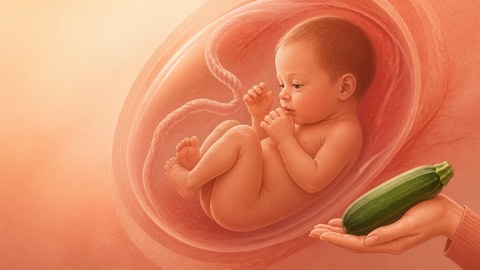
Awake, it's busy — thumb in mouth, cord in fist, hiccups on schedule, and a startle at loud noise followed by settling at your voice. The character arriving in a few months is already in rehearsal.
With the second trimester closing, one piece of honest orientation: the third is more work — heavier, slower, more visits. But it's also the arrival season, and everything about it is countable now. The bags get packed in it, the names get finalised in it, and it ends with a baby.
Your baby this week
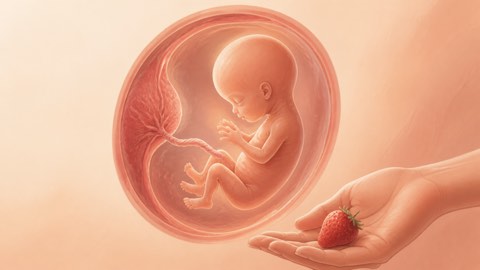
The baby is coconut-heavy now — about thirty-six centimetres and pushing nine hundred grams; the one-kilo line falls in days.
The brain's surface is folding in earnest now — the smooth ball is becoming the walnut. Those folds are capacity: the great brain-growth season (which runs through birth into toddlerhood) is opening.
The lungs could — with heavy machine help — attempt air from around now. Every extra inside week saves weeks of machines; that arithmetic is why the preterm-signal list stays sacred.
Read next
Changes in your body
Braxton Hicks may be regular visitors now — the bump goes drum-tight for half a minute, painless, irregular. Position change and water dissolve them; rhythm and pain distinguish the real kind.
Leg cramps, back protests, the waddle's first appearance — relaxin and the bump co-author the third-trimester gait. Shoes flat, steps shorter, pride intact.
Emotionally the arrival season lands on some as excitement and on some as dread — usually both by turns. Both are appropriate responses to an enormous event. Keep saying them out loud to someone.
What to do this week
Draft the hospital bag list this week (packing can wait till 32-34): for you — MCP card + reports pouch, loose front-opening clothes, maternity pads, toiletries; for the baby — soft cloths, nappies, one warm wrap, one cap; for the attendant — a change of clothes, phone charger, cash for the small counters.
The week-28 visit is booked, yes? It opens the third-trimester rhythm and often carries bloodwork (haemoglobin, sugar review) plus the anti-D for Rh-negative mothers.
Learn the kick-count method ahead of need: after a meal, lie on your left, count distinct movements — ten within two hours is the reassuring standard. From next week it's daily.
One relationship instruction, doctor-signed: this fortnight is the last easy travel window. If a small trip or an evening out has been postponed all pregnancy, it happens now — the ninth month makes no appointments.
Week 27 at a glance
The week's essentials in one place. Your doctor may adjust these for your situation.
| Item | In week 27 |
|---|---|
| Main event | Second trimester ends; REM sleep runs |
| Baby's size | ~36 cm, ~900 g — one kilo in days |
| Forming | Brain folds — the walnut begins |
| Possible symptoms | Braxton Hicks, cramps, the waddle |
| Draft now | Hospital bag list (pack at 32-34) |
| Next week | Third trimester; daily kick counts start |
| Last window | The easy-travel fortnight — use it |
When to see a doctor at once
The full standing list rides into the third trimester: bleeding, persistent pain, fever, urinary burning, watery discharge, calf swelling, the pre-eclampsia triad, rhythmic tightening, night itch, movement slumps — all same-day.
Distinguish once more, because it matters from here: Braxton Hicks = irregular, painless, dissolved by rest and water. Labour-type = rhythmic, strengthening, position-proof. The second kind, at this stage, is a same-day call — not a wait-and-see.
This article is general information only and no substitute for personal medical advice. The person who can advise you knowing your health, your medicines and your previous pregnancies is your obstetrician, or the doctor at your nearest health centre.
Work out your due date
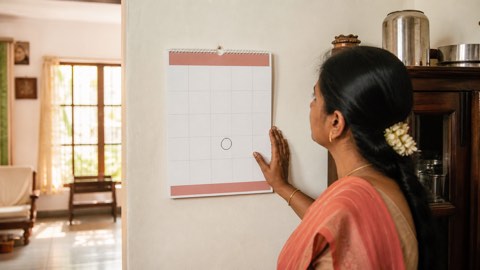
Enter the first day of your last period and your cycle length — your estimated due date, this week's count and the anomaly scan window all appear right here.
It is only an estimate — most babies aren't born on the exact date. A first-trimester scan dates a pregnancy more accurately; in the end, your doctor's date is the one that counts.
Frequently asked questions
Ten kicks in two hours
what if I get seven? — The count is a screen, not a verdict. Seven with a lively baby later that evening is usually nothing; the instruction is simply: didn't reach ten, call the same day and get the heartbeat checked. The check is quick and the reassurance is real.
Can I still travel by train/flight in the third trimester?
Airlines typically want a fitness certificate after 28 weeks and refuse boarding around 36; long journeys of any kind get harder and further from your hospital. Hence this week's instruction: the postponed trip happens now or waits for the baby.
My mother says the seventh month means no more going out alone
custom or sense? — Half sense: the third trimester does recommend company for long outings (balance, fatigue, just-in-case). Solo errands nearby with a charged phone remain entirely fine in a normal pregnancy. Frame it as backup, not house arrest.
What actually goes in the baby's hospital bag? Lists online are enormous.
The hospital newborn needs almost nothing: nappies, two-three soft old-cotton cloths, one wrap, one cap, and the going-home outfit. Everything else on those lists is for home, later. The mother's side of the bag is the one that earns its size.
Sources
Every clinical figure on this page is taken from the guidelines below. Where our numbers and your doctor's differ, ask which guideline they follow.
- WHO. WHO recommendations on antenatal care for a positive pregnancy experience (2016)Backs the page's emphasis on regular antenatal visits in the third trimester and same-day reporting of danger signs including bleeding, fever, watery discharge, and reduced fetal movement.
- ACOG. Practice Bulletin No. 229: Antepartum Fetal Surveillance (2021)Supports the kick-count method described on the page — ten distinct movements within two hours as a reassuring standard, and the instruction to call the same day if the count is not reached.
- ACOG. Practice Bulletin No. 171: Management of Preterm Labor (2016)Backs the page's distinction between Braxton Hicks contractions (irregular, painless, relieved by rest and hydration) and true preterm labour (rhythmic, strengthening, position-proof), and the instruction to treat the latter as a same-day call at this gestation.
- RCOG. Reduced Fetal Movements (Green-top Guideline No. 57) (2011)Supports the page's advice to report reduced or absent fetal movement the same day and to have the fetal heartbeat checked promptly when the kick count is not reached.
- MoHFW. Pradhan Mantri Surakshit Matritva Abhiyan — Antenatal Care Protocol (2016)Supports the page's reference to the week-28 antenatal visit carrying haemoglobin and blood-sugar review, and the administration of anti-D immunoglobulin for Rh-negative mothers, consistent with India's national ANC schedule.
- NICE. Antenatal care (NG201) (2021)Backs the page's listing of pre-eclampsia signs (the 'pre-eclampsia triad'), calf swelling, and persistent pain as same-day danger signs, and corroborates third-trimester haemoglobin and blood-pressure monitoring at the 28-week visit.
Reviewed by
- Nakul Phatak — CEO, theAsianparent India & IndonesiaHead of theAsianparent India; father of one
- Roshni Chugani — Head of Marketing, theAsianparent India & Singapore12 years in the mother-and-baby space; mother of two
Published by: theAsianparent editorial team