Vanishing twin: what it means, and the grief nobody expects

Two heartbeats at one scan and one at the next. It is more common than most people know, and it leaves parents grieving and celebrating at the same time.
What happens
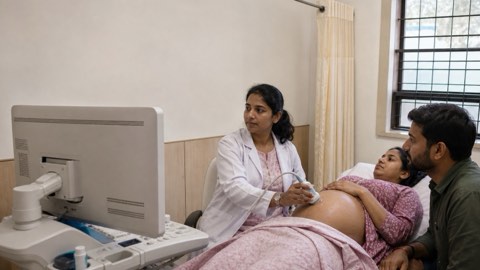
One twin stops developing early in pregnancy and its tissue is gradually absorbed, leaving a single continuing pregnancy. It is detected when an early scan showed two and a later scan shows one.
It is not rare. With early scanning now routine, a meaningful proportion of twin pregnancies identified in the first weeks end up as singletons.
The cause is usually a chromosomal problem in the twin that stopped developing — the same reason as most early losses, and not preventable.
Sometimes there is bleeding or cramping; often there are no symptoms at all and the only sign is the scan.
What it means for the surviving baby
When it happens in the first trimester, the outlook for the surviving twin is generally good, and the pregnancy usually continues as a normal singleton pregnancy.
Loss of one twin later in pregnancy is a more complex situation, particularly when twins share a placenta, and it needs specialist monitoring. Your obstetrician will explain what applies to your case.
Expect closer monitoring either way: additional scans, growth checks, and attention to your own blood counts. Rh-negative women need anti-D.
Ask directly: what does this mean for this baby, what monitoring will there be, and what should bring me in.


The grief that gets no space
This is one of the most isolating losses there is, because everyone around you responds to the surviving pregnancy: 'at least one is fine', 'be grateful', 'you were not going to manage twins anyway'.
Both things are true at once. You are pregnant and you have lost a baby, and being told to focus on the first does not remove the second.
Many parents also carry it into the birth and beyond — anniversaries, the sense of a missing sibling, difficulty answering 'is this your first?'. That is a recognised experience and it is not ingratitude.
Name the loss to at least one person who will let it be a loss. And if it is affecting your sleep, mood or ability to function, get help — pregnancy is a hard time to carry unacknowledged grief.
When to see a doctor
Go to hospital immediately for: bleeding that soaks a pad an hour or more, severe or one-sided abdominal pain, dizziness or fainting, shoulder-tip pain, fever with chills, or foul-smelling discharge. A positive pregnancy test with one-sided pain and bleeding needs assessment the same hour — an ectopic pregnancy is life-threatening. Call 108 if you cannot travel quickly.
Same-day: bleeding, cramping, severe pain, fever, or reduced fetal movements later in pregnancy.
Grief after a pregnancy loss is real grief, at any number of weeks. If you are struggling — persistent low mood, hopelessness, panic, an inability to function, or any thought of harming yourself — that deserves help rather than endurance. Tele-MANAS on 14416 is free, confidential and answers round the clock in Indian languages.
This article is general information, not medical advice, and is no substitute for personal medical advice. For any decision about your or your child's health, please consult your doctor.
Frequently asked questions
Did I do something to cause it?
No. It is almost always a chromosomal problem in the twin that stopped developing.
Will the tissue harm the surviving baby?
In early loss, the tissue is absorbed and the pregnancy usually continues normally. Later losses need specialist assessment.
Should I tell people?
Entirely your choice. Many parents tell nobody and find that isolating; many tell one or two people. There is no obligation either way.
Is it normal to feel guilty for grieving when this baby is fine?
Very common, and there is nothing to feel guilty about. Both feelings belong to you and neither cancels the other.
Sources
Every clinical figure on this page is taken from the guidelines below. Where our numbers and your doctor's differ, ask which guideline they follow.
- WHO. WHO recommendations on antenatal care for a positive pregnancy experience (2016)Backs the recommendation for closer monitoring including additional scans and growth checks in complicated pregnancies, and the general principle that Rh-negative women require anti-D immunoglobulin.
- RCOG. Management of Monochorionic Twin Pregnancy (Green-top Guideline No. 51) (2016)Backs the claim that loss of one twin later in pregnancy is more complex particularly when twins share a placenta, and that specialist monitoring is required in such cases.
- RCOG. Antepartum Haemorrhage (Green-top Guideline No. 63) (2011)Backs the emergency warning signs listed for bleeding heavy enough to soak a pad per hour, severe abdominal pain, dizziness or fainting, and the instruction to seek immediate hospital assessment.
- NICE. Ectopic pregnancy and miscarriage: diagnosis and initial management (NG126) (2019)Backs the statements that chromosomal problems are the usual cause of early pregnancy loss, that first-trimester vanishing twin generally has a good outcome for the surviving twin, and that one-sided pain with bleeding and a positive pregnancy test requires immediate same-hour assessment to exclude ectopic pregnancy.
- NHS. Miscarriage – Overview (2023)Backs the description of chromosomal abnormality as the most common cause of early pregnancy loss and the symptoms of bleeding and cramping as signs that may or may not accompany a loss.
Reviewed by
- Nakul Phatak — CEO, theAsianparent India & IndonesiaHead of theAsianparent India; father of one
- Roshni Chugani — Head of Marketing, theAsianparent India & Singapore12 years in the mother-and-baby space; mother of two
Published by: theAsianparent editorial team