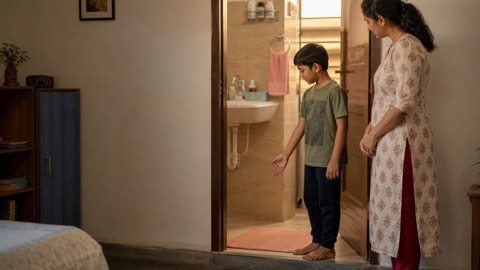
Bedtime battles: ending the nightly negotiation

The child who needs water, a wee, one more story and a different blanket is not being difficult on purpose. They are stalling, and stalling responds to structure rather than to argument.
Why it happens
Three usual causes. The child is overtired, because bedtime is too late — an overtired child is wired rather than sleepy and fights harder. The child is not tired enough, because of a late nap or no physical activity. Or bedtime is the only reliable way to get a busy parent's full attention.
That third one is worth sitting with, particularly in households where parents get home at eight or nine. A child who has had twenty minutes of you all day will spend an hour trying to get more at bedtime.
Add screens in the hour before bed, and the fight is guaranteed.
The routine that fixes most of it
Twenty to thirty minutes, the same order, every night: bath or wash, night clothes, milk if any, teeth, two stories, one song, lights out. Predictability is the mechanism — the sequence itself signals sleep.
Give the connection first rather than last: ten minutes of full attention with the phone away, before the routine starts, removes most of the stalling that follows.
Screens off an hour before, for the whole room. Then dim the lights, which matters more than most families realise.
Set the end clearly: two stories means two, chosen in advance. The negotiation happens before the routine, not during it.
And expect it to be shorter than the current battle. Most bedtime routines are long because of the arguing, not the steps.
The stalling, and the fears
Pre-empt the requests: water beside the bed, toilet before the last story, blanket sorted, light set. Then the requests have no material to work with.
For the child who keeps coming out: return them calmly, with the same short phrase, without conversation or eye contact games. It works through repetition and it is dull for three or four nights.
Use a bedtime pass for older preschoolers: one card that buys one extra request, handed over when used. It gives control and caps it.
Genuine fears are different from stalling and deserve a different answer: a night light, a torch by the bed, the door open, a check-in in five minutes that you actually keep. Do not argue a child out of a fear or search the room for monsters — searching confirms that monsters are the kind of thing one searches for.
Frequently asked questions
My husband gets home at nine and wants to play.
That is legitimate and it wrecks bedtime. Move the connection earlier where possible — a video call, breakfast together — and keep the late arrival low-key: a cuddle and a story rather than a game.
She sleeps late and wakes late and seems fine.
Then the schedule is shifted rather than short. Shift it back gradually if school demands it; otherwise, count the total hours before worrying.
We share one room with the television.
Agree a household screens-off time. In a single-room home, that shared decision is what makes a child's bedtime possible.
He is scared of the dark suddenly at four.
Normal as imagination develops. A night light, a torch of his own, and a matter-of-fact tone. It passes in weeks to months.
Reviewed by
- Nakul Phatak — CEO, theAsianparent India & IndonesiaHead of theAsianparent India; father of one
- Roshni Chugani — Head of Marketing, theAsianparent India & Singapore12 years in the mother-and-baby space; mother of two
Published by: theAsianparent editorial team