Why my toddler is always sick: immunity, playschool germs and what actually helps

Eight colds a year in a small child is normal, not a diagnosis. Here is what is actually happening, what genuinely helps, and the short list of signs that mean something else is going on.
What normal looks like
Six to eight respiratory infections a year is normal for a young child, and more in the first year of playschool or crèche — each cold running seven to ten days with a cough that lingers, which means a child can seem 'always ill' from October to February and still be entirely healthy.
The reassuring markers: growing well on the chart, active and playful between illnesses, recovering fully each time, no unusual or deep infections, and normal development. A child ticking those boxes has a working immune system doing its training.
Group care, siblings at school, crowded homes, winter, and India's air pollution all raise the count. Pollution in particular is an under-acknowledged driver of coughs, wheeze and ear infections in Indian cities.
What actually builds immunity
Vaccination, first and by a distance — it is the only thing that teaches specific immunity in advance, and the schedule is free at government facilities. Add the flu vaccine yearly where your doctor advises, especially for children with asthma.
Sleep, at the hours listed for the age. Nutrition that covers iron, zinc, protein and vitamin D — anaemia and vitamin D deficiency both genuinely increase infections, and both are common and testable. Breastfeeding for as long as it continues.
Handwashing with soap, taught properly and done by adults too; keeping the house smoke-free, including mosquito coils and kitchen smoke near small children; outdoor play and daylight; and keeping a sick child home so the cycle in the class is broken.
What does not build immunity: the shelf of tonics, syrups and 'immunity boosters' at the chemist, most of which are vitamins with marketing; repeated antibiotic courses, which do the reverse; and expensive supplements in a child who eats a normal diet. Treat any product promising to boost immunity as a claim to be sceptical of.

The antibiotic trap
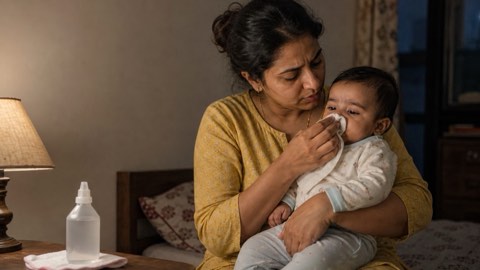
Most childhood infections are viral, and antibiotics do nothing for them. The Indian pattern — a course from the chemist at every fever, or a doctor pressured into prescribing — drives resistance, causes diarrhoea and rashes, and makes future infections harder to treat.
A good doctor who says 'this is viral, no antibiotic, here is what to watch for' is doing the right thing. Ask what to expect, what would change the plan, and when to come back rather than asking for a stronger medicine.
Never repeat a leftover course, never use someone else's prescription, and if antibiotics are prescribed, finish the course exactly as directed.
When it is not just normal
Warning signs of a genuine immune problem are specific and uncommon: repeated pneumonias, deep abscesses or bone infections; infections needing hospital admission or intravenous antibiotics repeatedly; thrush in the mouth that keeps returning beyond infancy; persistent diarrhoea; failure to gain weight or falling off the growth chart; unusual organisms; or a family history of immune deficiency.
Far commoner explanations for a genuinely 'always ill' child: anaemia, undernutrition, vitamin D deficiency, untreated allergic rhinitis or asthma being mistaken for endless colds, adenoid enlargement (snoring, mouth breathing, recurrent ear problems), passive smoking, indoor pollution, or tuberculosis exposure — which in India must always be considered with chronic cough, fever, weight loss or a contact at home.
When to see a doctor
Same-day: fast or laboured breathing, chest sucking in, blue lips, a child too breathless to feed or speak; any fever in a baby under three months; fever over 39°C or lasting beyond three days; a fit; a rash that does not fade under pressure; a child who is drowsy, floppy or not drinking; signs of dehydration; ear pain or discharge.
Book an assessment for: cough lasting more than three weeks, weight loss or poor weight gain, night sweats or prolonged low fever, snoring with pauses in breathing, wheeze that keeps coming back, or the specific immune-deficiency signs above.
This article is general information, not medical advice, and is no substitute for personal medical advice. For any decision about your or your child's health, please consult your doctor.
Frequently asked questions
Should I stop playschool for a year so he stops falling ill?
Usually not worth it. The infections happen whenever group exposure starts — at three or at five — and they build the immune library either way. Stop only for medical reasons your doctor identifies.
Do chyawanprash, haldi milk and kadha help?
As food and comfort, they are fine and harmless in normal amounts. As immunity treatments, they are not evidence-based, and no kadha replaces a vaccine. Keep them if the family enjoys them; do not spend heavily on them or delay medical care because of them.
Is my child low on immunity because of a caesarean birth or formula?
Small associations exist in research, but neither explains a normal number of childhood colds, and nothing about either is a reason for guilt. Sleep, nutrition, vaccination and smoke-free air matter far more now.
How long should a child stay home when sick?
Until fever-free for 24 hours without medicine and well enough to take part. Sending a feverish child in with paracetamol keeps the classroom cycle running and delays their own recovery.
Sources
Every clinical figure on this page is taken from the guidelines below. Where our numbers and your doctor's differ, ask which guideline they follow.
- WHO. Vaccines and immunization: What is vaccination? (2023)Backs the claim that vaccination is the primary intervention that teaches specific immunity in advance, and that schedules are available through public health systems.
- IAP. IAP Immunization Timetable 2023 (2023)Backs the claims about following the childhood vaccination schedule and the recommendation to add influenza vaccine annually, especially for children with asthma.
- WHO. Global Action Plan on Antimicrobial Resistance (2015)Backs the claims that most childhood infections are viral, that antibiotics are ineffective against them, that repeated antibiotic use drives resistance, and that antibiotic courses should be completed exactly as directed when prescribed.
- ICMR. National Action Plan on Antimicrobial Resistance (NAP-AMR) 2017–2021 (2017)Backs the description of the Indian pattern of antibiotic misuse — dispensing without prescription at chemists and pressure on doctors to prescribe — as a driver of antimicrobial resistance.
Reviewed by
- Nakul Phatak — CEO, theAsianparent India & IndonesiaHead of theAsianparent India; father of one
- Roshni Chugani — Head of Marketing, theAsianparent India & Singapore12 years in the mother-and-baby space; mother of two
Published by: theAsianparent editorial team