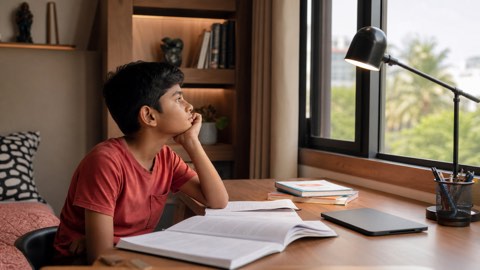
Your child at 11: early adolescence, and the year before it gets loud

Eleven is early adolescence: the body is changing, the mood is unreliable, and the child is negotiating for a version of independence they are not quite ready for.
What changes this year
Physically: puberty is well under way for most girls and beginning for most boys. Growth spurts, appetite, sleep needs and body odour all rise; coordination sometimes temporarily worsens as limbs grow.
Emotionally: mood swings, self-consciousness, and strong reactions to small things. The emotional brain matures well before the regulating part, which explains most of the year.
Socially: intense friendships, group identity, and sensitivity to exclusion. Peer opinion outweighs parental opinion on most day-to-day matters.
Cognitively: abstract thinking, moral reasoning, and the ability to argue a position properly — including yours, back at you.
Independence, negotiated
Expand freedom deliberately rather than by argument: going to a shop alone, cycling to a friend's house, managing pocket money, choosing their own clothes. Independence given in planned steps is safer than independence seized.
Keep a small number of non-negotiables — where they are, who with, when home, phone answered — and negotiate everything else. Rules that are all equally important are all equally ignorable.
Chores and responsibility for both sons and daughters, in equal measure. This is the age at which Indian households typically start dividing work by gender, and where equal division has to be deliberate.
Talk about consent, respect and pressure — to both sons and daughters — before it is needed, not after.
Read next


School, sleep and health
Workload rises with more subjects, more homework and often more tuition. Watch the total: a child with no free time and less than nine hours of sleep is being set up for the exam years badly.
Sleep: 9-12 hours, and the body clock naturally shifts later in adolescence. Phones out of the bedroom at night is the highest-value rule in the house.
Health: annual check, haemoglobin (especially for menstruating girls), vision, dental, and the HPV vaccine if not already given. Talk about periods, hygiene, acne and deodorant matter-of-factly.
Mental health: this is the age at which anxiety and low mood commonly first appear. Duration and function are the test — two weeks of persistent change that affects school, friends or sleep needs attention.
When to see a doctor
Same-day at any age: difficulty breathing, a fit, a child who is drowsy or confused, severe abdominal pain, a head injury with vomiting or drowsiness, a rash that does not fade when pressed, or dehydration. Call 108 for breathing difficulty.
At eleven to twelve specifically: no puberty signs by 13 in girls or 14 in boys; periods heavy enough to cause anaemia or pain that stops school; persistent low mood, anxiety or panic; withdrawal; disordered eating; self-harm marks; a sharp drop in school performance; or any talk of not wanting to live.
And treat any talk of self-harm or not wanting to live as an emergency at any age: stay with the child, remove means of harm, and get help the same day. Tele-MANAS on 14416 is free and round the clock; Childline is 1098.
This article is general information, not medical advice, and is no substitute for personal medical advice. For any decision about your or your child's health, please consult your doctor.
Frequently asked questions
He is rude and sullen and then perfectly nice an hour later.
Early adolescence. Do not take it personally, hold the line on rudeness without escalating, and repair afterwards. The version of him you like is still there.
She wants to go out with friends without an adult.
Start small and local, with a clear plan and a check-in, and expand as it goes well. Blanket refusal at eleven produces lying at thirteen.
How much tuition is too much?
If there is no unstructured time on a weekday and sleep is under nine hours, it is too much regardless of what the class is doing.
He has stopped telling me anything.
Normal, and worth working at. Be available without interrogating — car journeys, late evenings and side-by-side activities produce more conversation than face-to-face questions.
Sources
Every clinical figure on this page is taken from the guidelines below. Where our numbers and your doctor's differ, ask which guideline they follow.
- WHO. Physical activity, sedentary behaviour and sleep for children and adolescents: WHO guidelines (2020) (2020)Backs the article's recommendation of 9–12 hours of sleep per night for children at this age group, and the note that insufficient sleep is harmful to health and development.
- NICE. Depression in children and young people: identification and management (NICE guideline NG134) (2019)Supports the article's clinical threshold that persistent low mood or anxiety lasting two weeks and affecting school, friends, or sleep warrants attention, and that self-harm or talk of not wanting to live should be treated as an emergency.
- IAP. IAP Standard Treatment Guidelines: Adolescent Health (2022)Backs the article's red-flag thresholds — absence of any puberty signs by age 13 in girls or 14 in boys, and heavy or painful periods causing anaemia — as indicators requiring medical review in this age group.
- WHO. Adolescent mental health (WHO fact sheet) (2021)Supports the article's statement that anxiety and low mood commonly first emerge in early adolescence, and that early identification and support are important.
Reviewed by
- Nakul Phatak — CEO, theAsianparent India & IndonesiaHead of theAsianparent India; father of one
- Roshni Chugani — Head of Marketing, theAsianparent India & Singapore12 years in the mother-and-baby space; mother of two
Published by: theAsianparent editorial team