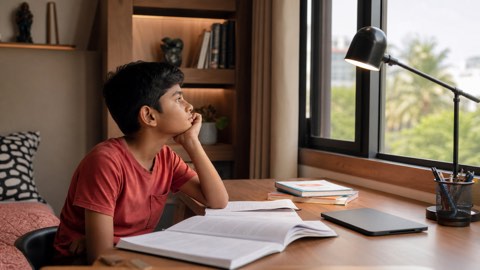
Your child at 10: double digits, puberty and the pull of friends

At ten, friends begin to matter more than parents. That is developmentally correct, and it is the moment to make sure the channel home stays open.
What changes this year
Puberty is under way for many girls and beginning for some boys: growth spurts, body odour, acne, mood swings, and for some girls the first period.
Friends take priority over family for the first time. Opinions come home from the friend group, and parental views are questioned rather than absorbed.
Self-consciousness rises sharply — about appearance, weight, height, skin, and being different in any visible way.
Academically, work becomes more demanding and independent, and children begin to identify as good or bad at particular subjects, often permanently. Watch the language used at home about that.
Body image and the Indian context
Comments about weight, height and complexion land hard at ten and are remembered for decades. Ban them at home, and interrupt relatives who make them in front of the child.
Fairness products and the family conversation around complexion cause real damage at this age, particularly to girls. Say plainly and repeatedly that skin colour is not a problem to be solved.
Teach eating and activity as health rather than appearance: family meals, home food most days, water instead of sugary drinks, and daily physical activity that they enjoy.
Watch for early signs of disordered eating — skipping meals, secretive eating, obsessive exercise, or preoccupation with weight — and take them seriously at this age rather than dismissing them.
Read next
Phones, school and keeping the channel open
This is the commonest age for a first phone in Indian families. If you give one, set it up together: no bedroom charging, location sharing, no accounts you do not know about, and an agreement that reporting a problem never leads to punishment first.
Talk about online safety concretely — grooming patterns, images once sent are permanent, that anyone asking a child to keep a secret from parents is the problem, and how to report. Our online-safety guide has the specifics.
School: teach study skills rather than supervising every page — self-testing, spacing practice across days, and a planner they own. This is the age to hand over the system.
And protect one daily unhurried moment — the drive, the walk, dinner — where nothing is being asked of them. That is the channel you will need at fourteen.
When to see a doctor
Same-day at any age: difficulty breathing, a fit, a child who is drowsy or confused, severe abdominal pain, a head injury with vomiting or drowsiness, a rash that does not fade when pressed, or dehydration. Call 108 for breathing difficulty.
At ten to eleven specifically: no signs of puberty by 13 in girls or 14 in boys; periods that are extremely heavy or painful enough to miss school; persistent low mood or anxiety; withdrawal from friends and activities; disordered eating; falling grades with no explanation; or any talk of self-harm.
And treat any talk of self-harm or not wanting to live as an emergency at any age: stay with the child, remove means of harm, and get help the same day. Tele-MANAS on 14416 is free and round the clock; Childline is 1098.
This article is general information, not medical advice, and is no substitute for personal medical advice. For any decision about your or your child's health, please consult your doctor.
Frequently asked questions
She has started her period at ten.
Within the normal range, which runs from about ten to fifteen. Practical preparation and a matter-of-fact tone matter more than anything else, plus a haemoglobin check, since anaemia is very common in Indian adolescent girls.
He only wants to be with his friends.
Developmentally correct. Keep family rituals rather than competing — a weekly meal, a drive, one activity — and stay interested without interrogating.
How much should I monitor the phone?
Openly rather than secretly, and with rules agreed in advance. Secret surveillance, when discovered, costs you the relationship exactly when you need it.
She is being teased about her body.
Address it with the school if it is classmates, and at home make it explicit that you disagree with the comment. Do not join in the teasing, and stop relatives who do.
Sources
Every clinical figure on this page is taken from the guidelines below. Where our numbers and your doctor's differ, ask which guideline they follow.
- WHO. Adolescent health: factsheets on adolescent health and development (2023)Supports the page's description of puberty onset, growth spurts, mood changes, and peer-group prioritisation as normal developmental features of this age.
- NICE. Eating disorders: recognition and treatment (NG69) (2020)Supports the page's advice to watch for early signs of disordered eating — including meal skipping, secretive eating, and preoccupation with weight — and to take them seriously rather than dismissing them.
- MoHFW. Rashtriya Kishor Swasthya Karyakram (RKSK) — Adolescent Health Programme Guidelines (2014)Supports the page's emphasis on anaemia screening in adolescent girls, healthy eating framed around health rather than appearance, and daily physical activity as part of adolescent well-being in the Indian context.
Reviewed by
- Nakul Phatak — CEO, theAsianparent India & IndonesiaHead of theAsianparent India; father of one
- Roshni Chugani — Head of Marketing, theAsianparent India & Singapore12 years in the mother-and-baby space; mother of two
Published by: theAsianparent editorial team