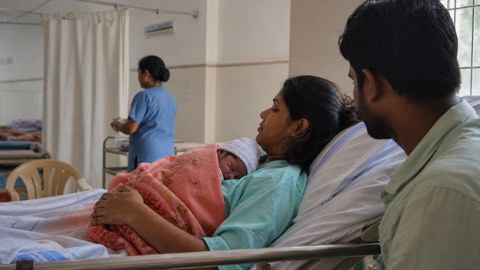
Where to deliver: choosing between a government and a private hospital

The choice is not simply about money. What matters is whether the place can handle an emergency at 3 a.m. — and both systems have hospitals that can and cannot.
What the public system provides
Delivery at a government facility is free or near-free, and comes with more than most families realise: antenatal checks, IFA and calcium supplements, ultrasound, tetanus vaccination, the MCP card, free transport under schemes like Janani Shishu Suraksha Karyakram, and postnatal visits by the ASHA worker.
Janani Suraksha Yojana (JSY) provides cash assistance for institutional delivery to eligible mothers, with amounts varying by state and by rural or urban location — ask the ASHA worker, who also facilitates the paperwork.
Ayushman Bharat (PM-JAY) covers hospitalisation for eligible families up to a substantial annual limit, and can be used at empanelled private hospitals as well — check your eligibility and the empanelled list in your district before the delivery rather than during it.
District hospitals and medical colleges usually have the strongest emergency capacity in a region: blood banks, operating theatres round the clock, anaesthetists, and NICUs. In a genuine obstetric emergency, that matters more than the room.
What private hospitals offer, and what to check
Private care buys continuity with one doctor, shorter waits, a private room, and usually a more comfortable experience for the family. In many cities it also buys 24-hour anaesthetist cover, epidurals on request, and a more flexible approach to birth companions.
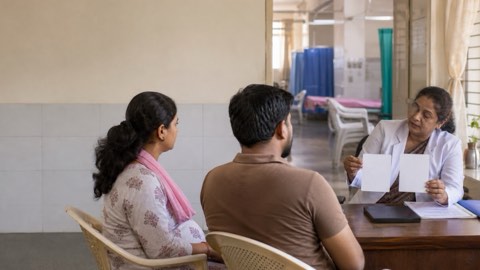
But 'private' is not a guarantee of capacity. Ask specifically: is there a NICU on site and at what level; is an anaesthetist available 24x7; is there a blood bank or a tie-up; what happens if I need an emergency caesarean at 3 a.m.; and who delivers if my doctor is unavailable.
Ask for the package cost in writing — normal delivery, caesarean, what is excluded, NICU per-day charges, and whether your insurance is cashless there. Bills after complicated deliveries are where families are most often blindsided.
Caesarean rates in Indian private hospitals are substantially higher than in the public system. Asking the hospital's rate is a fair question and the answer tells you something.
How to decide
The decisive questions are the same for both: can this place handle a haemorrhage, an emergency caesarean and a sick newborn, tonight, without transferring me? Everything else is comfort.
Distance and transport matter enormously. A well-equipped hospital two hours away is worse in an emergency than an adequate one twenty minutes away — plan for the journey you might make at 2 a.m. in the rain.
For a high-risk pregnancy — twins, preterm risk, severe anaemia, high blood pressure, diabetes, previous caesarean, or a baby with a known problem — choose for the NICU and the specialist team rather than for the room. Ask your obstetrician directly where they would deliver in your situation.
Many families use both: antenatal care where it is convenient and delivery where the capacity is. That is a legitimate plan, provided the delivering hospital has your records well before labour.
Frequently asked questions
Are government hospitals safe for delivery?
District hospitals and medical colleges handle the most complex cases in the country and have the emergency infrastructure to prove it. Crowding, waiting and privacy are the real drawbacks, not clinical capability. Smaller PHCs are equipped for normal deliveries and refer complications, so ask what your facility handles.
How much does a private delivery cost in India?
It varies enormously by city and hospital — from modest amounts in a small nursing home to very large sums in a metro corporate hospital, with caesareans and any NICU stay costing considerably more. Get the written package and the exclusions before you book.
Does insurance cover maternity?
Many employer group policies do; individual policies usually have a waiting period of two to four years for maternity, so it must be arranged well in advance. Check the sub-limits, the newborn cover and whether the hospital is cashless.
Can I use JSY or Ayushman Bharat at a private hospital?
JSY is for delivery at government or accredited facilities. Ayushman Bharat can be used at empanelled private hospitals for eligible families. Confirm empanelment and eligibility with the hospital's scheme desk before admission, not at discharge.
Sources
Every clinical figure on this page is taken from the guidelines below. Where our numbers and your doctor's differ, ask which guideline they follow.
- WHO. WHO Recommendations: Intrapartum Care for a Positive Childbirth Experience (2018)Backs the guidance that facilities for high-risk pregnancies (twins, preterm risk, severe anaemia, hypertension, diabetes, previous caesarean) should be chosen for NICU capacity and specialist teams, and that emergency obstetric readiness is the decisive criterion.
- WHO. Statement on Caesarean Section Rates (2015)Backs the observation that caesarean rates in Indian private hospitals are substantially higher than in the public system, and that the hospital's caesarean rate is a legitimate question for families to ask.
Reviewed by
- Nakul Phatak — CEO, theAsianparent India & IndonesiaHead of theAsianparent India; father of one
- Roshni Chugani — Head of Marketing, theAsianparent India & Singapore12 years in the mother-and-baby space; mother of two
Published by: theAsianparent editorial team