Two languages, three languages: raising a multilingual Indian child

Most Indian children grow up with two or three languages, and it does them nothing but good. The risk is not confusion — it is the quiet loss of the home language.
Multiple languages do not cause delay
Growing up with two or three languages does not cause speech delay, confusion or learning problems. Vocabulary in each language may look smaller for a while, but total vocabulary across languages is on track, and it evens out.
Mixing languages in one sentence is normal and skilful, not a sign of confusion — bilingual adults do it constantly. It is called code-switching and it follows rules.
What does hold a child back is impoverished language of any kind: little conversation, few stories, and a lot of screen time. The number of languages is not the issue; the amount of rich human interaction is.
Why the mother tongue matters for learning
Children learn concepts fastest in the language they think in. The National Education Policy recommends the home language or mother tongue as the medium of instruction at least to Class 5, and the evidence behind that is strong — early learning in an unfamiliar language produces rote memorisation without understanding.
The practical Indian problem is a child in an English-medium school whose home language is something else and whose parents' English is limited. That child can end up fluent in neither — following instructions without understanding, and losing the home language socially.
The answer is not to abandon English, which is a genuine economic asset. It is to build the home language deliberately and richly — stories, songs, conversation, reading — while English develops at school. Strong first-language skills make second-language learning easier, not harder.

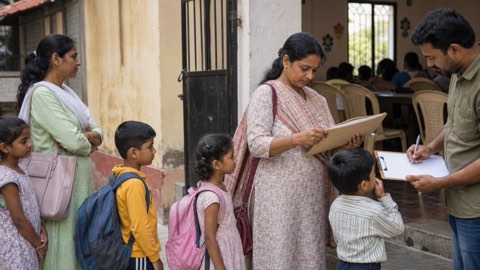
Keeping the home language alive
Adopt a consistent pattern the child can rely on: one parent one language, or home language at home and school language outside. Consistency helps more than the specific arrangement.
Speak the language you speak best with your child. A grandparent's fluent Bhojpuri gives a child more language than a parent's uncertain English, and the emotional richness matters.
Grandparents are the strongest asset most families have: phone calls, stories, songs, festivals and the family's own idioms. Children keep languages they need for relationships they value.
Read and write in the language too, not only speak it. Alphabet books, comics, rhymes and regional-language children's books make the language something with a future rather than a spoken relic.
The medium-of-instruction decision
Consider three things: whether the child will understand the teaching from day one, whether the school teaches the language well (many English-medium schools have staff whose own English is weak, producing neither), and what support is available at home.
A good school in the regional language plus deliberate English input at home often beats a weak English-medium school. Conversely, an English-medium school works well when the school actually teaches in English and someone at home can read with the child.
Whichever you choose, insist on the other language being learnt properly too — a child who cannot read their state's language loses access to their own society, and one with no English hits a ceiling in many careers.
Frequently asked questions
My child answers in English when we speak in Marathi. How do I stop the drift?
Common, and reversible if you act early: keep responding in the home language rather than switching, expand what they say, use media and books in that language, and give them reasons to use it — grandparents, cousins, a visit to the village.
Should I speak English with my child even though mine is weak?
Speak the language you are fluent in for real conversation, and let English come from books, school, and audio. Broken input as the main diet builds a broken model; rich input in any language builds a language brain that transfers.
My child was late to talk and we speak three languages at home. Should we cut one?
No. Multilingualism does not cause delay — get a hearing test and a speech assessment rather than removing a language, which costs family connection for no gain.
Is a third language at school too much?
For most children, no. Three languages is the norm in Indian schooling and children manage it. If a child is struggling significantly with the basics of reading in any language, that is a signal to assess for a learning difficulty, not to blame the third language.
Reviewed by
- Nakul Phatak — CEO, theAsianparent India & IndonesiaHead of theAsianparent India; father of one
- Roshni Chugani — Head of Marketing, theAsianparent India & Singapore12 years in the mother-and-baby space; mother of two
Published by: theAsianparent editorial team